Bay laurel
Bay laurel (Laurus nobilis), Bay Tree, Sweet Bay has been grown as an ornamental plant since ancient times. It is an aromatic evergreen Mediterranean herb that has dark green, glossy, leaves, produces pale yellow flowers followed by black shiny berries (bacca-laureus). A slow-growing, frost tender perennial, Bay laurel makes an ideal trimmed potted plant that can grow up to 10 feet but most likely 5 feet in a container which should be brought indoors for the winter where it will remain green but dormant.
Care
Bay laurel is grows best in fertile, light, loose soil, full sun to partial shade and moderate temperatures. Because it is susceptible to sunburn, grow it in dappled shade during the hot summer. Bay laurel is slow and difficult to propagate. It is easier to purchase a potted plant from the garden center.
Root cuttings
To root bay laurel take a 4 inch cutting of new growth and strip away all but the top 2 leaves, dip in rooting hormone and plant in a 1/2 sand 1/2 peat mix. Cover with clear plastic and place in a warm shady area. Cuttings can be taken 8 weeks after new spring growth and rooting can take up to 6 weeks. Late summer/early fall cuttings are slower to root and will take several months. It can also be started from seed in early spring.
The leaves of bay laurel can be dried whole or crushed and used in cooking. It can be harvested all year round but the best time to dry the leaves is in August when the leaves are most favorful. It is used as part of the classic bouquet garni which consists of bay leaf, thyme, marjoram, parsley and black peppercorn tied in a muslin bag. The oil is used for treating internal disorders, ear aches, rheumatism, ointments, soaps and perfumes even an insect repellant. The leaves are also used in garlands, funeral and memorial wreaths.
Laurus nobilis is not poisonous, whereas most other laurels are.
Troubleshooting
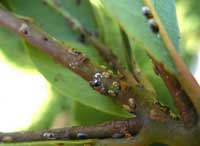
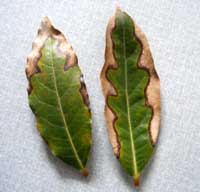
Bay laurel tends to get scale , small, brown, raised spots clustered on the undersides of leaves and along the stems. Powdery mildew can also be a problem. “Shot hole disease”-fungus that causes purplish-red spot on the leaves.
From the reader archive
Useful reader questions
Dear Hortchat, I would really appreciate your advice, I don’t know which Zone I am in, but I live in London, England. U.K. I planted a Bay Laurel which was about 8 inches, 20 years ago when I moved to my home,…
Read John Alexander discussioni have a bay laurel that has grown good. i brought in for winter. now the leaves are looking different color & feels like they are drying out. i check soil and top inch is little dry, but past inch it’s moist.…
Read tandra mathis discussionPruning after winter We have a bay laurel that was a given to us last spring. It was outdoors all summer and seemed to be thriving (it went from 4″-6″ to over a foot tall). When it started getting cold (before freezing,…
Read Liz Thomas discussionWe have a bay laurel that was under 6′ when we moved in 6 years ago. It was a three-stemmed shrub. We limbed it up about 4′ from ground level about 4 years ago, and then it took off. It is now…
Read Methyl discussion
Where can I buy a bay laurel? Is it hardy in zone 8?
I live in Zone 8 and have a very healthy bay laurel tree. Was told it wouldn’t make it through the winters outside but it has for over ten years now. If it got very cold, I was told I could protect it by putting a blanket over it, but I have never had to resort to that. There’s another bay laurel tree flourishing in my neighborhood in Seattle.
i have a bay laurel that has grown good. i brought in for winter. now the leaves are looking different color & feels like they are drying out. i check soil and top inch is little dry, but past inch it’s moist. the trunk still looks green & has some new growth. the leaf color change starts @ tip & works down leaf. it kind of makes me think it’s drying from lack of water, but like i said soil is moist. i don’t know alot about the plant, just that i cook w/ bay leaf alot, i love the plant, & not very winter hardy,
i live in zone 7/8, Bonham, Tx. can you help? i’ve search the web, but only thing i know more about plant is history, & resist insects & dieases.
thanks tandra
I have a Bay Tree which for the past 7 years and until now it has been a very healthy specimen.
I noticed approx 2 Months ago that it looked a little sad and the leaves were turning yellow. I had never repotted the tree since I had it & so presumed it needed a larger container.
After repotting we had a great deal of rain and having changed the clay container for a resin style I noticed no improvement in the colouration or health. It is now June and the tree is looking very poor, the leave are withered and a brownish yellow.
Any ideas?
what is the best treatment for my bay tree. It has got a black sticky matter on the leaves. I have tried fairy liquid spray. What else can I try.
We recently moved house and I replanted my Bay tree in the ground after several years of it being in a container. The leaves have now started to go from a healthy green to a yellowish-brown, and have black spots. It is quite a large bush, about 3 ft tall. Did it just object to being moved, or is it something more serious?
I recently bought a Bay Laurel “tree” it is only about 18″ tall but it has 2 distinct stalks and i would like to create a topiary look, I was wondering is it possible to seperate these and make 2 plants out of it? It looks to be a young plant. It is healthy and now in a 8″ pot so the 2 stalks are not close enough to twist into a single one Can i cut down through the roots between these 2 stalks without harming the plant?
Thanks for your input…Aud
Bay leaf miner
I have acquired a mature bay tree (20 yrs old?). It spent the summer outdoors and is now moved into the house. I notice tiny areas in the leaves that are discoloured and some areas with perforations. Not scale infestation. Looks like a leaf miner. Is this possible? Any ideas and should I treat this somehow or just wait and see? Leaves are not wilted and there is a bit of new growth.
Dear Hortchat, I would really appreciate your advice, I don’t know which Zone I am in, but I live in London, England. U.K.
I planted a Bay Laurel which was about 8 inches, 20 years ago when I moved to my home, I had only ever thought of Bay trees as being like shrubs, about 10 feet maximum.
It is now approximately about 25 – 30 feet tall, and as I do not own my home, the Housing Association that I rent from, want to cut it down as it is very close to the next door property i.e. the trunk is nearly touching the wall next door, about 2cm from the wall.
I have come to terms with the fact that if it has to come down, then so be it, but I really do wonder if it will cause damage by it’s growth, or by it’s root system. I have heard it has a shallow root system, and I do think that if it was going to cause damage by the root system, then it would have done so already and there is no evidence that it has done any damage.
I am trying to save it, but I understand the reasons the Housing Association have for wanting to cut it down, so I would really appreciate some true and honest advice.
I am also thinking of taking cuttings to grow in pots if it does have too come down, and would like to know the best way of doing this at this time of year i.e. November 9th 2009.
Yours sincerely.
John
Hi,
I just bought a bay laurel in a pot about a month or so ago. It was beautiful. I put it in a nice sunny window and watered it when the soil started to feel dry. I think the pot is draining well (water comes out of the bottom). The leaves have gotten super dry. The trunk still looks greenish.
What should I do? There doesn’t seem to be any growth, but it’s midwinter and I’ve read they grow more in the spring and summer. Should I try fertilizing or repotting? Should I trim it? I’m very new to gardening of any kind and I really want to do the best I can for this tree.
Thanks,
JJ
Thank you so much!! I will do this. I watered heavily this morning and the water definitely drains well through the bottom of the pot. I have a humidifier and will put it in the room where the plant is. That room gets a little dryer because it has a little more sun.
I will wait patiently for spring.
Thanks again — I loved this tree when we brought it home and am really hopeful it will rejuvenate with this plan.
JJ
Sooty mold
please please help!! I live near the beach and my bay tree is outside my house the problem is the leaves are covered in black dusty filth, Its too big to clean each individual leaf so I need a solution to getting it clean again. I will faint if you can give me the answer.many thanks jo x from Broadstairs England
Thanks very much for the advice, I took some cuttings before the cut it down about 10 days ago, I have kept the trunk, I was thinking of trying to carve it into something, but I can’t believe how dense and heavy it is. I may have to leave it in situ in the garden for now.
I also took some cuttings (I didn’t know about stripping it back or the sand) and just potted them up with rooting hormone in peat based compost. I think there is some life still in them.
I have them in the kitchen, I just hope they survive the cold snap that is expected this weekend.
Pruning after winter
We have a bay laurel that was a given to us last spring. It was outdoors all summer and seemed to be thriving (it went from 4″-6″ to over a foot tall). When it started getting cold (before freezing, we live in zone 4) we brought all the container plants indoors, and the laurel seemed to be doing just as well. That is until about December when all of the leaves began to dry out. We were watering it once a week (it was watered more when outside), but some of the roots were exposed so we thought that was the problem -and added more potting soil, to no avail. All of the leaves except two looked as though they’d been cured for the pantry. We moved the laurel to another room that gets more light and eventually forgot about it. It hasn’t been watered in more than a month, perhaps longer. Today we noticed that it has two new bright green baby leaves sprouting from one of the main branches, and we are shocked to say the least. Have you ever heard of this happening? Should we trim back the branches that are completely dried out? We would love to save this plant, and any advice is much appreciated!
Well speaking as a total amateur about this, I would leave it for the time being, no fussing over it.
My soil is exceptionally bad in my garden the Bay Laurel was one of the most significant things that grew there, most seeds don’t germinate, even wild garden seeds. I have a massive problem with Ground Elder as well, which is a bit like knotweed in effect. So, if the Bay could exist in the harsh soil in zone 3 (or 4 I think) without any help from me, I would just do what feels right, and gradually re-introduce it into the garden when the summer finally arrives, should be soon I hope.
Best of luck
Brown/dry leaves
my mother gave me a small bay she’d rooted from her larger one. it’s in a clay pot, and she had it in a quite shaded area outside in early summer. i buried its pot in the ground in a quite sunny garden in virginia – it’s been VERY hot, though i’ve kept the bay watered.
now the leaves on my 8″ bay have turned brownish and are dry, starting to get that curling-up dry look. it’s put out a bunch of shoots at the bottom.
i’d like to keep the already-grown part, that seems to be browning and dry (the ‘trunk’ doesn’t look bad … yet)
what should i do? move it to the shade?
Well in spite of the Housing Associations efforts to kill the bay laurel I had in my garden last year (November) the tree surgeons came and cut it down, I took cuttings but to no avail, none of them grew.
I was under the impression that the Tree Surgeons had poured a poisonous liquid on the stump that they left, so imagine my surprise and delight, when new branches and leaves started growing around April-May time, there is now substantial growth around the base of the old tree, so either the ‘poison’ didn’t work or it was just engine oil.
I want to make the best out of it and should perhaps start thinning it out a bit, and possibly planting some cuttings in my terrible soil, 6 inches down heavy London clay, anyway I just wanted to say thanks to everyone who helped me on this forum, and I hope I can help someone else sometime.
Oh the trunk, it was very heavy so I left it outside, along with a large stump that I took into the house, it must be from the drying out process, but there are huge gaping rips into the trunk from the outside, something may come of it yet.
Yellowing leaves
Hello ,I live in Athens Greece norther suburb ,my mother planted a laurel over 15 years ago ,the plant was doing great!This summer i noticed (after a good pruning 4 months ago) that the leaves are turning yellow ,i worry we might lose it ,it has been such an awesome shade over the years i would hate to lose it .The weather has been very hot (40s) any suggestions would be appreciated.
Hi i hope you can help , we have planted about 25 laurels in the month of march and was hoping for a farly healthy hedge row buy now . we are in the month of september and they have only grow about 6 inches in hight . is this normal or is there anything we can use to improve growth . when we planted them they were about 12 inches high . many thanks mark
Hi Mark, I would say that is quite a healthy growth rate, I am no expert but I had a Bay Laurel for 20 years in my garden till it got chopped down in January this year, it was about 20 feet + add 10 feet for a bit I cut off years ago, in the mistaken belief that I thought it would stop growing too high.
I don’t know the conditions of your garden, so I will tell you about mine, the topsoil I have is terrible and riddled with Ground Elder, which criss crosses the underneath of the garden (about 6-8 inches depth)like a veritable matrix.
I also don’t get a lot of Sun as garden is West facing, where I planted it was in the north -east part of the garden which shielded it from the wind, but I was probablt in the shadiest part of the garden.
As I’ve mention about about it getting cut down because it was to near to a wall of a house, the tree fellers, poured some stuff on the stump and said that will kill the roots, so I was amazed when tiny little green tips of shoots started appearing around March, they have now grown to roughly 2 – 3 feet since then.
The point I am trying to make is that they are a lot tougher than most people think, and are good survivors.
Just another thing, I do remember when I first planted it, after a year it hadn’t grown as much as yours had, and I didn’t think it would grow tall, so best of luck to you and the laurels.
John
We have a bay laurel that was under 6′ when we moved in 6 years ago. It was a three-stemmed shrub. We limbed it up about 4′ from ground level about 4 years ago, and then it took off. It is now about 18′ tall, tripling its size in 6 years (seriously!) It is now a handsome three-trunked tree, that is due for some topiary trimming.
It has very shallow roots that extend everywhere, so it may have to come down, as it was originally planted in my vegetable garden. It is also troubled by some sort of white-fly that causes some of the leaves to curl, but as this doesn’t affect every leaf, we’re leaving it be for now, though insecticidal soap will work when we get around to it. We live in Zone 7/8, in Seattle, WA.
I’ld like to build some raised beds for the vegetable garden there, partly to reclaim some water and soil fertility. Obviously, I have to work around the tree, but I’m pretty sure that the roots will just work their way up into the raised beds seeking water. Any other thoughts? Will a severe topiary-trim help keep the tree in check, or will I always be battling it? I suppose, I can take cuttings and see if I can get a new start put in elsewhere in the garden …. It’s a pity it is such a handsome tree.
I have a multi-trunked bay laurel that I planted about 20 years ago. It has been growing nicely all this time and I love it. This spring I noticed that part of a branch was dead. I removed all the dead wood. A few weeks later I had to remove the rest of that entire branch. Now another entire trunk is dying back and I am worried the entire tree will eventually be affected. I have new growth on the tree this year, as usual, but the branch that is dying is one that has had the new growth on it.
We did have a strange and cold winter this year, with a deep lasting freeze in November, which is still growing season for many of my plants in my Tacoma, zone 8 yard. Many of my shrubs were damaged during this freeze. There was another deep and lasting freeze in February. This tree is planted beneath a huge douglas fir tree and has weathered winters here with no protection since its been in the ground, but the early deep freeze, temps in the high teens, lasted for about 2 weeks.
I’m wondering if it’s possible I’m seeing frost damage to the root system? I just checked the tree and there is what appears to be a new shoot at the base of the tree.
So my two possibilities are frost damage and some kind of organism. I see nothing amiss with the leaves except for the ones on the branches that have died back. Your ideas will be helpful and welcome. Thanks.
I don’t need any help, but I just wanted to thank you for being so helpful to others. 🙂
Love and light,
An herbalist
Methyl,
Your thoughts on raised beds are really a good idea.
Be sure to install hardware cloth on the bottom of your raised beds. Sunset Gardens has some really good free online plans for raised beds. Not only will the hardware cloth barrier keep burrowing rodents out of your beds, but will help keep root intrusion to a minimum.
Good luck!
Al
Our 2 year old Bay Laurel is only about 2 feet high and enjoys our SW Florida weather but today I saw holes in a few of the leaves. What is it and how do we care for it?