Kalanchoe blossfeldiana belongs to Crassulaceae family. It is an attractive plant with fleshy, scalloped leaves that bear clusters of star-like flowers and comes in a myriad of vibrant colors. Given the right growing conditions this low-maintenance plant will bloom up to 10 weeks. It blooms naturally in late winter to late spring but growers can make it available any time of year as long as it gets 6 weeks of 14 hours of darkness. This succulent plant can tolerate dry soil and low humidity which makes them an ideal indoor plant during the winter.
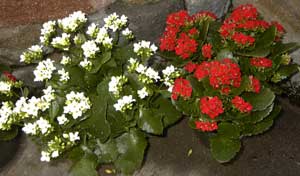
Care:
Kalanchoe needs bright light, full sun (south window) in the winter and some shade during the heat of summer (east/west window). The fleshy leaves will blush red when exposed to full sun. Grow it in well-drained soil consisting of peat, sand or perlite and sterile soil. Cooler temperatures and bright light will prolong blooming. Remove spent flowers for a neater appearance. When all flowers are spent, enjoy your Kalanchoe as a houseplant.
Water thoroughly, then allow the soil to dry. They are drought tolerant so allow the top half to dry out before watering again. Don’t over water, soggy soil will cause stem and root rot. If the lower leaves start to shrivel and yellow, then the soil is too dry.
Feed a balanced liquid fertilizer every 3 weeks when actively growing and when in bloom.
Problems: Scale, mealy bugs and root mealy bugs , mites.
Disease: Fungal-powdery mildew, phytophtora, pythium (root rot)
Reblooming : Some feel it is hardly worth the effort. It is difficult but can be done. To rebloom, remove all dead flower stalks and when new growth appears start feeding with a 15-30-15 fertilizer at 1/2 strength in March-October. Kalanchoe, like Poinsettias are short-day flowering plants which require 6 weeks of 14 hr nights and bright light during the day with temperatures of 60F at night and 70F during the day. Blooming should start within 4 months after treatment.
You can also propagate your plant from tip cuttings taken in spring. Root them in a mix of peat moss and coarse sand and place in bright filtered light.
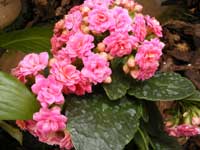
An exciting new variety is the Calandiva, a double-flower that looks like a cluster miniature roses and comes in a variety of colors. It has the same growing requirements as the Kalanchoe.
From the reader archive
Useful reader questions
Hello, wish I had found this site many years ago 🙂 I am cutting back a plant to make it more compact, but the inner stems have no lower leaves left(didn’t get enough light), I will cut it back so it has…
Read Nicola discussionHello and thank you for such great resources for gardening advice, I just purchased a baby Kalanchoe blossfeldiana plant for my house. It has some beautiful red flowers on it, and I want it to continue to bloom nicely. I am confused…
Read Alfred discussionHi, my Kalanchoe is not doing well and I need some urgent advice. It was doing fine until in the summer it got infested (especially the young leaves) with some small white parasites, looking like small white dots, which I assumed were…
Read Kate discussionHi, I’ve just pinched the yellowing and shriveling at ends big leaves from my kalanchoe to keep it tidy while I’m trying to understand what caused it. I took the plant out of the pot to check the soil and the roots.…
Read Marina discussion
I received a small kalanchoe as a gift last year. It is no longer small! What do people usually do with this plant when its branches are in excess of 2 feet each? Tie it to stakes or turn it into a hanging plant? I like it but am a bit bewildered! : )
.
I HAVE A ONE YEAR OLD. IS THIS PLANT POISONOUS FOR HIM? I READ ABOUT MITES. IS THIS A PROBLEM FOR INSIDE A HOUSE AND WITH A CHILD.
I live in Ohio can this plant be put in ground to come back in spring?
I have a new blooming Kalanchoe house plant and am wondering if I could put it in a hanging basket on the outside deck for the summer months.
My Kalanchoe plant has developed brown spots on it’s leaves. What is this a sign of and what should I do?
Michelle
I received an orange Kalanchoe plant the last week in April from a florist shop – I just love it – but my flowers started getting pale and eventually started wilting. I cut them off – it looks like I am still getting some flowers/leaves. Is this the time I would put it in the dark for 14 hours for 6 weeks and will it start to bloom again? Or won’t it bloom now until October? Thanks!
I recieved an orange Kalanchoe plant for a gift, and until recently it was doing fine. I accidently left the plant in the car overnight, and due to the summer heat, the entire plant has wilted. Is there anything I can do to bring this plant back?
I see the plant, Kalanchoe is listed as poisionous to cats and dogs. Do you tink it would be poisionous to a miniature sheep?
By chance can you tell me what the Kalanchoe is hardy to? I’ve looked all over for the dangerouse low temperature.
I just got a Kalanchoe for my room as an indoor plant and I live in the tropics, where it’s hot (average 85 degrees F) and humid every day of the year. Would it be better out on the balcony? Would it survive this heat?
I have a plant that I bought and it stated it was a kalanchoe but it does not look like my other one it has light large green flat leaves. the stem is thick and when it gets colder outside the tips of the leaves turn red. could this be another variety
I just received the Kalanchoe plant for Valentines Day, Its a beautiful plant, but after reading all the questions and problems, it seems like a very difficult plant to take care of. Right now it has flowers and no brown spots.
Propagate Kalanchoe
Hello, I also received my Kalanchoe plant as a gift. I do love it but I have a couple of concerns. I repotted it from the green plastic pot it came in to a pot that’s not very wide but extends 6-7 inches below the lowest leaves. Should I repot to a shorter pot? I would also love to propagate the plant, what is the best way to do so and how often should I water the repotted clipping? Thank you very much for your time!
I have a question regarding removing the old blooms from the Kalanchoe plant….everything I read says ‘remove the old blooms’. Does this mean down to the mother plant or to the first set of little leaves? Will those little leaves grow or should they be removed?
Thanks
I live in Western Canada & have just received a Kalachoe plant as a gift. Can I put it outside in a container for the remainder of the Spring & Summer?
Thank-you
I have a Kalanchoe Blossfeldiana that’s probably over 10 years old. It has developed very long bare branches with leaves on the ends. How do I get it to look like a normal potted plant again? Should I cut everything off and let it start over from the ground up? Believe it or not, it’s in bloom now.
ps I’m not sure how a 10 year
old plant will respond to severe pruning.
Thanks for the reply. What about watering? I have a succulant garden in an old bar-b-que, would the Kalanchoe work there & the rain we so often get—would it hurt it?
I have a Pear Cactus doing famously also spreading Sedum.
Hi, you stated that the Kalanchoe plant needs six weeks of 14 hour nights. I am not clear about where the plant should be stored during this time. I keep it as a houseplant now in front of a huge picture window. Should it be moved in the fall, and if so to where?
Thanks,
Teresa
Put it in a room that you don’t use in the evenings, where you don’t turn on the lights.
I rec’d a Kalanchoe as a gift and it is beautiful, however it is very full in the pot it came in and the leaves are touching the soil. I know it’s only to be watered when the soil gets dry and I’ve being doing that but the leaves near the base of the pot are turning yellow and I want to know what to do. Should I replant in a larger pot? What about the yellow and dried out leaves? Thank you
I rooted a stem cutting and potted it in soil. It grew well for a while, but now most of the lower leaves are wilting. Could it be because of the summer heat or do you think it’s water logged? Also, do Kalanchoes do well in coastal areas?
Hi I received a Kalanchoe as a bday gift from my dad last year. It was very beautiful for several months and eventually lost its bloom. The leave remained thick and green until recently when I noticed that the stems began to appear black. Its not the whole stem but sections. Yet the sections above and below the blackened stem appear very green and healthy. I don’t know if this means that its rotting and I need to cut and treat it. I need advice in order to keep this plant alive. HELP please.
I have a Kalanchoe on my window sill. I’ve had it some months now and the flowers have been plentiful. I haven’t been removing the faded flowers regularly and at present there are a lot of dried flowers which I’ve just removed. There’s plenty new leaf growth on the plant. I didn’t want to overwater but the latest flowers don’t seem to have got off to a good start as they seem to have become dry very quickly. My Kalanchoe is looking quite bare of flowers but I don’t think it’s stopped flowering yet. What can I do?
Powdery mildew
I was given a kalanchoe that has “white” stuff all over the leaves and stock. I have wiped it off several times but it keeps coming back. Also a couple fo the leaves are turning yellow then brown at the ends and curling up. It is also starting to get “gangly” looking. Need to find out what to do to help this plant.
Hi! I received my Kalanchoe as a mother’s day present from my husband and the plant still have few flowers on July. How should I take care of it if I have it as an outdoor plant and I live in El Centro, CA where during summer the temperature rises to 110 degrees in average? Thanks in advance for your help.
Hi, I just bought a Kalanchoe about a month ago, the flowers were beautiful, but they stop blooming, now I keep it as a green plant in the kitchen by the window where it can get some light from the sun. I live in San Luis, Az. and the temperature gets pretty high here, average of 110 to 115 degrees. I’m afraid to leave it outside because of the heat. The leaves are starting to die and they look saggy, I guess I overwatered the plant, what can I do now. Thank you for your time.
Kalanchoe growing tip
Hi, I can give an advice on how to make a Kalanchoe to rebloom. It’s easier to do than you think. After blooming let the plant rest for a month or two watering it as usual only when the soil gets dry. Then there should be the period of “sleep” for the plant. So you need to put the plant in very “hard” conditions which means the following: put it in a very dark place without any light and stop watering it just at all. (I put mine in the bathroom without windows) The harder condiotions for the plant are the better. This period should last for about a month. Don’t worry, the plant shouldn’t die providing it was healthy before being put in this “prison”. After about a month you can check on the plant to see if it has flower stems on it. If so, you can take it out to the sun light and care about it as usual – water and fertilize it regularly. I did this with my plant and it was successful, the plant was blooming for several months. I wish you all good luck and nice blooming of your Kalanchoes!
Hi,
Thanks for this post! I am kinda worried because most (though not all) of my kalanchoe flowers have started wilting and have stopped blooming. The leaves are in great condition. I am in Irvine, southern California and I keep the potted plant ouside in the shade and water it twice a week, making sure it drains well. However, I haven’t fertilized it in the 6 weeks since I bought it.
Has it done blooming naturally or am I doing something wrong? Also, how should I prune the flowers?
Hi. I have had my kalanchoe plant for almost a year. I keep it on my desk at work. There has been a lot of growth but some of the stems are curvy – dip down and come back up. Is this due to needing more light?
Save money on plants tip
Greetings and salutations,
I love plants, but have a low plant budget. Sooo, anyone like me, might could use this tip of the day.
At many grocery stores there’s a plant section. Look or ask where are the marked down plants are located, usually hidden.
Most plants have just lost their selling power. Others have problems. That’s when I use this website.
I buy $4.99 to $20.00 plants marked down to $.99 to $4.99. Most are usually Kalanchoe at the end of summer. Some others are: mini-tea rose, and gerbera daisy, gloxina, cyclamen…… Good luck, Celeste
Hi, my Kalanchoe is not doing well and I need some urgent advice. It was doing fine until in the summer it got infested (especially the young leaves) with some small white parasites, looking like small white dots, which I assumed were aphides. I sprayed the plant with an insecticide and the parasites were gone. However, they reappeared about 2 months ago and as I had read that some insecticides were actually poisonous to the plant, I decided to wash away the parasites with water. The operation was successful but the plant started to lose leaves very quickly – some leaves get brown and dry out but a large number get light greenish-yellow circular spots and fall off long before they dry out. The situation has deteriorated dramatically over the last weeks and now the few remaining leaves display some white-grey fluffy spots (which I presume are powdery mildew that, as I realise now, must be due to the water I used to clean the leaves and the fact that the pot is situated on a window sill above the radiator, hence humidity and warmth). On top of this, at a closer look I have just detected the presence of the white parasites once again. I am desperate and don’t know what to do to save my plant. This must be a disease or a combination of diseases. Should I cut back the stems? Could you please help? Thanks in advance.
Hi, the insects (white dots) are mostly on the upper side of the leaf surface, few of them are on the lower side of the surface of the youngest leaves. The white-greyish fluffy spots are always on top of the leaf surface.
Hello. I have a question regarding frostbite. Back in the spring a bought a small Kalanchoe plant from a local nursery. I repotted into a larger pot with better drainage and it has done well and really gotten big all summer long. The leave are thick and a beautiful dark green is very full, but never bloomed. It has been very healthy until recently when I forgot to bring my plant indoors on a very cold night. The forcast didn’t indicate frost but low and behold then next morning there it was. My Kalanchoe was on my porch banister rail under the overhang of the porch roof so it wasn’t completely exposed to the frost, but it did suffer quite a bite anyway. Is there anything I can do to revive or treat my plant to help from the frostbite?
Hi!
My Kalanchoe was really flourishing but more recently new leaves have come through deformed. There are browny patches on the leaves which can be wiped off but if left seem to destroy the leaf. The tips of new growth also seem to be under attack from a light brownish substance which feels powdery to touch.
I had 2 cuttings, one that I’ve left where it is and is suffering more than ever, the other I’ve moved to a warmer, darker location which is doing better although the problem is continuing.
Any ideas? Thanks for your expertise
I have one at home and I just want to know I should keep it indoors till the blooms exist or i can put it out every time that i want??!!
Thank u very much in advance.
Yellowing leaves
Hi, I got a Kalanchoe potted plant that bloomed in early summer and now the leaves are starting to turn yellow. The ends of the leaves are dry and brown. It has always been indoors close to a window for sunlight. How can I save my plant? Pls help!
thanks in advance!
Outdoor Kalanchoe care
Hi. I live in Orange County (Southern California). I am planning to plant several Kalanchoes in my backyard which is east facing. Can it survive the outdoors all year round? Also how often will it bloom if planted outside.
I am notoriously terrible with plants. Unfortunately for my grandmother, I am now the primary care-giver to her houseplants. I keep reading that the kalanchoe plant is hardy, but I seem to still be doing it wrong. All 3 plants are set in a windowsill that is bright but mostly indirect light for most of the day. One is flowering but some of its leaves are curling up and the ends are turning black, almost completely random locations on the stalk. The other is doing alright, but the leaves are not as thick as they used to be and isn’t flowering. The third is leggy but I’m scared to death to trim it as it seems to be doing alright. They all have quick draining soil and I run a bit of water over them and let them drain about every other day. Any suggestions?
I purchased my Kalanchoe about 2 weeks ago while it was blooming, brought it home, repotted it, and have had it setting in a window sill with a lot of indirect light. Within the last few days, I’ve noticed that the leaves seem to be drooping a little and that some of them are turning yellow and some have shriveled up. What could be the cause and what can I do to nurse the plant back to health? I’d like to keep it around for many years.
I just received my plant. Just wondering, would it do okay planted in the ground in Texas, Dalls area?
Root hairs
I got a Kalanchoe plant as a gift about a year ago. I keep it on my windowsill in my office at work – a north facing window and it gets watered once a week. It flowered very nicely for quite a while, but seems to have pretty much stopped doing that. That isn’t the problem though… The stems seem to be growing little “hairs” on them. What are these? And how do I get rid of them?
Powdery mildew
I have two kalanchoe plants that have developed powdery mildew. I saw your site’s advice to try the baking soda/dish soap spray. I’m wondering if my other plants are in danger of “catching” the mildew.
I’ve just moved the kalanchoe plants to my outer stairwell, so the mildew won’t thrive indoors. I have some cyclamen, zygocactus and poinsettias out there, as well (they’re doing great).
Does this sound like a safe setup, or would you recommend moving the kalanchoe?
Also, I recently took cuttings of the spindly kalanchoe to propagate. They’re rooting in water. Should I spray them, too, or dispose?
Thank you…I LOVE this site!!
I have a kalanchoe plant that I received in August. It was actually 3 kalanchoe plants together in one tiny pot. I repotted them into a slightly larger pot, and they have grown beautifully all winter. About 3 weeks ago, most of the large leaves on one of the plants went droopy. Completely droopy and wilted. The rest of the plant looks fine, and there is still a lot of new growth on it. The other two plants in the same pot are fine. Do you know what could cause this, or what I should do?
Root rot
I also have 3 plants in one pot, and have been struggling with these Kalanchoes for over a year now. Shockingly, despite my complete inability to care for plants, one of them is still flowering just barely even after a year.. but one of the 3 isn’t doing too well. The smallest one is an ugly yellow-brown, and wilting quickly. I believe the problem was that I kept the Val’s day heart wrapping around the pot and thus it didn’t drain enough after watering, and now I’ve got root rot. My mother said to take it out, wash and cut the affected roots, and repot it in sterile soil. Is there anything else you can think of to save my plant? I guess as a last resort I can still propagate it, right? I appreciate your help.
Wilting yellow leaves
my Kalanchoe has started wilting…the leaves are turning yellow and flowers are falling off…..what should i do? please help!
can kalanchoe of different colors be planted together without them all turning the same color bloom?
Hello and thank you for such great resources for gardening advice,
I just purchased a baby Kalanchoe blossfeldiana plant for my house. It has some beautiful red flowers on it, and I want it to continue to bloom nicely.
I am confused about your advice regarding how to provide short days for the plant. My Kalanchoe is a baby and it has flowers on it already. Considering this, should I still do my best to limit the amount of (filtered) sunlight it receives? I placed it on my sunny windowsill, inside my air conditioned house. Should I only place it in darkness when I want it to grow NEW flowers after having none at all, or should I always practice taking it out of sunlight at around 5 PM, in order to keep the flowers on it and encourage new ones to bloom?
I also have a mature Kalanchoe that someone gave to me. The flowers on it look like they are pretty much dying, or dead. Do you think i can revive these flowers, or are they going to inevitably die soon, and i’ll have to make it rebloom? What is the best way to get the flowers to perk up? Should i remove the flowers? I repotted the plant and im noticing that the leaves are still green, but some stems, while sturdy, are seeming to turn a reddish brownish color.
Thank you so much,
Alfred
Reddish leaves/ yellow lower leaves
Some of the leaves on my Kalanchoe, toward the base of it near the soil, are becoming very light and flimsy compared to the staunch leaves higher up on the plant. I notice some of these leaves are getting a reddish/brownish tint. I have been giving the plant plenty of sun. Is it possible it has been getting too much sun? I live in New York City.
Thank you, Alfred
I had a kalanchoe plant for two years now. It’s still growing and blooming. It’s getting so big and growing out of control so I was wondering. Should I trim this plant to keep it limit or leave it alone, only to cut off the old flower stem? One of the branches keep growing out like it’s a beanstalk. So, I wasn’t too sure if I should cut it or not. I like this website. Very easy and simple. Thanks.
Propagate cuttings
I am a grower and this is this first year we have tried to grow Kalanchoes. We are having a problem with them rooting. I am located in Indiana. Seeing it is summer it gets to be about 100 degrees or greater in the greenhouse that they are grown. They are not under much shade. Is there a reason we are having trouble with the roots? I know there are common disease, but there are no visible signs on the leaves that there is a root problem. They are just small plants. We received them as rooted cutting. Please let me know if you can help.
Thanks!
My kalanchoe has 6 stems coming up from the pot/soil. Five of the stems have firm, shiny, bright green (healthy) leaves. On one stem, all the leaves are dull, soft and limp. Can I just pull out this one bad stem; and why just one part? Will the others follow suite because of an unseen problem?
Soft, dull leavesA lot of the leaves on my Kalanchoe have become soft and dull. I’m very careful not to over water. What am I doing wrong?
Grow outdoors
Hello,
I recently acquired my first Kalanchoe plant and have been keeping it indoors on my kitchen windowsill. However I would like to eventually move it outdoors to be a part of my yard landscape – would it be ok to plant it in the ground as long as it has partial shade during hot days and if I cover it during the cold nights when it gets < 40 degrees? Or should I leave it as a potted plant that way I can move it into shade when too hot or bring indoors when too cold? I live in Apache Junction, Arizona.
BTW I’ve been reading through the comments on this site trying to learn as much as I can since this is my first Kalanchoe – there is a lot of very helpful info – Thank You!
Hello, wish I had found this site many years ago 🙂
I am cutting back a plant to make it more compact, but the inner stems have no lower leaves left(didn’t get enough light), I will cut it back so it has 1-2 pairs of leaves on these stems, but can it produce new leaves lower down, or will the bottom few inches just be stems from now on? Could I force leaves down here by say scoring the stems near an old leaf node?
Also, any idea how long I should leave between cutting-back a tall/straggly plant and allowing it flower so that it flowers at a compact consistent height. I am never sure about this and usually find that it starts to bud (randomly throughout the year, including the height of our 17hr summer) just as I want to cut it back when it starts to look like an unkempt bush. Basically, how old does a stem tip need to be before it will bud?
Last qu – When you buy a Kalanchoe Blossfeldiana or Calandiva they always seem to have large (3-5 inch) base leaves, but these easily drop off if they get damp on the soil/the plant dries out, or they can break on the edge of a pot. Now all 5 of my plants came with these leaves. One of my 15month-old calandivas still has 2 of these 5 inch leaves (just lost third), but the other 2 have long lost these, as did my 5.5 year blossfeldiana in its first year. I have never since seen my plants grow leaves this large, and haven’t found anything on the internet about producing such large leaves, but I would like them as the plants look much better when they hide the soil with these large leaves.
I have found on the oldest stems’ leaves can about 2.5 inches but no more, and one calandiva now wont produce leaves bigger than ~1 inch although it gets tall very quickly?
Any suggestions would be greatly appreciated.
Thank you so much
Root hairs
Me again! So far you have helped me with all my Kalanchoe problems, and I thank you. Now my plants have WHISKERS! One to three inches up from the soil are little roots coming out from the stems. I “potted-up” about a month ago and the plant thanked me by growing bigger and bushier; but what’s with the whiskers? The plant books in the library say nothing of this.
hi henry here ,
May i know how to propagate kalanchoe blossfeldiana . I have tried ways include stem cutting and leaf tip propagation but always it fail . The media i used was sand+cocopeat as this plant does not need too much water to grow .( it will rot if apply too much water ) . and i also encounter stem rot of this plant but i did not water too much water .
Do you have any suggestion on the propagation and share with me more tips on this .
Thanks and hope you will get back to me
Regards
Cut back kalanchoe
My Kalanchloe is VERY leggy. Can I cut it back?
Flower color fading
hi…i bought a kalanchoe flower about 3 weeks ago, its in a small pot and the plant is about 20 centimiters hight with 3 stems. i put it near the window and waterized it often. at first it hade a fully orange flowers but now some of the flower dry and the new flowers getting a little pale!!!
what should i do to make them look like the first day?? and i forget to tell that they didnt recive a plenty of light!! should i put them outside??. outside is cold!!!
Designing w/ Kalanchoe flowers
I am putting together some DIY centerpieces using a leather fern as a base. Can I cut some long stems and stick them into the soil of the fern for color? Will this arrangement last overnight and one day?
Floppy leaves
I live in an apartment in Michigan West sun access. It is currently middle may and 80 degrees and just purchased a small Kalanchoe. I was keeping it inside on a coffee table that was getting bright light, and watering small amounts. I then started leaving it on the balcony in full sun because the leaves were floppy. Now the leaves are still floppy and I’m trying to let the soil dry and the base of the flower buds are turning yellow/brown. Any advice appreciated I do not want to let it die, so pretty!!
I am needing to prune back my indoor kalanchoe and am having some difficulty applying the advice I am finding online to my situation. Like many others, it seems, my plant got very leggy over the past winter, and I am only now getting around to doing something about it. The issue is that all the pruning advice I can find says to cut just above the first pair of leaves on a stem, but I am in the situation where there are no leaves left on the longest stems. The stems are maybe 2.5′ long and only have leaves (in a sort of blossom formation) on the last 5″. So should I just cut above any of the “seams” where leaves would once have been? And how much dare I remove at one time? The plant seems very healthy, blooming throughout the spring and I would hate to do anything to hurt it.
Hi Elaine
Are the stems really 2.5 feet long?
Hello,
I’ve had my Kalanchoe plant for a few years but never knew to propagate it. It’s around 20-22 inches tall but most of the stems grow down over the side of the pot and then back up. I notice you say it probably needs more light however it’s not at all a leggy plant. It’s very bushy, I was thinking the stems were too heavy until I found this site. I live in an apt so the only way to give it more light would be to put it outside but I’m afraid that it’ll be too hot outside in Northern CA?
Other than that, my plant is very full & always thriving although it hasn’t bloomed since I got it.
Thanks for your help & advice!
Hello i have a problem with me Kalanchoe Blossfeldiana, I have been watering it like i was told to care for it. and I jsut looked at it today and the stem and the leaves are turning black what is the matter with it and what do i do to fix it before it dies?
thank you
Hi! I’v noticed just recently that my kalanchoe is changing. I have it in a north window and i water it about once a week. Lately when i touch it a bunch of green leaves fall off and i did notice that there are a few little gnat-like bugs flying around it when i touch it also! What could be the problem? Or is this a normal stage? Please help me! I love this plant!
We received a Kalanchoe plant about 4 months ago and it seems to be doing ok, besides growing up and now out. I was just about to replant it and noticed a bunch of roots, I think that is what they are, about 3-4 inches up the stalk. Can I cut blow this roots and replant those to make more? I have read about the leaves but nothing about the areas that have started roots. Thank you in advance.
Hello. I have one that I bought about 3 mos ago and it’s gotten so big I’ve repotted it twice! It’s doing well. I recently bought a small one that the blooms were yellow. A week later they are bright orange??Is that normal? It looks healthy but the color change is drastic.
some pretty good info on this site it has helped me with two of my three kalanchoe purchased from walmart the third however has started dieing rapidly im treating it as i treat my other two its stems have all browned and shriveled i would love a little advice on this plant im a noob at kalanchoe and am more used to produce plants.
I received a kalanchoe as a gift. I put it on the windowsill of my office (which faces east) – and the flowers that got direct light seemed to turn brown quickly (the other flowers are still fine). Should I put it in the shade? Also, I pinched off the flowers that died, but now there are ugly stems where the flowers were. What do I do?
My pointettia got frost bite. the leaves are drooping however the stem seem to be firm. Will survive, if so, what can I do?
Hi Sharon
If it has any life in it, it can send out new growth at the leaf nodes. Poinsettias are sensitive to cold temperatures.
Small leaves on Kalanchoe
I have had a Kalanchoe plant for several years and the leaves are very tiny on it. The biggest leaf is about the size of a fingernail. I try to let it dry out between watering and it gets north light, but it is set back from the windowsill with other plants inbetween. Does it need more light? It seems to be healthy otherwise, just tiny.
It’s at work and the plant guy was watering my plants without me knowing and some ended up over watered until I found out and asked him to quit. I end up with people’s plants when they get sickly or they aren’t wanted anymore. (33 plants at my desk, 10 at home)
hi i bought a kalanchoe 2 weeks ago at a greenhouse, when i brought it home the leaves became floppy on the bottom of the plant, i figured it was in my car for a while and it was rather cold that day. i put it on a south facing window and water it every week or 2. the leaves are still floppy and some fall off, the top part looks fine, what do i do?
Watering kalanchoe
I received a small kalanchoe for Valentine’s Day. Currently it sits in my southern window and gets watered once a week. My question is how much water I should give it? Is there such a thing as under-watering this plant?
hey! your posts are great!
I have a question about my kalanchoe. I got it as a cutting 3 weeks ago, and it was doing amazing. just this week it began to wilt! I didn’t change a thing: watering, sunlight, all the same. he is in a small ish pot, but he was doing fine till now. maybe I should re pot?
what should I do? he is one of my favorite succulents and I am afraid to see him die. thanks so much in advance for your help!!
Overwatered Kalanchoe
I’m afraid I must have over watered my kalanchoe. It’s only a few weeks old & was looking great. Before leaving home for several days I watered it (even though the soil was not completely dry), and now most of the blooms look shriveled up & dried out. Should I leave them on or trim them off? Any suggestions?
Your over watering it. Let it dry out.
Thank you person who helped Vycci! Where ever you are! I finally found out how to help my flower!
Hey, there! I was given a Kalanchoe plant recently and left it in my car accidentally for a couple of days. It froze. I was wondering if there was any hope in reviving it? Its flowers are bent and withered. Any suggestions?
Hello!
I have a big very vine-like Calandiva that I have had for a few years now. When I moved back home from school, I left all my plants outside over night. Sadly they got little black bugs. Then eventually they got practically microscopic white bugs at some point as well. I have been treating them all with fertilome triple action plus, dawn dish soap, and hi-yield garden/pet/livestock dust. The bugs seem to be gone but now all my plants seem to be dying! All of the leaves have shriveled up and died on the Calandiva. black smudges/spots are appearing on its stalks. I would like to save this plant most of all. But, the aloe’s stalks are dying as well along with my other plants. HELP!!! let me know if you need anymore info/details. thank you!
Hello! I got a tall, skinny Kalanchoe a few weeks ago. It has a purple stem and thin, green leaves with darker green stripes on them. I have it in a south facing window with other succulents. There has been quite a lot of new growth at the top of the plant, but the bottom leaves are closing in on themselves and falling off. First, how can I stop this from happening? Second, will those leaves ever grow back? Thanks very much!
Hi! I live in middle east in a very hot and dry country. I have bought kalanchoes for the first time and I don’t know much about gardening. I have placed my plants inside the room with only artificial light and Air conditioning is always dehumidifying the room. Plants started to dry and I cut its dry ends. I don’t know should i keep them in sun or a dark room or in the same room. Please help!
Hi, I’ve just pinched the yellowing and shriveling at ends big leaves from my kalanchoe to keep it tidy while I’m trying to understand what caused it. I took the plant out of the pot to check the soil and the roots. I havent noticed anything abnormal. The soil at the roots seemed moist, so i thought it could be overwatered. However, a few days later new leaves started to yellow and shrivel along edges. I got scared to loose the plant and concluded that it must be under watering then and watered it. But I’m still not sure what to do about watering. Most say this plant tolerates drought. Since my plant’s soil is still moist then maybe its the remaining effects of overwatering? I was also wondering if it could be the soil. I bought it from a green section of a grocery store. On the internet, most say this plant needs well-drained soil with the use of sand and perlite. When I’m looking at my plant’s soil it appears very spongy and not loose at all. So could the store used soil be wrong for this plant? I’m not an expert but it just seems this type of soil would retain waterrather than let it pass through. Otherwise my kalancjoe blossgeldiana has lots and lots of new growth but all leaves are small in comparison to the original leaves. It is by the window on the northwest facing side getting plenty of light and afternoon sun. Not much of sun thought right now in Canada, Ontario.
I just learned my plant is a Kalanchoe blossfeldiana. Unfortunately until now it has been getting indirect light. It is 2 years old (still new leaves/growing!) but it has thick stalks that are completely bent over. I tried rotating it so it would grow more evenly but then the tips of the branches just grew in a different direction. Is there anyway to get this plant to be upright again? It almost looks like a vine. I feel like if I were to try to stand it upright the branches would snap! What can I do?
Hello, I just got a Kalanchoe plant and am reading that it will be better if I put it outside. I live in Phoenix, Arizona and wanted to know if it can survive outside in the Arizona summer? The days right now are around 90 degrees, but in the summer can get into the 120s. Can it take that kind of heat even in the shade? The shade (sometimes) isn’t really cooler, you just don’t bake quite as quickly. 🙂 (Sometimes even the cactus appears to be struggling!)
If I keep it indoors, it won’t get much sunlight, because we keep things closed up quite a bit to keep the A/C costs a little lower. So, what would be the best way to keep it alive and healthy?
Also, do you cut or pinch off the dead flowers and how far back?
Thank you for any help you can give me – I really don’t want to kill it
I just received one Kalanchoe blossfeldiana, ‘White Calandiva’ as a gift. I want to keep it on my desk, but we have no windows.. the bright light it requires, can that come from the overhead florescent lights? Will that be good enough to keep it healthy?
Would florescent office lights be enough instead of sunlight for this plant?
There’s no substitute for sunlight but in a pinch florescent light will do.
I just got a Kalanchoe blossfeldana as a gift on Easter. I’ve been taking good care of it but a lot of the flowers are still buds or are just coming out. What does this mean? Are they blooming or are they spent? And how do you know if your plant’s leaves are spent?
Thanks a lot!
Hello!
I got a kalanchoe for valentine’s day (so about 2 and a half to 3 months ago). I’ve been taking proper care by watering it every couple weeks and keeping it in proper light and it’s been doing great, with big leaves and many blooms! However, I left for about 2 weeks so it didn’t get water then, but left it in the same spot as before but now the leaves are getting very soft and about half of the flowers have gone from red to pink or have died. How can I nurse it back to health?
Hi
I’ve got a kalanchoe for about 6months now, it has Bloomed several times, however, its new leaves are not as firm as before, and I find some white powder where the leaves meet the stem. I’m also not sure if I should put it outside, since it’s right beside the window and it has the light near 6or 8 hours a day. could you tell me what to do ?
Hi there!
I have a particular oddity with a Calandiva that, in all my research online in the years of owning them, have never run across a solution for or even a similar example of. In the past, I’ve successfully rooted clippings from them to start new plants, however – I can never get these rooted plants to branch out! They just grow continually up higher as one, long branch, almost like a Christmas tree, without forming segments even when I’ve attempted removing a leaf here or there to encourage new growth, which only forms at the very top. The plant would be completely healthy and almost about a foot tall! Was it because I rooted it first in water instead of most soil – I’ve read that shouldn’t matter, though? I can’t understand why it doesn’t develop branches. Please help!
my 2 year old broke my mini kalanchoe apart but it still has a good size stem with the roots with it will it grow back or is it done it was blooming to
Had mine for 2 years with no sign of flowering! It is growing huge stalks with a lot of green leaves and more stems are growing from the ground. Has the sunlight ( outside all summer) and the dark, looks pretty healthy what do I need to do for it to flower?
Hi,
I have a curious situation.
I took a cutting from my mother’s kalanchoe last summer. (it’s spring where I live now) and it took really nicely in my garden. It looks like the ones in your photos but the flowers are sort of peachy orangy coloured.
when I saw how nicely my cutting was growing I took a cutting from my cutting (now a plant) and rooted it. Possibly because of sun stress the leaves turned a deep purple pinkish colour. It continued to grow nicely but never turned green again. Now this is the curious thing, the flowers are a totally different colour to the original plant as well. they are a pretty pinkish shade of the way the leaves are now and while looking healthy it’s almost like the dna of the plant has changed completely and isn’t going back. Can you explain this? I’m familiar with sun stress but I didn’t know it can be permanent in a plant and continue with new leaves and flowers
I received a Kalanchoe plant as a gift several weeks ago (Nov. 10). It was fine when I received it. Then the “flowerlettes” started drooping as if the stems needed more water. However, the soil feels damp. I don’t have direct sunlight in my apartment in the winter and I keep my apartment temperature around 60 degrees. What could be making them droop – actually just flopping over? Thank you for any help you can give!
Carol
Hi! I’ve had a Kalanchoe as a house plant for about 2 years. It’s very beautiful but very big! I keep it in the south facing window of my home and water it about once a week. Recently, it has started leaning heavily to one side. What can I do? Can I cut off a whole branch?
Thanks!
Hello, I have just discovered that the “marigold” plant that my (now 10 year old daughter) brought home from kindergarten almost 4 years ago is actually a Kalanchoe. It is very leggy – over 2 ft tall and being propped up with stakes. It just started blooming for the first time ever so it must like the light at our new house. I don’t have the best record with house plants and I’m afraid I might kill it if I cut it back. Can I cut the stems off below the leaves?
Hi, I just got a kalanchoe from my son, and it was blooming beautifully, but now the buds that were on it are drooping, and some are drying up and/or falling off. I have a black thumb when it comes to plants he gives me. I immediately looked up how to care for kalanchoe when he brought it home, so I repotted it in a small clay pot and have been careful not to overwater it. What do I do!
Hi,
I have a variety of Kalanchoes and Calandivas inside the house(no garden space outside) on a bright window. Few of them stopped flowering and some branches have small roots growing where the branch is attached to the main stem. It is the end of summer now. Is the plant ready to give cuttings? How should I cut the branch to retain the root growth?
TIA
Hi! I really want to maintain the growth of my plant and care for it but I am utterly confused. I have read through all the comments and want to be certain of what is wrong with my plant. The leaves are bright and green and many more of them are continuing to grow on the bottom of the stem. However the flowers are browning and wilting. I have cut off a few buds that I noticed to be completely brown and have left the others untouched. I even gently wiped the leaves in case of any plant associated disease that might have contracted with something I did/ pests. I noticed this on Sunday and since then it has been 3 days and the trend is continuing. I also have noticed what i believe to be roots are I see flimsy little tiny threads coming out of the soil. I have watered the plant slightly more than I usually every week afraid that maybe my lack of water or sunlight caused this. I am wondering if I am underwatering or if when i repotted the soil i did a really bad job causing the roots to grow on top of the soil.
Help! I am a really novice gardener and this is my first plant. I would really want to maintain this plant and its care for a long time.
The Kalanchoe selling at my local supermarket have one single stem and big leaves whereas my 1 year old (2 pots) have many clusters of small leaves. How to get them big like the ones in supermarkets?
They are surviving well, and I’m fighting the regular mealy bugs with rubbing alcohol.
I am having this issue too, leaves are small whereas the ones at nurseries are huge and dark
Hi, do you allow guest posting on hortchat.com ? 🙂 Let me know on my e-mail
I have the same problem. My kalanchoe’s leaves turned very thin and soft (like dry soft). The ones at the bottom kept turning yellow and fell off. I watered it on the same schedule for a year but this only happened after the snow storm last week. Have you find any solution to yours? Do you know the cause? Thank you a lot!
My leaves on my Kalanchoe use to be big. I had to divide my Kalanchoe into to pots because the plant needed repotting. Now, my plant have grown in both pots but, the leave are a lot smaller. What happen?
My kalanchoe leaves are soft but it is flowering.I haven’t been over watering it.What is the problem? I want to save it
My kalanchoe leaves are soft but it is flowering.I haven’t been over watering it. I want to save it.How often should I be watering it?I’m also afraid of it sitting in the window cause it’s twenty degrees outside so I usually place it on an area that gets sun for five hours in the day time.If a leave has to much brown on it should I pluck it?It also has a big hole from it
I think when they are forced at a greenhouse they must give them super food. The leaves are not naturally supposed to be big. Your plant is fine.