The world of carnivorous plants consists of exotic flesh-eating plants that will peak anyone’s curiosity. The large family of 645 registered species are grown all over the world in diverse environments and come in different shapes and sizes. They are the Startrekkers of the earth. They grow where no other plant can grow. Carnivorous plants grow where nutrients are very low and therefore have evolved into flesh eating plants consuming insects and other animals for their food supply. Each species has a unique way of attracting and trapping its victims.
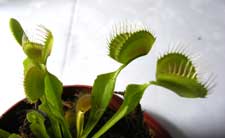
Venus fly trap (Dionaea muscipula) is one the popular snap trap species from this large family. This intriguing novelty grows only in the boggy coastal areas of North and South. Carolina and yet it is known all over the world. This plant grows in a rosette form and develops snap traps that get 1-1 1/2 inch long with sharp teeth and bristle sensor hairs inside each trap. In the spring it sends out a flower stalk with a cluster of small white flowers.
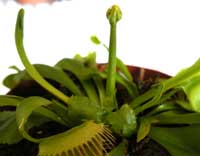
Emerging flower heads should be pinched off to conserve energy for plant growth.
Care
In order to grow a Venus Fly trap you must know what kind of environment it requires. It does well in an open terrarium where humidity and moisture can be controlled.
It needs wet, acidic (ph 3.9-4.8) soil, humid air (min 50%) and temperatures ranging from 55-80F degrees. Plant the tuberous perennial in 50% peat and sand or 100% sphagnum moss. Be sure to always keep the plant moist and never let it dry out. You can flood or soak the soil but then drain it so it doesn’t get water logged. When watering, use distilled or clean rainwater. Keep it in 1/2 day full sun and 50% shade in spring to fall with increased shade in summer. Don’t need to fertilize, for the most part they will feed themselves.
How the traps feed
The traps have 6 sensor hairs inside. If 1 hair is touched twice or 2 hairs are touched simultaneously the trap starts to partially close to determine if the object is edible. As the insect struggles to free itself more hairs are triggered causing the trap squeezes tighter then closing all the way releasing acidic enzymes to digest the insect. This process can take 5-12 days. If the trap is triggered by something else then it will reopen within 12 hours. Each trap can take 2-3 insects and then dies. Dying leaves and traps are part of the growing cycle and should be trimmed off.
Winter dormancy
VFT requires a 3-4 month dormant period. It should be dusted with a fungicide, wrapped in slightly moist spagnum moss and stored in a plastic bag. Keep it at 45-50F degrees. At this time it may loose all its leaves and die back. Trim any blackened foliage to avoid disease. Bring it out in March/April and repot in fresh meduim mix, place it in a bright light, humid area and water.
Be sure your Vft has been propagated vegetatively from clump division, leaf cuttings, tissue culture or started from seed and not removed from the wild as this species is threatened by extinction.
http://hortchat.com/info/how-to-choose-a-venus-flytrap-plant-to-buy
From the reader archive
Useful reader questions
My VFT was doing well this past fall, when it has plenty of flies to feed on. We once saw it with 4 at a time and it started going down hill from there. Maybe it used too much energy? Now it…
Read Jenni discussionHi, Having read the previous posts/replies, i think it’s too late for my VFT but I thought it was worth a post anyway. The plant has been doing really well for 7-9months since getting it and when it started to produce it’s…
Read Damian discussionhello, i am in the army deployed to baghdad, iraq and i have just got my 1st vft and i read the above QanA but nothing really was asked or said on my area or temp situation. 1st off it took 11…
Read SPC:BRAY discussionOkay I bought my Venus flytrap about 6 days ago, and it has been doing great! It is eating a ladybug right now, and I have trimmed it, gave it plenty of water, and kept it under a light because it has…
Read Aaron discussion
My Venus Flytrap is flowering and know I’ve learned that it will almost certainly kill it, but it’s producing new traps and seems healthy, so is it still in danger or is it possible that it will survive?
Also, I think of buying another one on the internet, but is it legal to ship plants from America to Europe and is it healthy for the plant?
– Camille
I recently bought a venus fly trap and some of the leaves are turning black. Is this a disease or are the leaves just old and dying? Alison
My VFT was doing well this past fall, when it has plenty of flies to feed on. We once saw it with 4 at a time and it started going down hill from there. Maybe it used too much energy? Now it is early spring and for several months now it grows a new shoot every week or two, but a “mouth” never develops – therefore it cannot eat (even though there are no flies now anyway). Should I be doing something different to help it grow or is this normal? Do they need to be repotted? Mine is in a tiny 2.5″ pot. Also, can we water it with tap water we have left sitting in a cup for a few days to allow the chlorine to vaporize?
Two weeks ago I brought my fly trap out of winter dormancy after three months of being in the refrigerator and have just noticed some small bluish gray bugs walking around on the top of the soil. They really don�t look like aphids and seem to have no interest in the plant at all. Should I be worried? The plant is still growing back its first new traps of the year and I don’t want to stress the fragile plant by doing anything unnecessary. This is an indoor plant and I did not see them last year. Thanks
I have been growing both venus flytraps and pitcher plants and have a large infestation of whiteflies on the pitcher plants and some on the flytraps. I have tried using isopropyl alcohol, but the plants are very sensitive to it and it caused damage where it touched the plant. How else could the whiteflies be controlled on carnivorous plants?
I’m in the same situation as courtney.. is there any other remedy of ridding my VFT of the whitefly infestation?. ive had it for nearly 3 years and a few months ago it just died off completely and keeps throwing up stems every few weeks. I know you would say it is dormant.. but it hasnt died off in previous winters for some reason.
Okay I bought my Venus flytrap about 6 days ago, and it has been doing great! It is eating a ladybug right now, and I have trimmed it, gave it plenty of water, and kept it under a light because it has been rainy down here, and there has been no sunlight. But I have comed worried about the humidity! I have nothing to put over it to have humidity, and I was wanting to know if just watering it good everyday will do fine? And I keep it inside, and hand feed it often, is handfeeding it ok, as long as the trap shuts by itself?
Thanks, Aaron
i have flytraps, i live in southern cali. and have them in full sun and set in a bog enviorment, i use reverse osmosis treated water and fill a try on the bottom of the pot, when the tray is about dry i fill it back up, i don’t feed it i let it catch its own bugs and it is doing great no problems,
hello, i am in the army deployed to baghdad, iraq and i have just got my 1st vft and i read the above QanA but nothing really was asked or said on my area or temp situation. 1st off it took 11 days for my plant to get here from michigan. then once it arrived two plants looked ok and were tall and green and one was small and black and one other one was small and green. my vft i believe is a starter one it is in a small square plastic case two inch wide by 4inch tall with a plastic top on it. can you give me some info on how to take care of it with me being in baghdad. also there is a thin plastic liner that is in the case with a half inch hole in the middle were the plants are growing thru should i take that out to give the plants more room or is it there for a reason. also it gets to be about 100-110 in the shade here. thank you for your help.
I just bought a VFT, it’s small and looks young, i’d like to re-plant it to give it more room to grow but should i wait to re-plant until next spring since it’s already August?
Dormancy
hello there, so When you grow Venus flytraps in the winter, i dont get the part about dusting it with fungicide?
Hi,
Having read the previous posts/replies, i think it’s too late for my VFT but I thought it was worth a post anyway.
The plant has been doing really well for 7-9months since getting it and when it started to produce it’s first flowering stem I was really happy.
However, yesterday the plant would not close on a pasisng fly so I wondered if a floweriing plant didn’t trap things that might be pollinating it, which lead me to this form, and I now see that it cold be the end of the road for my VFT afterall – is there anything that can be done to save it or is it time to get another one?
D
Traps turn black
Hello I have a VFT and have seen some rather large but not bigger than the trap leaves spiders go be eaten by my traps but after a couple of days of digestion my traps leaves start turning black and dry from the outside why is this happening?
Do not feed your traps, they will get enough food on their own, one bug a month is good. Put them outside in full sun sitting in a tray of distilled water and let them do their thing. Hand feeding kills the trap and they only close three times and then the trap dies. Your taking energy from the plant everytime it closes. Research flytrap care at cobraplant.com, let the plant feed itself your killing it.
Aphids
my VTF has aphids that I am treating, but it also seems to have little blister like bubbles forming on the leafe stalks. Might this be a fungus or a result of the aphid infestation? If it’s a sickness, any reccomendations on what product to get from the store for treatment? Thanks!!
my venus fly trap already grow a flower and i am 10 years old
Feeding
Just got a venus fly trap. I was wondering how will feeding the plant kill it as it said in one of the coments above. The box that mine came in said that I could feed it. I would like to be educated on this matter. Thank you.
Aphids or fungus gnats
Hi there, I’ve had my VFT for about 3 years. It has been very healthy (has divided into 9 plants) till now. I have noticed some of the trap ‘tips’ that clasp together when trap shuts are curling. On one particular plant the curling is so bad that it is very deformed and the traps are curling as well. Any ideas? Also, the peat soil has an infestation of minute white ‘hopper’ like insects. How will I get rid of these. Thanks a lot.
trap dying after feeding
My planets are dieting right after thay ate some thing like a ant fly ladybug red