Rosemary officinalis is a member of the mint family and a native of the Mediterranean whose history trails back to 2500 years. The needle like, gray green foliage with antifungal and antibacterial properties has a pungent, resinous smell that was considered a cure for many ailments. A brush against the plant releases fragrant, aromatic oils that invigorate the senses.
A tender perennial shrub, rosemary will not tolerate temperatures lower than 10F. It can winter over on the West coast growing up to 6ft. tall but in Northern climates it can only be grown in a container.
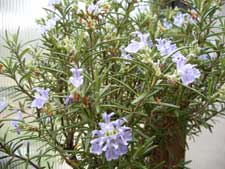
Care
Outdoors: Rosemary tolerates poor soil with good drainage and full sun to light shade.
Indoors: Place it in bright sunny window and keep the soil evenly moist but not waterlogged. Allow the water to drain freely and let it dry between watering. Brown needles indicate over-watering. In the spring around May 1 repot in fresh soil and set it outside. Slowly acclimate it to the outdoors by keeping it in protected semi shade for 1-2 weeks and then set it on a sunny porch or sink the pot into the ground for the summer. To maintain a compact shape, trim up to 1/2 of any leggy winter growth in the spring. Rosemary needs very little fertilizer during the growing season.
Propagation
Seed germination is very slow; therefore propagation from cuttings in the spring is the preferred method. :
To make new plants, take 4-6 cuttings, strip off lower leaves, dip in rooting hormone and insert in soilless mix. Cover the cuttings with a plastic bag (away from direct sun) to increase humidity. Rooting should take 4-6 weeks. Water rooting is another quick way to propagate rosemary. I have found that cuttings placed in colored blue or green glass root faster than clear glass. Rooting started after 2 weeks.
Wintering Rosemary
The dry indoor air is difficult for Rosemary to endure therefore allow the plant to remain outdoors for as long as possible and bring it inside around end of October. Keep it in a cool (45 degrees is ideal) well ventilated room with a south or west sunny location. Water less in the winter keeping it on the dry side. Try not to get the leaves wet and provide good air circulation to avoid powdery mildew. With a little luck it should make it through the winter, if not you can always purchase a new one in the spring.
From the reader archive
Useful reader questions
Thought I would share my experience with Endless Summer Twist & Shout Hydrangea in zone 4: July 14, 2016, I live in West Central MN, zone 4, have had an Endless Summer, Twist & Shout, planted on East corner of house since…
Read kate discussionRosemary in hot humid weather Hi i am from malaysia, i love rosemary and use normally in my cookings. Last few months, I bought one potted from a hypermarket (Jaya Jusco), eventually it died, it went all brown on the leaves and…
Read Jason Ng discussionHello. Hoping you can help. I got my rosemary about spring time, I potted it into an old copper coal bucket (just because it looked nice). It grew fantastically over the summer from about 6 inches tall to about 30 inches tall.…
Read T.W.Darby discussionSoluble salts I have a small potted rosemary plant that’s indoors for the winter. The clay pot continues to have a yellow and white residue all over it? When you try to clean it off, it just comes right back. Any ideas…
Read Mark discussion
Good Evening, I have a question about our Rosemary. It has over wintered outside for the last 2 years. This year it’s all brown and the neddles are falling off, yet the plant itself is not dried up or brittle. Do I need to cut it back ? What do you think I need to do. It’s planted on the south side of our home, so it’s gotten sun all winter. Thanks Becky Wurm
I recently purchased a potted rosemary plant and I was hoping to keep it hanging indoors in my mudroom for two reasons its nice to look at when you first come in and it smells fabulous. Everything that I am reading is telling me that they don’t do well indoors. Do you have to bring them outside in the summer time or is it possible to keep it an indoor plant?
We planted a rosemary when we moved to Alamogordo, NM, 3 years ago. It’s been doing great and is about 30 inches wide and 15 inches tall but we just noticed some white,milky, sticky secretions on some of the stalks. Is this a common occurrence or the sign of a problem? We didn’t notice any kind of insects in these secretions.
I bought a potted rosemary and have to keep it indoor (i rent an apartment with no balcony). i notice the tips are turning brown. I only water the plant when the soil feels dry, what do you think might have gone wrong?
thank you!
Hello, I am from Malaysia, I bought a rosemary plant about a foot tall and it’s grown in a clay pot. After 2 weeks I noticed a lot of the leaves turnng black and drop off. I am abit worry. Rosemary plant don’t come easy in Malaysia here. Is it too much or too little water. Please help. Thanks
I planted a small rosemary in Yuma, AZ a year ago. It went from April to late October, 2008 without water. After watering it has grown rapidly. Can I expect it to continue to grow during the hot summer here without water? Thanks.
Rosemary turning brown
Hi. I’m in Seattle. 7 out of 9 of our rosemary bushes turned brown over the winter. They were probably planted 5 years ago. Any tips on how to save them or should I did them up and plant something else?
Hi,
I live in North Texas. We have had an unusually wet spring season. We moved into this house in January and a rosemary plant is in the front flower bed. It is very large and looked very healthy. Today, however, we noticed some of the branches look to be dead. We have not noticed them being brown and dry at all. It is a beautiful, fragrant, plant and we don’t want ot loose it. We did just add pine mulch to the flower bed last weekend. Is it too wet or something else? Thanks for any help or suggestions.
Not sure which part of M’sia you guys are in, but, you can buy your rosemary plants in several places. I found mine more often than not in Sungai Buloh. Last week, I found 4 small pots of rosemary in Jaya Jusco 1 Utama, and bought em all.
Best bet is to try Sungai Buloh and Jaya Jusco Midvalley and 1 Utama.
PS. I’m still having problems with my rosemary. Bought so many of em now, and have to keep sending them upwards. Seems that in M’sia, you have to give it lots more tlc.
Misting rosemary in winter
should rosemary leaves be sprayed with water during the winter while in the house? I don’t water the soil often but I spray the leaves daily
Hi –
I live in Seattle and have three beautiful rosemary plants that I put in my rock garden last Spring. They were doing wonderfully – growing, flowering, etc until about March of this year. Now they have all turned white. I really can’t tell if they are dead or not. Two have a few shoots of green, but only a tiny amount. We did have a very unseasonably cold winter. I’m assuming they are pretty much dead, but I LOVE these plants and don’t want to pull them up if there is any way to save them.
Thanks!
Mealy bug
I live in Arizona and have a 2 foot Rosemary plant that is doing very well until recently. It also has the same white spongy spots between the leaves that you describe. I don’t know what mealy bugs are but I do have some beetle like bugs in the yard. Did you find out what this is?
You can email me at dpuppi7@hotmail.com
Thank you.
Yellow leaves
My rosemary tree has been doing great up until about a week ago. It sits on the deck outside and I water it regularly. It has been nice and thick, very fragant. I noticed yellow leaves a few days ago, too much water or not enough?
The plant was transplanted into a nice new pot with fresh soil this spring. There are no insects on the leaves, so it must be a fertilizer issue. What type of fertilizer should I use on my rosemary and how often?
Very needy plants these rosemary trees, but they are a beautiful addition to my deck/garden. I bring them in during the winter and so far have successfully kept them through a northern Maine cold snap.
Thank you for your prompt replies. The rosemary plant has actually perked up since my first question was posted. My rosemary plants have about two months left to soak in the glorious outside and then they will be brought into the house to winter over. I feel pretty good that here in northern Maine I have successfully wintered over several rosemary plants on my first attempt and that I have all of them to try again this upcoming season. Wish me luck….
Hi,
I’ve had a Rosemary plant for the past year and a half and have kept it indoors the entire time with zero problems. I kept the plant inside out of necessity since I live in an apartment. However, recently my plant somehow got exposed to some small, flying insects and now those insects can constantly be seen hovering around the plant. Additionally, I think they might be harming it since certain needles have started to turn brown, a problem that I had never had previously. My question is, how can I kill these bugs without using any harmful chemicals (since I like to use rosemary in my cooking and don’t want to ingest any of the chemicals)?
Thank You
Hi,
I’m looking for some photos of rosemary diseases. Any of the following will do:
Alternaria
Armarillia tubescens
Botrytis
Powdery Mildew
Pseudomonas
Rhizoctonia sp.
Sphaerotheca fuliginea
I grew a Rosemary brush from a seedling. It started of well but now the tips of the leaves are turning brown and the stems are also losing leaves. I’m not sure whether it’s from overwatering (it’s potted) or whether it’s a pathogen, but I’d like to compare the color and texture of my ill leaves to some photos of known problems. Is there a site were I can submit photos of the plant for diagnosis?
I live in Memphis and my Rosemary is in a very large plastic pot on my East facing patio. Do I move the pot indoors or will it survive the winter on the patio. The temps can drop below freezing. Should I move it to a Southern location protected from the wind or move it indoors to the garage or florida room?
Rosemary in hot humid weather
Hi i am from malaysia, i love rosemary and use normally in my cookings. Last few months, I bought one potted from a hypermarket (Jaya Jusco), eventually it died, it went all brown on the leaves and then dried up. Being ignorant, i thought it was insufficient water, as most of the time, when u see a plant turning brown, it means drying up and needs water. So i water it too much eventually I killed it.
I found another pot again, this time at another hypermarket (Cold Storage – Ikano), and this time i dont water it much except for spraying like mist water to it. Eventually it turning brown now, especially the bottom leaves.
I have the plant indoor, in my kitchen to be specific, and it was not under direct sun or rain. Is this a problem?
Malaysia is a tropical country, very high humidity, but does this affect the rosemary? I only know that rosemary can withstand the most dry season ever… Malaysia is hot for your information.
Soluble salts
I have a small potted rosemary plant that’s indoors for the winter. The clay pot continues to have a yellow and white residue all over it? When you try to clean it off, it just comes right back.
Any ideas as to whether this is the plant, soil, pot, or water source? And is it harmful to the rosemary? What can I do?
Browning needles
I have a rosemary Christmas tree that was doing fine in my west-facing office window, but I forgot to ask my assistant to water it over the holiday vacation, and it’s fairly brown. I know they are slow-growing, so I’ve been hesitant to cut it back entirely. I’m not sure how to tell if it’s totally dead.
Powdery mildew
My rosemary plant was bought at Christmastime and has done very well. I am following the directions that came with it which said to give it one cup of water daily. In the last week it has developed a white powdery dusting on all the leaves. Could you please tell me what this is and how do I get rid of it? Is it harmful to the plant?
I live in AZ and have tons of rosemary in my yard. All my plants in the back yard have milky white drops of goo on the stems. There are hundreds of them. I used the hose to spray them off which worked fine, but they were immediately back a day or 2 later. I am not sure what this is. last year this happened and a nursery told me it was mealy bugs…I sure don’t see any bugs. I don’t want to put a harmful pesticide all over them…first of all, I have huge plants and it would harm the birds and bees, etc. What can I do about them? Thank you.
Hi Carl
Mealy bugs have a cottony looking fuzz on the outside and the insect is inside. They are very difficult to get rid of
Here in the Denton, TX area, we have a rosemary that has grown almost rank, some branches growing up, some along the ground, but does not bloom much at all. Seems healthy otherwise. Recently we have pruned it rather heavily. Did not know it could be pruned, but just had to corral it. Any suggestion about keeping the branches off the ground? It is on the east side of our house, about three feet from the brick wall.
Rosemary turning brown
Hey, I live in North Carolina and I have an indoor potted Rosemary plant. I got it a few months ago from Lowe’s and it was fairly big then. Over the summer, it seemed to be doing fine but about a month ago, it started going brown. The strange thing is, only half of it has gone brown. The other half is still green and is growing fine. How can one side be completely brown and brittle and the other side be fine? What’s wrong? Should I cut away the brown stems?
Rooting rosemary cuttings
propagation:I take stem cuttings from rosemary. removal of the bottom leaves. I put in a sand (river). in 4-6 days began to darken the edges of the leaves(black color). began to fall after the leaves. i cover the cutting with clear plastic (a plastic box) and don’t put the cuttings in direct sun but near the window.watered every 1-2 days.
why started leaves turn black/brown? fungus?
A good rooting medium for rosemary?
I have a beautiful rosemary hedge in front of my house; 3 feet side and about 4-5 feet tall. The Gardner has shaped it and trims it when it is needed. I has started to pull away from the wall of the house like the leaning Tower of Pisa. What can I do to pull it back ?
Hello. Hoping you can help. I got my rosemary about spring time, I potted it into an old copper coal bucket (just because it looked nice). It grew fantastically over the summer from about 6 inches tall to about 30 inches tall. I keep it outside. When winter came I was unable to bring it indoors but it remained green and healthy looking. When the weather dropped in temperature (in england been minus celsius for a few weeks) I wrapped it in towels, ha thats love! But as I felt it wasn’t getting enough sunlight I moved it to a decent sunspot. In the past couple of days I’ve had to bring it indoors due to the leaves suddenly turning brown. Are my worst fears coming true and is it dead? How can I tell if the roots are still alive? Luckily I took a cutting a few weeks ago and its just started rooting in some water so I’ve got an offspring but hoping the mother hasn’t died. Thank you.
Spray plants in winter
Is it ok to spray indoor Rosemary in winter?
Hi everyone,
I’m from Malaysia.Bought a rosemary yesterday..was juz wondering how to keep it outdoor as im not good in gardening.. so, need some tips how to keep it fresh ??
thanx,
ashley
I live in VT. I have two rosemary plants wintering inside. Both have white powedery stuff now. How do I get rid of them?
Hi Chandra
See http://hortchat.com/info/powdery-leaves-on-my-rosemary-plant for a solution
I really love Rosemary, It’s an awesome growing, looking, smelling plant. I enjoy so much to use my rosemary to cook with mostly with my whole chickens and lemons; it just tends to make my mouth water. As should yours
Hi, I noticed a cpl people complaining of the white spongy looking “sack-like” things on their rosemary plants. This is what I have! They almost look like spider sacks but they aren’t. I can’t find any information online about this and it is definitely not the “tracking” of an animal or insect because they are clearly individual and not linked or long, but this is on all of my rosemary plants outside that are otherwise doing fine. What is this stuff? The leaves are green not brown, and it’s definitely not the “powdery fungus” that I see is common w/rosemary (the actual leaves aren’t affected), it’s just these individual, spongy, white, squishy-looking, small, sack-like things that are attached to the branches here and there. Can anyone give me a good link to what this might be? Thanks! 🙂
Hi! I’ve just moved into a lovely old home with a fantastic huge rosemary bush…several actually planted along a wall all about 6′ wide and 5′ tall. Part of several plants are yellowing on the tips of some leaves…but also have new growth on top. I have only watered it once, and it gets light mist from occasional rain here. As far as I know, it has been left to it’s own devices. It’s flowering now. I can email pictures if that helps. What should I do.. Water more, or not? Thanks for your help!
hi, i live in malaysia and i was wondering weather i should leave my rosemary
plant in direc sunlight or partial shade? so far all the rosemary plant i’ve bought died.
thanks.
Wintering rosemary indoors
Just curious. I thought you could take a rosemary plant out of the soil prior to winter, let the roots dry out & place it in a paper bag to store during winter. I’m from Michigan & have had success in the past w/wintering it indoors. Although this past winter it didn’t make it. So I purchase another plant & put it in a container on my deck. It has done great, but I don’t want it to die. What’s your suggestion please & thank you.
If I use a systemic insecticide to control the mealy bug egg sacs on my Rosemary and Lavender plants, will this also kill the newborn Praying Mantis’ and Grasshoppers that we have tons of?
Thank You,
Indy
i bought a rosemary plant and the tips of braches are starting to turn down. what is wrong?
Hi Peggie,
check out spittle-bugs on line. I too have the issue you describe.
good luck
Hello,
I am a very very beginner in herb gardens. My first year I lost many plants. My rosemary being one of them. I watered it way too much. I decided to try again this year, I was careful on the watering but unfortunately my careful was still a little too much. I realized this early and immediately re-potted with new dry soil. That was over a month ago. The plant has been doing well, putting out new growth and new green leaves. I did lose a stem that was against the ground but when it started to turn I snipped it off completely.
However, now I am noticing a problem. Nothing is brown or drooping (I’ve been waiting to water until the tender tips start to droop). However, I am losing a lot of my larger, older needles. They are still green when they fall off and the plant itself is healthy looking.
I’m wondering if this is an early warning sign?
Thanks – Ash
Thought I would share my experience with Endless Summer Twist & Shout Hydrangea in zone 4:
July 14, 2016, I live in West Central MN, zone 4, have had an Endless Summer, Twist & Shout, planted on East corner of house since summer of 2011 (5 yrs at time of this writing). It gets full sun in morning, a little dappled sun in late afternoon for a very short time, rich soil, moist conditions, landscape fabric covered with 2-3 ” wood mulch, no turf or other nearby vegetation to compete with. This should be perfect Hydrangea conditions, and while this plant has been robust and healthy from the very beginning, it does NOT get anywhere near its advertised size. (Label that came on my plant says 4 to 5 ft tall and wide.) It dies back completely to the ground every winter so growth starts all over, from ground level, every spring, rather late in the spring, and reaches its maximum size of 2 ft tall X 3 ft wide in mid July. (Note that I do not give it any special insulation over winter, either. Since we can have occasional temps in the -20 range, it seems to me a futile & foolish waste of time to try to save “old growth” that cannot survive on its own. For the same reason, I never knowingly buy ANY perennial plant, bush or tree that is not rated hardy to zone 4. I had no idea when I bought the Twist & Shout that its growth would be different in my zone from what was printed on the tag that stated it was hardy to my zone.) The die back of old growth also means it blooms only on new growth. Again, though the tag said is blooms on both new and old growth, there is no old growth that survives the zone 4 winter for blooms to grow on. I do not cut it back in the fall….don’t touch it at all…..and leave the old growth until the following season. In the spring, I clean up the dead and fallen leaves from the year before but leave the old stems standing. (I’ve left the previous year’s dead stems standing through the following spring from the very beginning, hoping that, if given enough time, they’d come to life and be that “old growth” that would give the plant its bigger size and more flowers. I gave up that notion after the 2nd winter, and it’s now just a habit, one of those, “This is how I do it because I know it does no harm” kind of things.) Once the new growth is nearing the height of the previous year’s stems, I simply break the old ones off as close to ground level as I can without disturbing the new, tender stems, leaving the old about 3-4 inches above ground level & completely hidden by the new. Because they’re “dead”, the old stems just snap off by hand, very easily, and those few inches that may be left behind have fallen into the soil by the time late fall arrives and the plant once again goes into dormancy, has shed its summer foliage, and everything that was living that summer dies back completely over the coming winter. Over the summer and early fall, it usually has up to 12 blooms at any given time, depending on how much TLC it gets. Blooms range in size from 3″ to 7″ across. Each flower lasts a good long time. As far as the color of the flowers, mostly they’re what I consider purple, some years they have a bit more pink, usually I’ve seen an interesting mix of both colors on each individual flower, often times starting out more on the pink side but changing to mostly purple with a smattering of pink in the center as the blooms grow in size. I have never amended the soil with anything to change the PH level or influence the bloom color, so the plant (and its soil, I suppose) determine what we see each year. As far as feeding the plant, all I do is give it a drink of water soluble “bloom booster” fertilizer (10-52-10) three or four times during the summer, beginning around July 1 (when the plant is nearing its full size and focusing most of its energy into putting on new blooms), and ending around mid August, end of August at the latest. This feeding routine seems to give the best results, in my situation, anyway. I tried giving it a balanced fertilizer beginning earlier in the season and found that it there was lots of green foliage but sparse on flowers and the plant could get rather leggy. I’m very fortunate to live in an area of glacier-rich, deep black topsoil where pretty much EVERYTHING I’ve ever planted in my 40 yrs of digging in the dirt grows much larger and faster than what’s stated on the labels. I was expecting the same with this Hydrangea, that its mature size would be greater than its label indicated, so I gave it plenty of room, which is doesn’t come close to filling. I’ve decided to transplant it, probably the end of August unless it’s too hot, very early September if it is. I’ll just move it further down the east side of the house, next to a large bunch of established White Phlox just about to break into beautiful full bloom this time of year. It’ll look much better in that smaller area. Thought of planting a Black Lace Elderberry bush in the spot vacated by the Hydrangea but, from what I’ve read, that may be the same situation…..complete die-back in my zone resulting in a very small bush rather than the 8-10 ft bush I’d prefer. As for the Endless Summer Twist & Shout…..That’s my only disappointment with this Hydrangea, its ultimate size. According to my experience, it will never reach the size stated on the label in zone 4, where it dies back to the ground every winter and grows back from ground level every spring. It’s an attractive and, so far, hardy zone 4 plant, to be sure, but not nearly as large as some other varieties in the Hydrangea family, and the larger size is what I was wanting when I bought my pretty, but diminutive, Twist and Shout.
my rosemary plant, is planted in the ground. I am in South Texas and it is pretty warm here. The leaves are turning yellow on the bush and I do not know if I have watered it too much. We have also had some big rain storms here.