Powdery Mildew starts out as whitish spots that spread quickly until the entire leaf is covered. The white powdery growth is a fungus that with time becomes gray to tan/brown felt like patches. Leaves may become stunted, curled, chlorotic and eventually wither and dry up.
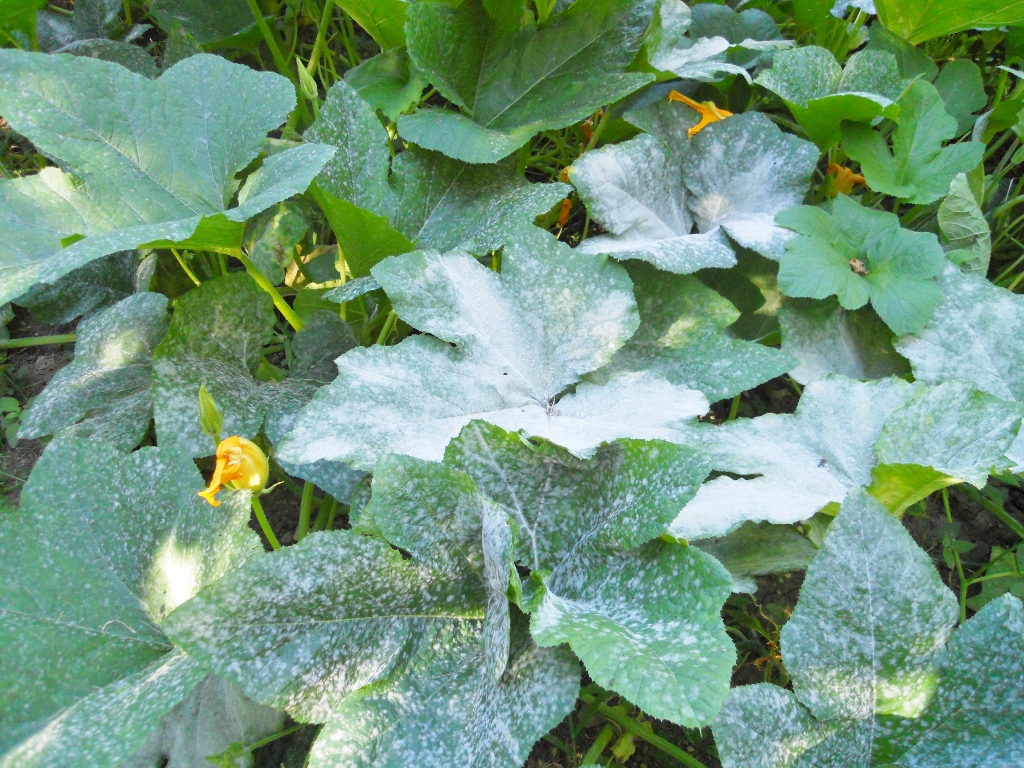
Powdery mildew on pumpkin
Moderate temperatures and high humidity help develop the disease. The pathogen also favors hot days, cool nights, high humid (85%) conditions and the change of season. Each mildew pathogens is specific to its host, the mildew that attacks gerbera daisy will not spread to cucumbers.
Powdery mildew on zinnia
Fungicide treatments and preventative controls
Depending on the severity, spraying it with a baking soda formula is effective as a preventative when applied regularily. For active infections spray daily for a week.
1. Mix 1 TBsp each of baking soda and horticultural oil (dormant oil/vegetable oil) or a few drops of liquid soap to 1 gallon of water. Spray weekly making a new mix each time. It will not elliminate the disease but help control it.
2. Mix 1 tsp baking soda with a few drops of vegetable oil in 1 quart of water. Spray or paint on the leaves. Works on houseplants, cucurbits & roses (balck spot).
3.Another suggestion is a solution of 1/3 milk and 2/3 water and spray on plants. Use every other day.
4.I also heard of mixing 1 tbsp of pine sol to 1 gal of water as a mildew spray.
Neem Oil is also affectective in controling powdery mildew infections. Use 1 oz (2 Tbsp) of Neem oil and 1/ 1/2 tsp of dishwashing detergent to one gallon of water. Spray once a week for two weeks. A combination of Neem oil and baking soda is the safest control method.
Chemical Fungicide sprays
Use chemical sprays such as Benomyl (systemic fungicide) sulfur/fungicidal soap or Safer’s garden fungicide. Spray early in the growing season as a preventative or as soon as symptoms appear.
A synthetic fungicide Baylaton sold as Strike also works on powdery mildew.
Always follow label directions, to make sure the product is approved for specific plants. Early detection works best. Once the disease takes hold, it is difficult to control.
Cultural preventatives
– remove the infected leaves
-do not crowd the plants
-provide good air circulation
– keep plants well watered and stress free
-grow resistant plants when available
-avoid fertilizing with too much nitrogen – succulent new growth can be succeptible .
From the reader archive
Useful reader questions
transplanting mini rose Hi, I have another question. I’m planing on transplanting my mini roses into bigger pots, and I thought I saw something on previous post about getting a pot that’s only 1″ bigger or something like that? Why does it…
Read Danielle discussionCrepe myrtle I just bought a “dynamite” crape myrtle tree. It’s leaves are all black. When I asked the person at the nursery about the black leaves, she said it had previously had powdery mildew, but it had been treated and it…
Read Emily discussiondecomposing mulch Hello~ I am writing to inquire about a white substance on the mulch at the base of my vegetables plants in my garden. It seems like this is a fungi, but one that occurs naturally with the decomposing of the…
Read Jill Curry discussionPowdery mildew Hi I’m new to gardening. I live in an apartment and have just put some mini roses on the patio. My husband gave me some mini confetti roses for our first anniversary and I thought they where doing well. I…
Read Danielle discussion
my son started plant in school 2nd week in aug. we live in florida. but now his leaves are little brown on some and white spots. what is causeing that.we havent really been cold it is a good size plant but no pumkins yet. it has like 10 buds on it but they die what should we do?
Hello, I’m new to this forum, and have been searching for information on what I am experiencing with my jasmine plant. It is indoors, with lots of light, in a cold climate. It has developped a mold on all it’s leaves. It is white and powdery. Any suggestions? Also, when we water it, the water runs straight through, we were told not to soak it, but I feel like it’s not even getting a moderate watering. Thanks
we seem to have white powdery mildew on our soil. it started in 1 or 2 plants in winter and has spread to our entire household collection. i can only find information about powdery mildew on leaves, not one of our leaves are effected, is this the same thing? will the same treatment be sufficient? will repotting in new soil and cleaning out pots also help? i appreciate your info.
While away, mildew has taken over my peonies and a lilac tree. It is too late to prevent. Is there a treatment? Will the mildew effect the health of the plants for the next growing season? Can they survive this?!?
My squash plants have white powdery mildew, which has begun to spread to my zucchini and cucumbers. I went to Lowe’s to purchase a treatment for the mildew. I was advised by two garden center employees to use Disease Control, which is manufactured by Bayer Advanced. The active ingredient is Tebuconazole (2.9%). We sprayed the plants last night and checked on them this morning. The white powdery mildew did not seem to be affected by the fungicide. So, I called Bayer’s 1-800 question line. The woman informed me that this product is not to be applied to plants used for food. She could not give me any further information. The Poison Control Hotline and the National Pesticide Information Center could not offer any additional information either. If you have any information concerning this fungicide, please share. I am heartbroken at the thought of having to destroy my garden that I have worked so hard on.
Crepe myrtle
I just bought a “dynamite” crape myrtle tree. It’s leaves are all black. When I asked the person at the nursery about the black leaves, she said it had previously had powdery mildew, but it had been treated and it “should” be okay. The price had been reduced and she said the black would rub off and that by next spring(again), it “should” be okay. Is this true? And also will it spread to my other plant shrubs and trees?
In south Florida I have a large hibiscus tree that is covered with the white fungus and is in bad shape. I have been used an oil fungicide, but no luck. Any help, thanks, Carl
Do you have an eco-friendly solution, you know, no chemicals, to Powdery mildew? i have creek full of frogs in my back yard, and chemicals clog their pores and kill them.
Use a solution of 1/3 milk and 2/3 water and spray on plants. Use every other day
Hi,
I have 3 hibiscus that I thought were experiencing some sort of mildew/mold due to the heat here in Houston TX. After further research, it appears it may be mealy bugs as the blooms never open but instead shrivel up, all new growth is very dark green and bunched up almost like small heads of lettuce and there is a white coating on the branches along with a black ashy substance. Is there any hope for these plants- it has been about 5 months of trying different solutions and I am about to rip them out so the rest of my bushes and shrubs are not affected… We are now trying to sell the house and I want to make it appear as attractive in the front as it is inside and this is not helping!!! Thanks!
Pumpkins/squash
I have the worst case of powdery mildew through out my gardens. I am planning to mow the perennial beds to about 3.5 inches and burn the clippings. Then I will spray with a milk solution. My pumpkins and squash leaves are white with it. Are the pumpkins and squash safe to harvest and eat? I have not put any chemicals on the plants, yet.
Rhododendrum powdery mildew
My Rhody’s have many yellow leaves and 2 have white powdery stuff on them. What can I do? Thanks
Zinnia
Zinnia’s are one of our favorite cut flower, but it is a battle with powdery mildew. What can i do to help prevent this, I water in the mornings, and try not to hit the leaves. Thanks
In the last 3-4 weeks, I suppose, two large pine trees have been infected by (I think) powdery mildew. There are some thick limbs entirely covered and spots are appearing on other limbs. I scraped some off, they are sticky and powdery.furry. It seems early for this- could it be something else? How should I treat the trees?
Powdery mildew
Hi
I’m new to gardening. I live in an apartment and have just put some mini roses on the patio. My husband gave me some mini confetti roses for our first anniversary and I thought they where doing well.
I trimmed the old blooms off when they started to wilt and the bush grew, kind of out in a bowl shape. The out side newer growth is taller than the bush was when I got it. Anyway it has put new blooms out and they’ve opened so I thought they where doing well and I just bought 3 more plants because I like them so much.
But I noticed that there’s a white powdery dust on some of the leaves and when I rub it off the leaves are brown spotted under the white powder. My mother-in-law said I should wash the leaves with a little bit of dish soap and then rinse them really well so that there isn’t any soap in the soil.
Is this Powdery mildew? Will my plant be ok?
transplanting mini rose
Hi,
I have another question. I’m planing on transplanting my mini roses into bigger pots, and I thought I saw something on previous post about getting a pot that’s only 1″ bigger or something like that? Why does it matter? I don’t want to keep buy new pots? Also, I saw something on transplant shock? How do I transplant them correctly?
I’m in an apartment so I can’t have them out of a pot.
Thank you so much. I am so glad that I can ask some one these questions.
Lantana
My lantana plants seemed to have dried up ,leaving only brown stems. There is a white coating on some of the stems. Have I lost these plants totally or will they come back?. They are in the yard and have done well for several years.
Laurel bush
i have a white fuzzy coating all over the branches of my otto luyken laurel bush.i noticed it after i trimmed it back in the summer. the leaves are also yellowing and falling off in large amounts.have had the bushes for approx 5 yrs now without any trouble until recently.i fear it will spread to the other bushes.any suggestions?
Can I wash powdery mildew off of my infected chard leaves after I harvest them, and still eat them? And, can I eat previously infected leaves after I’ve (hopefully!) cleared the problem up with Neem oil or organic home remedy? Thanks!
hi,
i have a white powdery substance under the soil where my tomato plants were. we have pulled them all out and i was turning the soil to get ready to plant potatoes. can i just treat the soil directly with baking soda to kill the fungus, and how much should i use?
thanks, kristina
I have a Gerbera Daisy in a whiskey barrel that is covered in powdery mildew. would I be better off gettign rid of the plant or do i have a chance at saving it?
i have a raised garden and the powdery mildew is in the soil about two feet deep…… how can i restore my soil, it is a severe case . i live in arizona. the garden is 5 ft wide and 20 ft long. i don’t know how to treat this. it started in the winter months and i did’nt realize
how bad it was till i harvested and turned the soil over.. please help the raised garden has good drainage and grew tone of mushrooms, never had that happen before.
You don’t have powdery mildew-that is an air-borne fungal disease. When you made the raised bed what did you fill it with?
Sun scorch
I recently purchased 2 blueberry bushes. Within a couple of days, the bushes have developed white patches on the leaves. I have not yet planted them. What should I do?
Powdery mildew on squash plants
I have powdery mildew on my squash plants. I have been treating it with a spray of baking soda, milk and dish soap. It does HELP to control it.
However, as stated in other posts, you need to reapply every one to weeks. My question is: Does this mildew live in the soil. WIll it affect
next years crop? Is there something I can add to the soil in the fall to prevent this next year?
By the way, I live in Massachusetts, and we have had an exceptionally damp humid summer.
Thanks
Suzy
Fungal disease
Another question: My tomatoe plants are growing nicely, BUT some leaves are wilting and have “rusty” edges and black spots on them.
I’ve been pinching off the affected leaves. What is this? Can I treat it with something? I do have tomatoes that are growing but none
have begun to ripen yet.
thanks again
suzy
Last fall I bought several bags of mulch which I did not use and left outside. When I opened the bags last week, the mulch was wet, there was a lot of white matter which looked liked mold, and it stunk. I spread the contents on a tarp and left ouside in the sun and wind for 2 days. Most of the mold was gone, still a little damp, and did not smell as before. I spread it under a hydrangea bush, but am now having second thoughs. Was it safe to use? Anything I should do? What if encouter the same in the unopened bags? Thanks for help anyone has.
My collard greens have developed powdery mildew. Are rhey safe to eat?
Magnolia scale?
I have a Japanese Magnolia tree that blooms beautiful lilac flowers. The last two years it hasn’t bloomed very much if at all. I cut it back, I mulched the soil around it. Today I noticed spots all over the trunk and branches. The leaves are turning yellow to black as if burned. It keeps producing leaves but by the time most mature they are yellow/black and falling off. When I rubbed the branches it was almost like a white chalk coming off.
I am from ethiopia, i am growing tomato and onion. But i have faced a few challenge while i am doing it. You know, unknowingly i have sprayed baylaton on in-matured tomato plant.Does it has any negative effect on flowering of tomato.
email: ashenabey2000@yahoo.com
I think I may have powdery mildew along a 50′ English laurel hedge. Is it okay to begin spraying at this time of year (mid fall in Southern Oregon)? I think it may also be affecting a much older privet hedge along a different location in my yard. Okay to spray that, too?
My rhododendrun and azaleas have what I think is powdery mildew. A couple of years ago is when it started, but I didn’t realize that was the problem. I gave them a really good pruning, they came back beautifully, only to get the powdery leaves again. I don’t want to rip them out because they are very old. I do think I may need to do something with the soil? Maybe add compost? I just looked at them today and they look terrible. Very woody and sparse leaves, powdery, they haven’t bloomed in a while either. They are on the north east side of my house. HELP! (thank you:))
I also prefer not to use any chemicals. Or if there are safe ones you can recommend?
I have noticed a white powdery looking substance around the roots of my purpletop turnips and my salad greens(midew?). It is only in the soil and no on the leaves of the plants. It does not seem to affect the plants at all but I am worried it will affect them eventually. Any Ideas what this may be?
Hi Thomas
I’m not sure what it is. Can you send me a picture? send to Kris@Hortchat.com
Powdery mildew on Gerbera daisy
I have a Gerbera Daisy plant that got, what looked like, powdery mildew. I cut back the whole plant and it grew back beautifully- BUT, I just noticed that the new leaves have powdery mildew again! The plant is indoors and I switched from watering normally to using a watering globe because I read somewhere that it could’ve been from getting water on the leaves. So, the leaves haven’t had any water on them, and I had completely cut down the plant so all leaves are new… I’ve got a few geranium plants next to the daisy plant, and neither of those have ever had mildew. Any ideas as to why my gerbera daisy is getting powdery mildew?
I should note that the plant is on the sill of a large window that gets full sunlight most of the day! Any advice would be much appreciated! …I don’t want to chop the plant down and wait for it to grow back only to have this happen again 🙁
Sooty mold on jasmine
I have a jasmine that produces white flowers in summer, but the leaves are getting a black soot like dust all over them could you advise
Hi PJ
The black soot like dust is called sooty mold (Fumago vagans) which grows on the honeydew that is secreted by insects such as aphids, mealy bugs or scale. My guess it that your jasmine has scale.
I have powdery mildew on my squash plants. I am going out to trim some leaves off and spray with the baking powder solution. Can I put the leaves in the compost or will it contaminate it and corrupt any garden beds we use the compost on in the future?
decomposing mulch
Hello~ I am writing to inquire about a white substance on the mulch at the base of my vegetables plants in my garden. It seems like this is a fungi, but one that occurs naturally with the decomposing of the mulch (?). Is it harmful to the plants? I did spray my garden with a copper fungicide prior to planting anything this spring. That has perhaps helped with my yields, which have increased over last year, when I barely had any tomatoes. Also, my cucumber plant is flowering but producing tiny shriveled cucumbers. What is the problem? Thank you for your help!
Whitefly and sooty mold
I’ve read the article about powdery mildew and the trailing posts. I’ve sprayed my squash, zuchini, sunflowers, and cucumbers with my favorite “all-purpose” home remedy insecticidal soap. (mixture of water, baking soda, milk, olive oil, dish soap, minced garlic, red pepper flakes, peppermint, and tea tree oil) Now I’m wondering if I’ve identified the correct problem. I have found brownish “dust” on the tops and bottoms of my squash leaves and stems. It is choking the life out of the new growth on the squash and on the developing pickling cucumbers. When I move the foliage, fluffy tiny flying bugs fly around. Could this be whiteflies?
This is my first garden season living in Central California (near Modesto) and I’m unfamiliar with local weather and bugs. Any suggestions or resources would be appreciated. Thanks!
I am betting those are cabbage gnats (thats what my gma calls them). My first year I had cabbage, cauliflower and broccoli… these little suckers made me decide to NEVER do those particular vegis again. They looked kind of like large granules of dust down in the tender nooks and crannys, but within just a few days they looked like someone had dumped kitty litter in the new growth.
Then I touched em. EEEK. That was when I realized they were bugs. I tried the soapy water spray, the milk and water mix, vinegar and water.. etc. I guess I had let the infestation go too long because nothing worked. Ultimately I pulled the plants.
The second year I had squash beetles. Those looked like dust and had tiny white flying things, at first they looked like they were floating around the leaf after shaking it, but upon further inspection they were flying.
This year I have Powdery Mildew. I tried SFG (square foot gardening) and vertical gardening this time. I mostly garden for the joy, because Lord knows I sure ain’t saving money at it. My observations this year so far is that I really like the look of the crowded overgrown boxes. I threw flowers in and around the garden and it really jazzed it up. Especially the petunias!
The overcrowding I think created the supceptibility to the mildew, and I didn’t recognize it fast enough. This weekend I will be doctoring the garden and removing the affected leaves. It’s starting to get cold, so I don’t know that I will manage to get any more fruit from the affected plants. It attacked the honeydew melons, yellow squash, zucchini (all three varieties I had), the cucumbers, and one of my broader leaf watermelon plants.
I hope it helps, I am betting we have similar climates and growing conditions being all part of the western plateau and all.
Be well…
Lisa
I have just read about powdery mildew, it is very helpful, is there a e- newsletter or anyway that you have with more info that i can receive or download? thank you
Compost powdery mildew plants
Can I put squash leaves covered in powdery mildew into a cold compost pile?
Hi
I have been reading up on powdery mildew but am I too late
I have a crowded container of pansies and saw today that the powdery mildew is all over.
I have just stayed with the baking soda recipe bit is this enough?
Should I do this daily and see what happens?
Should I cut the flowers back? If so from where?
Many thanks for your help
am Admasie from Ethiopia, can i use baking soda for the control of tomato and potato late blight disease. and please tell me the dose of baking soda for one hectare of infested field?