Climbing hydrangea
Hydrangea anomala subsp. petiolaris known as Climbing Hydrangea is considered the best of vines. This attractive 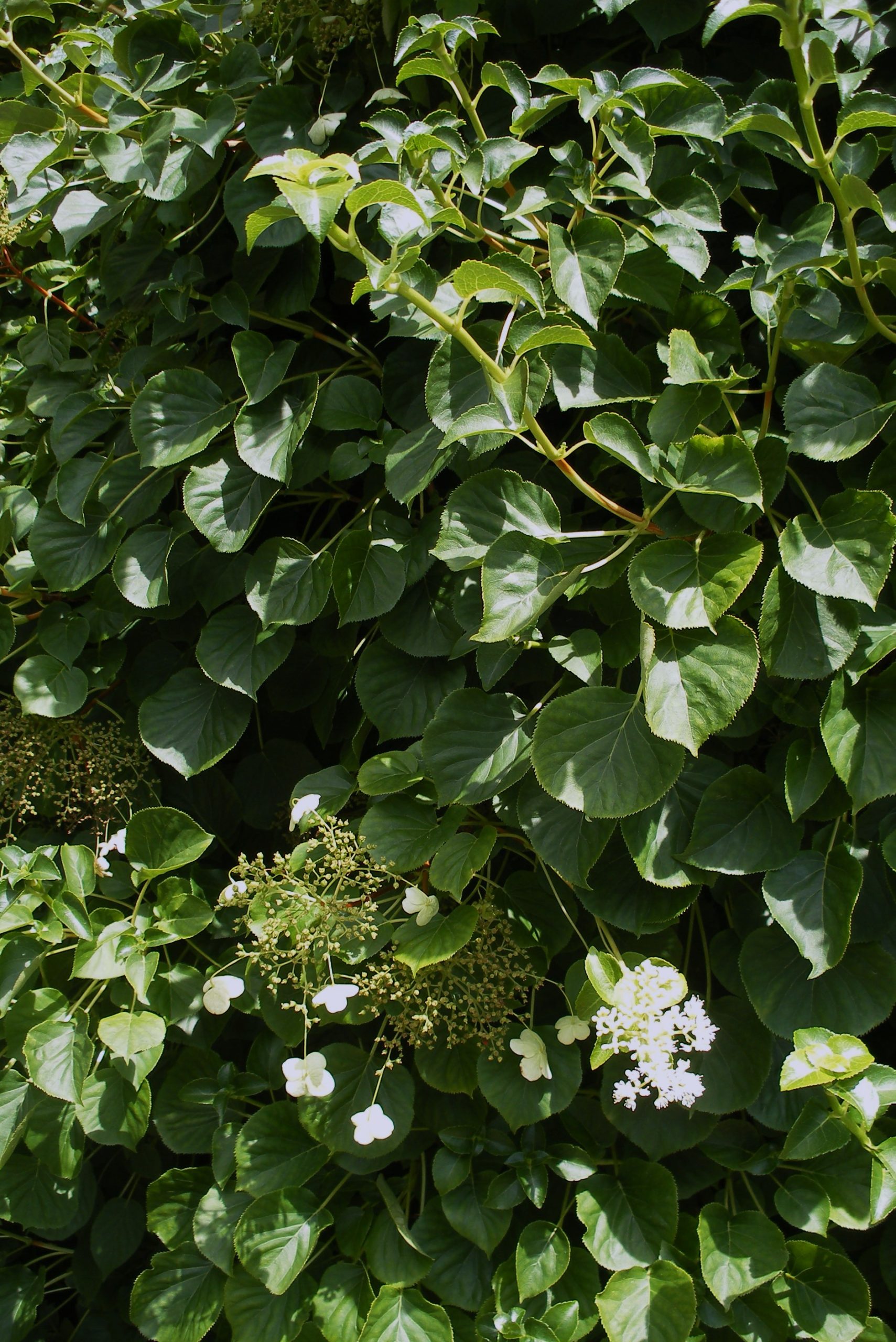 climber grows a cinnamon exfoliating bark with deep glossy green foliage. It produces a waterfall of fragrant clusters of white flowers 6-10 inches wide attached to a 1 inch stalk making it a stunning vine when in bloom.
Plant in rich, moist, well-drained soil in full sun or shade. A North or East side of a building is preferred. In hotter climates provide more shade and moisture. Be sure to provide a sturdy structure for it to climb on.
Climbing hydrangea will be slow to establish the first year; the fibrous roots take time to recover from transplanting. During this time maintain even moisture and because of minimal growth feed it very little. Do not prune in the juvenile stage. Once established, it will take off and eventually grow 50-70 ft high and 30-40 ft wide. This vigorous climber will develop tenacious aerial roots that “cement” themselves to bark, brick, wood, vinyl siding which can be a problem when removing the vine. The residue left by the aerial roots is difficult to remove. Avoid planting against a Maple tree as it will compete for moisture.
Blooming
When the vine reaches adult stage it will grow multi branched stems that produce flattened clusters of white flowers that change to light green with age. The vine blooms on old wood and can take 6-10 years to start blooming. It blooms in May thru July.
The vine can be pruned after flowering.
Propagation: Take cuttings in early spring when shoots are green and soft.
From the reader archive
Useful reader questions
I am in the process of removing a Wisteria that has, unfortunately, damaged my front porch to the point of needing replacement. It has grown onto the roof of my two-story home, and up into the eaves and siding, damaging the boards.…
Read Karla (Edmonds, WA) discussionHello, I have a 10 year old climbing hydrangea facing East getting morning sun. We had a very heavy winter in NYC so I was very happy to see the buds appearing a few weeks ago. The problem is is has been…
Read Diane Raimondo discussionPurchased and planted two climbing hydrangeas (about one to two feet tall and skinny)last summer. Planted on either side of iron arched arbor. I did prune it last year and covered with mulch which I’ve read isn’t what should have been done.…
Read lila discussionTrain the vine We just moved into our home last fall and have inherited new gardens & plants. Two climbing hydrangeas in front of house are not attached to anything, but are spread along the ground in a stiff tangled sprawl about…
Read Beth discussion
Climbing Hydrangea: can climbing hydrangea’s be grown on cyclone fencing, thankyou, rick
Hi:
I planted two climbing hydrangea vines this spring. They are planted on a north facing fence and get some morning sun. They seem to be doing well except that on one of them the leaves are turning red. What could be the cause of this?
Thank you
Ann
my climbing hydrangea was growing up a brick wall. someone or something pulled it away from the wall. are there any types of clips i can use to reposition it until new rootlets take hold?
Propagate climbing hydrangea
I just bought a house that has a beautiful climbing hydrangea along an entire side of the house. I suspect it is 10-20 years old but all of the growth comes from 2 stems. This results in some spotty growth near the top of the wall in a few areas. I am going to try your tip with using picture support clips.
Would there be any harm in trying to take some cuttings and add them to the wall, or do these plants like that kind of crowding? Also, are soft wood cuttings the best for propagation or will the plant make viable seeds?
We bought what was labeled a spreading hydrangea. It is low and spreading very slowly along a fence. We planted it 3 years ago. How do care for it? Should we dead head it and if so when? Should we prune branches or old leaves and if so when?
Pruning climbing hydrangea
The tag on my plant says hydrangia petiolaris. It’s been in 2 years, the vines are healthly looking, bright green, but nothing that looks like a flower or bloom. I’m in partial shade, but vines look great as well as leaves. Where are my flowers? I did not trim it back last year…Thanks..can you help me? I’m in upstate new york, sidney to be exact.
I read all the articles on the Climbing hydrangeas and nothing helped me. My problem with mine is that I have had it for 6 years now and has only grown to about 3 feet and has never bloomed. I have it planted on the north side of the house and next to a fence for support. it has plentry of shade. Help!
Pruning Climbing Hydrangea
We just bought a home that has climbing hydrangea along the back fence. It looks like it has been neglected for years. When we moved in April it had all the dead leaves and flowers from last year on it. We weren’t sure what it was so we left it alone. It has now grown over the top of the 7′ fence and out about 3-4′ into the yard. Will it hurt if we prune it way back? How far back can we prune it? I know there are other plants on either side of it that try to survive but are have a difficult time.
Will climbing hydrangea grow to cover a creosote treated wood and metal retaining wall?
I planted a climbing hydrangea approximately 3 years ago next to our pergola on the west side of our home. We noticed some good growth last year until we pulled it back to stain the pergola – we will not do that agajn! However, toward the end of the summer – I noticed that many of the leaves were turning brown and falling off. Could it be diseased? I keep waiting for the growth spurt to begin and hear it is the “cadillac” of vines. Should I wait it out, try some compost, or move the plant to a better location?
April 3, 2009
I planted my climbing hydrangea 5 years ago. It is located on the South side of our house and looks beautiful every year except no flowers. I prune it a little during the summer and cut it back a lot in the Fall. Am I pruning it to much that prevents it from flowering?
I have a bug of some kind that is eating the leaves on my climbing hydrangea and would like to know what it is and what to use to get rid of them. I don’t see any bugs on the leaves or stems. Thanks
HI Christine,
It’s difficult to determine what is eating your climbing hydrangea. In order to treat it you need to determine what kind of insect is causing the problem. I recommend that you examine the vine closely for insects and take a leaf to a local extension office .
Climbing on metal surface
I have a climbing hydrangea that is 3 or 4 years old. Got it at a plant sale. It is very healthy and I have to climb on a metal arbor. It has not grown more than 18 inch high. Does it have to be on a wooden structure in order to climb. I do not want to put it on my house or other buildings.
Please advise.
Thanks,
Dottie
We have a climbing hydrangia that is seven years old – and has never bloomed. We were told to cut it way back at the end of each season. Its on the north side of the house and we were considering digging it up and planting it on the south – where it would get sun. Is that wise??
Will moving the climbing hydrangia “kill” it at this age of 7 years?
I am considering a climbing hydrangea for a difficult shady spot that receives morning sun, but I’m worried about the roots damaging the brick wall of the house. Can you talk a bit about the effect the climbing hydrangea has upon brick walls?
Climb up a tree
I have a climbing hydrangea waiting to be planted. I have lots of new trellis to fill but also have a cherry tree in one corner and am wondering whether it would be a good idea to train the hydrangea up the cherry tree? Any advice would be much appreciated. Thanks
recently purchased climbing hydrangea, although concerned at the plants appearance at time of purchase I bought anyway. Plant seems very “leggy” with yellowing leaves, and numerous flowers (which I assume is good). What can I do to revive or care for this sad looking plant??
Thank you
I am in the process of removing a Wisteria that has, unfortunately, damaged my front porch to the point of needing replacement. It has grown onto the roof of my two-story home, and up into the eaves and siding, damaging the boards. Two beautiful rose vines, one pink, one red, have grown up through it, creating a beautiful display. I am trying to save the roses as I remove the Wisteria.
I purchased a Climbing Hydrangea (Hydrangea Anomala Petiolaris) that I wanted to plant in place of the Wisteria. I understand, from my research and reading the posts here, that the Climbing Hydrangea will attach to the wood siding of my home.
My First Question—will it have the same tendencies as the Wisteria, namely, to develop thick, woody stems that will creep under my siding, lifting and destroying the structure, or will it have a less “invasive” vine that “sticks” just to the outside of the wood.
My Second Question—Would it be wiser to construct a wood trellis a foot away from the house upon which the Climbing Hydrangea could grow? Thank you for your time and help.–K
I planted several climbing hydrangeas on a 6 ft high wooden fence and they have spread quite a bit and I’m now concerned about their weight on the fence. Any easy way of removing them?
Remove root markings
I bought my house two years ago and it had a beautiful climbing hydrangia on one portion of the front of the house. It started growing too tall reaching the roof line so I had to cut off about 3 feet of the plant to keep in under control. The problem is I am now left with the aerial roots on the siding and the brick. Are there any tricks to getting the root marks off of the house?
Will the vines live on treated lumber?
I recently planted 2 Japanese climbing hydrangeas and in preparation for the upcoming snowy winter, I wanted to know how I winterize it to protect it from the extreme cold and snow. Does anyone know?
I am about to plany a climbing hydrangea next to our shed. I attached a trellis to the shed. My question is about the roots of the climbing hydrangea. My question is about their roots. I was only able to dig about a foot and a half before hitting a a lot of big rocks which so far I have been able unable to remove. I am thinking of raising the level by adding about a foot of dirt, which would give them about 2 1/2 feet of dirt. How deep do the roots of the climbing hydrangea need to go? if they encounter some rocks will they adapt and be able to go around them underground?
Thanks
Rust on hydrangea vine
In the early spring, I planted two healthy climbing hydrangia on a metal arbor. They were doing really well until about a month ago. The leaves started to get rusty looking spots on the bottom and are now turning yellow and beginning to fall off. There is still new growth appearing. I am worred that something may be killing my plants. What could be causing this?
Fall leaf drop and pruning
Hello, I have 3 very healthy climbing Hydrangia, and they are now, at least 6 years old. They all bloombed well this summer. Now after a good frost, in the 20F’s the other night, all three look like they are dying back. Do they do this in the winter? And should I cut back, or leave alone? They have already been pruned a little after flowering? I don’t want to loose these plants, so I will wait to hear from you!!! Thank you so much!
Planting climbing hydrangea
Is it too late in the season to plan a climbing hydrangea? I live in northwest Washington State. We haven’t had our first frost yet, but I am sure it will be coming in the next couple of weeks.
Train the vine
We just moved into our home last fall and have inherited new gardens & plants. Two climbing hydrangeas in front of house are not attached to anything, but are spread along the ground in a stiff tangled sprawl about 3 feet wide. The plants (now dormant) look healthy, about 18″ high, with long, strong branches covered in buds.
The house has metal siding, perhaps too slick for the hydrangea vines to attach. Reading your comments above, it sounds like I should install a wooden trellis along the wall so the vines can attach.
How should I train the stiff & tangled woody vines up the trellis since they do not “wind”?
Can I have both a climbing hydrangea and climbing jasmine in the same trellis in our patio? Will the hydrangea eventually take over and kill the jasmine or vice versa?
Pruning old hydrangea
Hi
We moved to a home that has some very well established climbing hydrangeas growing up one wall. I love them however they have gotten quite busy and don’t seem to be attached very well to the brick any longer.
I don’t know how old they are but the base of them are the size of my arm. Any ideas on how I get them to keep growing up rather than bushing up?
And would pruning them to be less bushy work without harming them?
Thanks
Barb
blooms come out but the individual flowerets on each bloom do not open.they look more like queen annes lace
they are at least 25 years old on a trellace fence surrounding a lower garden on all 4 sides with a pergola entrance
should they be composted and/or fertilized
Purchased and planted two climbing hydrangeas (about one to two feet tall and skinny)last summer. Planted on either side of iron arched arbor. I did prune it last year and covered with mulch which I’ve read isn’t what should have been done. However we had an unusual cold winter in mid-east Alabama and maybe glad I did. One side is coming back strong other isn’t. (Arch gets some morning sun, but mostly in shade (lake is three feet away.) Soil isn’t the best, so what can I add to make this vine grow more rapidly and produce blooms? Should I water often? I’m anxious for blooms and will not prune for winter as advised? Next summer will be their third year. Will they grow well on this iron arbor? And please answer other questions. Thanks, Lila
Oh Shoot, I Just spent $70 buckeroos on a climbing hydrangea that’s about 42″ tall for a sturdy vinyl arbor. Will it not grow on a vinyl arbor???
If not, (and they won’t let me return it) what may I do to help it adhere to the vinyl?
Wish I cam across this posting sooner. It’s filled with great information and I’m afraid after reading it, I already know the unfortunate answer, but hey, if you have any tricks, I’m all ears!
Thanks!
I have a climbing hydrangea which is about 15 years old (facing north) and three vines about 7 years old which face south-east. This year the older vine has only partially leafed out. There are large areas of the vine which show leaf buds where you can see green tips, but they appear to be dead. The three younger vines are in bloom. Any ideas what would have caused this? Our winter had very little snow and spring has had wild temperature fluctuations.
Pale leaves
My climbing hydrangea is healthy, 3 yrs old and blooming. I heavily compost it each spring. My concern is that the leaves are a nice shiny but PALE green. Does it need anything else?
thank you
Sun exposure
I planted at climbing hydrangea 3 years ago, and it is growing slowly but well. The only problem is that it is facing west and the leaves are turning brown, apparently from sun damage. Should I (and can I?) move it?
Growing from seed
Thank you so very much for all of this WONDERFUL information! I live in Puyallup Washington. My questions is, I read somewhere on here that the “Climbing Hydrangea” produced a seed. Where is this seed at, and exactly how do you care for it and when can you re-plant it? I would LOVE to utilize them. I have the most AMAZING Climbing Hydrangea’s that my family and neighors just love! I would love to give them seeds to grow for their own if this is possible!
Thanks again so very much for all your help! This is such a great site!
I also forgot to ask. I am having my house painted next weeks and have to trim mine back. Where would be the VERY BEST place to trim?
I REALLY HATE having to do this!
Trim from the top of the vine and lateral stems to make it manageable. You may be surprised to see how well the vine sticks to your house and the residue may be difficult to remove. Pruning before bloom will of course remove the flowers.
Browning flowers
I have climbing hydrangeas on a fence in my backyard. They now cover both sides and are very full/healthy looking. They are about 5-6 years old. They have started to flower but they only seem to go half way. They form what looks like the beginning of the flower, lots of tiny buds, but they seem to then just turn brown. Only a few seem to open, and I mean literally a handful out of all of them. They are in full sun, I love in the Northeast. I haven’t pruned them at all in 5 years. Should I be giving them any type of fertilizer or pruning? If all those flowers turned white it would be so beautiful!
I have a climbing hydrangea that is in it’s 3rd season. Planted it in the Spring on a north-facing wall of my two-story stucco house, which is basically in total shade. The plant has done well and has attached and grown up the side of the stucco to about 14 feet already (all from one pot!). However, the leaves now around the bottom third are falling off. The leaves at the top 2/3 are fine and healthy. I have noticed some (but not a lot) of small brown spots and brown edges on some of the leaves that are still on the vine. Wondering if I have a fungus, too much water, too little water, etc…Have never fertilized.
Hi, I have a climbing Hydrangea and I think it’s 3-4 years old. As expected, its been a slow grower but this year (now mid-June), I haven’t got even any green leaves on it. The bark looks like it’s partially exfoliating, so I’m thinking it’s not dead? We’ve had some warm spells although it was a very cold winter.
It’s in a pot but doesn’t seem to have outgrown it.
Is it dead? Does it just need fertilizing?
Thanks
All over my climbing hydrangea leaves are turning yellow and falling off. Also, a number of leaves have raised white powdery spots. I don’t want to lose the vine…it’s going on it’s fourth year and I’m still waiting for it to flower for the first time! Thanks for you help.
Hi kevin
What kind of soil is it in? Is there soil wet? Where is it planted?- North exposure.
Our newly planted (last fall) climbing hydrangeas are doing well. Even bloomed a bit already. We are using them to climb a two wooden screens built as privacy structures.
I’ve noticed that they are not only growing up the screens but sending out runners along the ground. Should we/can we trim the ground runners to keep the growth up?
I have a climbing hydrangea that is beautifully established on a fence. the neighbours are about to change the fence. Is there anything i can do to save the hydrangea?
climbing hyrangea from seed
Hi! I ordered some climbing hydrangea seeds, which arrived too late to be considered for planting in the spring. Should I plant them next spring or can I plant them in the fall? Since the plant takes so long to establish, I would like to get them in the ground as soon as possible, but fall planting doesn’t suit every plant, and this is the first time I’ve tried to grow hydrangea from seed.
Thanks for any tips you can give me on growing these plants from seed! I have an ugly deck area in the north corner of the house, which I’m hoping will be hidden and somewhat buffered by the climbing hydrangea in a few years.
Canadian gardening zone 5a, just north of Toronto. Last frost is mid to late May, first killing frost would be October, I think.
I have two established climbing hydrangeas which are growing on a trellis on the north side of my house. They are about 10 years old and until now had been thriving nicely. One of the two continues to do so, but the second one appears to have smaller shriveled leaves, some of which are dropping in early July. I see no apparent pests and the problem seems to cover the entire plant. Can you help me diagnose what the problem(s) might be and what steps I might take to alleviate the problem(s)?
Hi Robert
It sounds like a cultural problem that is affecting the roots. Are both plants next to each other? Is the soil wetter in one area than the other?
Both plants are rooted about 10-12 feet apart on either side of a north facing patio. The wetness might be higher on the sick plant’s side due to proximity to a stone wall. However, its been fairly dry for the past few weeks. Both plants had bloomed this season and I have only noticed the problem a week ago or so. Can you explain what you mean by “cultural problem”?
The only chemical introduced in the vicinity of the plant recently was some house painting about six to eight feet away from the plants. Both plants were near the painted wall. Otherwise, I can’t think of any chemical that might have been introduced. If this is the problem, what can I do to alleviate it?
Vine weevil
I have a climbing hydrangea on the north side of my house -planted two years ago. Problem is every year the leaves are eaten. Not complete defoliation but little bits eaten around the edges. Despite this the plant looks pretty good and puts on growth every year. I think the problem is weevils; I’ve seen them on the plant at night. This spring I applied beneficial nematodes which I hoped would kill off the weevils. Unfortunately the leaves are still being eaten. Help. Any suggestions? Anyone else dealing with eaten leaves on their hydrangeas?
Climbing hydrangea on vinyl siding
Hi! Would climbing hydrangea do well on vinyl siding? Would love to put a couple of plants on the bare side of the house, but not sure if I’d be setting it up for failure?
If this is not a good choice, is there a climber that you could recommend that would be able to climb vinyl siding without putting any supports up?
Thank you!
Will the climbing hydrangea damage my wood house. Someone told me it would damage the wood and create future problems like water damage. I planned on planting it on the north side of the house where there is a lot of room for it to grow. Thank you
i bought a climbing hydrangea last feb, it hasn’t grown height/width wise, but has a zillion shooters at the bottom. someone told me to cut off all the shooters as that may be the reason the energy is not going up? what would you do?
Propagate from cuttings
We just moved a massive petiolaris to a new location as we’re having a house addition, and I think we took good care and it will heel in okay. I’ve given it plenty of water and we tied the vines gently and they’re supported against an arbour we have in the island bed. I had some leftover prunings from it, and wonder if they will root in water?
Thank you very much.
Christy
Hello, I have a 10 year old climbing hydrangea facing East getting morning sun. We had a very heavy winter in NYC so I was very happy to see the buds appearing a few weeks ago. The problem is is has been a cold & very rainy spring and now only 1/3 of the plant has leafed out. The other 2/3 has sparse random green extremely wilted leaves, some of them dark green. The flower buds are there on the tips looking ok but the leaves are just hanging their heads down. I love this plant with its twisted peeling furry trunk and wonder what is happening? I pinched off the wilted, leaves and some new leaves are beginning to grow but it is not the plant is used to be in previous years. I have Jackmani clematis next to it which is doing fine as well as regular blue hydrangeas, fine too. They have all been together for all of these years. What can I do to assist in its leaf recovery? Will the leaves come back? Am I being impatient now that it is only April 30? Thanks for any advice.
I bought a climbing hydrangea at the end of last summer during a horrific heat spell. Tried to keep it watered, however the heat was so extreme that it threw many of my plants into an early dormancy. We then had an extreme winter and though the lower part of the plant is leafing the upper part is not. should I wait til fall to prune it back? I will fertilize and water it today. It is planted in dappled shade but gets some east sun in the a.m. The root shoots died off so I pruned them…Could it survive. The leafing part is about 3 feet tall…
I have a 5 year old climbing hydrangea that is blooming and doing great.
It’s planted along side a raised deck and this year reached the 6′ high top
hand rail. It going to need something higher to grow on next year. Can I
construct a flat arbor type cover over the deck (10’X20′) and let the vine
cover the deck? I would like to use it to shade the deck if possable. I realized
that it’s going to require some heavy construction.
About 10 years ago we purchased a climbing hydrangea and planted it at the base of a large ash tree in full light shade. (It was sold as a plant that would grow in full shade.) After 8 years it was just hanging on. Had some leaves and smallish shoots but no real growth.
Fearing it was in too much competition with the tree, I dug it up and put it in a pot. For two winters I babied it by bringing the pot into the garage that gets cold but not below freezing. This spring the plant is bursting with leaves and new shoots. Time I think to replant. But where? I don’t want it against the house siding and we live in a woods. I can pick a tree that gets more sun. Choices are oak or maple. (We are losing our ash trees in SW Ontario so don’t want to plant there. If by the oak it would get sun from 10am until 2pm and shade thereafter. By the maple it would get a little less sun – 10am to noon perhaps. Another choice would be a flower bed that gets limited morning sun but nothing to climb on.
What would you do? Thanks.
will climbing hydranga climb up a painted 6×6 post on an arbor? Will the painted surface harm the plant? Thanks
Can I plant the climbing hydrangea under a pine tree?
I have a climbing hydrangea that I planted 3 years ago. I was excited at the beginning of this spring because it really started taking off and having been told it does so after 2 or 3 years, I was really looking forward to seeing it possibly bloom for the first time this year. However, after 3 or 4 weeks of vigorous growth, all of the leaves turned brown. It is growing on a north-facing wall in front of our house. It receives mostly shade with only spotty direct sun mid-day to early afternoon, then it is in shade the rest of the day. It seems to have plenty of moisture. Given that it has grown so well for 2 years, what could have happened all of a sudden? I don’t see any sign of insects. It couldn’t be scorched by the sun. The only thing that I did differently this year than in the past was that I fed it some hydrangea food. It went downhill soon after. Could this have caused the problem??? I had read somewhere that if you cut a vine and it was still green inside (and mine is), there is still hope to save it. Any suggestions on how to possible save and revive it?
Hi Robert
What about the weather? Have you had any colder temps?
I just bought a climbing hydrangea. I am wanting it to climb up the front of my house where the all brick chimney is. My concern is, will it grow onto the roof and out to the side of the house where the brick is not? I know it will be years until i need to worry about that but i dont want it to spread outside of the brick or onto the roof!
Aggressive grower
Climbing hydrangea definately needs sun. I have one that is on the front of my house on the brick and is doing so incredibly well it has completely taken over and every couple of weeks I have to trim it fairly heavily. It’s attempting to climb up to the high peak of roof line of my one-story house. As beautiful as it is I wish it wasn’t on the house, it leaves root marks everywhere it lands, not great for the brick and is a pretty aggressive grower (I don’t feed it or do anything to it other than trim it up often) It will grow in every crevis it has the opportunity so you have to keep a close eye on it to ensure it doesn’t get behind gutter downspouts and similar. Th stalks can also get pretty wide in diamater and it even grew so tight behind the electric meter box I had to saw that part of the hydrangea off. The birds also love making nests in it.
Trimming aggressive grower
Ashley, see my post i just put up. If I had my choice, I wouldn’t want the hydrangea on the brick, it’s really not good for it because it really digs in and grabs with the roots and it’s really a commitment because it’s hard to get the roots off if you change your mind and pull the plant off. MIne has made it to the roof line then took a b-line across the trim so not sure if it would climb on the roof or not, i don’t give it a chance to even try since i trim it before it gets to that point. You need to ensure you can reach it too since you want it to be in a particular area and if it’s as healthy as mine, you will be trimming it nearly 1-2 / month. It will definately take a b-line to the other side of the wall onto trim as mine has unless again you are always trimming it, it’s a traveler and a grabber!
We bought a mature climbing hydrangea last summer, it had bloomed beautifully at the nursery, but was unfortunately left in the pot in our shed all winter. I thought it would have died, but it survived and is growing green and lovely from the bottom, about a 18 inches high. It’s about 3 ft tall and has buds all over the upper vines, but they appear brown and soggy. I think they are dead. Should I prune off all the branches with the dead buds or will new buds appear on them.
Climbing hydrangea not invasive
My 3-4 year-old climbing hydrangea is finally looking beautiful, covering the ugly stone wall I have to look at. Now the homeowner’s association of my development tells me I have to remove it because it’s invasive. The landscape architect I hired selected this particular vine because it’s not invasive, so which is it? If I have to remove it, could there be an alternative so I could keep it, like removing it from the wall, and then putting a lattice or some sort of support between it and the wall? Help!
Southeast location
We love climbing hydrangea and want to place one at our brick wall (2 -story) at the edge of a new garden. It is south and slightly east facing so I am concerned about the sun . . .will it grown in this space? It is in the sunniest space of our yard, but there are a number of large trees that will provide some later afternoon shade.
Lacecap blooms
I have had my climbing hydranga for years. The flowers only open on the outer edge, can you suggest anything I can do to get full blooms on the plant?
thanks
How much shade can climbing hydrangas tolerate? When the trees leaf in it gets very little sun in the location I had picked out for them.
I’m looking for a vine for a trellis on the side of a garage. Maybe a half-day of sun. Everyone likes climbing hydrangeas. However …
1) It’s a small garage. One trellis is 5′ wide by 7′ tall. There’s a window in the side of the garage. Then another trellis 3×7. Would a climbing hydrangea be too big?
2) In the bed fronting the vines will be a couple Viburnum nudum Winterthur. Would the plants complement each other?
3) It’s mid-August (southern New Hampshire). It is too late to plant?
Thanks.
Dieback
I have a climbing hydrangea about 20 years old climbing a stucco wall. It gets afternoon shade and morning sun. In the last few years large sections have died whereas before it was very vigorous. Nothing has changed. It still flowers and has for years. Are there any pests or diseases that would cause dieback?
Thanks!!
Hi,
I planted a climbing hydrangea this summer along a brick wall… the soil is clay and the hydrangea gets little to no sunlight. I was told this was one of the only climbing vines that would survive in these conditions. However recently the leaves have started turning brown around the edges and then falling off. The middle of the plant is completely bare. HELP how can I save this plant?
I want to get a climbing hydrangia for the west side of my house. I live in Okla in zone 7. It will get morning sun only. My question is: I live in a mobile home with vinyl siding and a brick bottom. I don’t intend to move the plant so i’m not concerned with staining i am wondering about it moving under the siding and pulling it away from the house and causing structural damage. Can anyone help me.
Climbing hydrangea is VERY invasive. It’s literally growing in my basement through the concrete.
Do you know if a Moonlight Climbing Hydrangea can be trained to grow on a chain link fence? Do you know what the big difference between the two are?
Our 50 year old climbing hydrangea blew over in strong winds. The root, approximately 4.5 inches in diameter, was somewhat fractured. We repositioned the plant but notice the leaves limp, although green. When we water it, it looks a little better, but I’m concerned. Any suggestions…it’s been about a week.
Hi,
I have a new house with southern exposure with a board and batten type vinyl siding. The siding is warping a bit so am looking to cover this. I was thinking of growing some boston ivy up the house but love the look of the climbing hydrangea. I have been looking at a firefly climbing hydrangea (hydrangea a. petiolaris). On the Vesey’s site it says full sun to part shade. Do you think the hydrangea would tolerate southern exposure on vinyl or should i go with the ivy?
Thanks
Thank you! It’s not brown yet….the leaves really perk up with the rain; so we’ll keep our fingers crossed. Glad to hear it can repair itself.
I think Susan may be referring to the “lacecap” habit of the flower itself. If you look up lacecap hydrangeas and compare to regular, you’ll see that it’s built that way.
Thanks Gina!
We planted a climbing hydrangea last year. It has grown vigorously last year and this but it is not clinging to the breeze-block wall which we hope it will cover. It is planted in a hole in very rocky soil which I filled with a rich compost to get it going and it gets a huge amount of moisture because below there is what amounts to an underground stream. Would any of these factors be affecting its ability to cling – it produces the advantitious roots but they don’t hold to the wall – at all.
Thanks for any advice,
Bob Fowke, Egland
Propagate hydrangea by layering
I have a climbing hydrangea in my back garden which is doing really well. Last year I noticed that the branches/shoots which laid on the soil started putting air roots down into the soil and appeared to act as ground roots so I covered them with soil and gently staked them to the ground to see if they would layer. They have and I have now removed them from the mother plant and put them into pots. My question is how do I care for them now. I know with some plants, to encourage a strong root structure you should allow the pots to dry out before giving more water. I cannot find any reference to this plant and I would hate to lose them after they have done so well. Please any advice would be appreciated. Thank you
I planted climbing hydrangea last year. CI live in Philadelphia, PA and they get a western exposure. I live on the east side of the street. They a re climbing on the north side of a 5 foot wall and thriving. They have reached the top. The issue is that they are blooming on the ground and not on the wall. What’s the issue?
I planted four climbing hydrangea along the north wall of my two story, metal sided pole barn. Will they climb up or will I need a trellace? I also planted one at my mail box. After reading this I’m wondering if I should relocate it.
Hi, I bought a climbing hydrangea about a month ago. It is roughly 5/6 feet and had bright green buds all over it at time if purchase. I planted it in a pot in the northwest corner up against my house.it receives very little morning sun. My problem is that only the bottom 1/3 of the plant looks alive. The bottom has dark green leaves everywhere, but the middle and the top are dying or drying out. I keep the soil moist so I’m not sure what caused this. Should I trim each vine back now(middle of May in central california) ? If I trim it back it will only be about 2 feet…
I have a climbing hydrangea I’ve been growing in a very large 100L planter for several years. It has flowered the last 2-3 years though it hasn’t grown much in size. Also once the initial flowers come out I get the sterile flower ring and a whole lot of the inner wispy fertile flower buds which are very light and airy. However after a week or so, these all appear to dry out and fall off like rain and leaves the flowers with just the outer sterile ring and without much structure, so they droop a bit and don’t look very impressive. What am I doing wrong to a) not have the vine grow much in size and b) for the flowers to drop all their inner buds and not remain full and lush for longer than a week or two?
architect/association probably mean it’s destructive – rather than invasive! strong and heavy and tenacious they worry it could damage the ugly stone wall 🙂
I have the same issue and trying to figure out how to preserve the beautiful 30 year old hydrangea while replacing my fence. Can this be done? I don’t see a response to this issue
The lower branches of my climbing hydrangea have been totally eaten by a local groundhog who uses the heavy vines to climb up further and further and eat more and morewill the leaves grow back or do I have to look at it until next year?
I don’t want to trap the groundhog and have used numerous local remedies like deer repellant and animal repellant went as well as Tabasco on the leaves but he seems to be winning the war!
Can I transplant my climbing hydrangea which is several years old, 5 – 6 feet high, very healthy but never blooms. Almost no sun where it is on a north wall. Probably needs 2 – 4 hours sun a day??.
Will it survive the transplant?
I have/had a beautiful climbing hydrangea, about 4 years old, that was flourishing on a clapboard garage wall, and I was guiding it to arch up over the rounded side door or the garage. No blooms yet, but I was patient. Then, about 2 weeks ago the entire vine went limp. No bugs, no rodents, no leaf damage. Just a totally limp vine, as if someone had cut it at the base. (But no one has.) My only thought is too much water? It’s been quite a damp spring/early summer. But even before all the rain, about half of the new climbing tendrils failed to fully leaf out. Could it just be an internal something, a virus or fungus or something? Is there any hope for it? I’m so sad to see it dying after several years of vigorous growth.