Instead of a Christmas tree some may opt for a Norfolk pine (Araucaria heterophylla)which is usually available in stores before Christmas. It may be sold plain or decorated to serve as an alternate mini Christmas tree for those with little space. Once the holiday is over, the Norfolk pine can double as a patio or long-lasting houseplant.
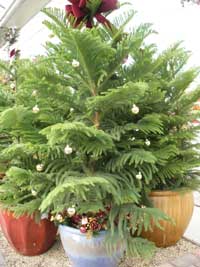
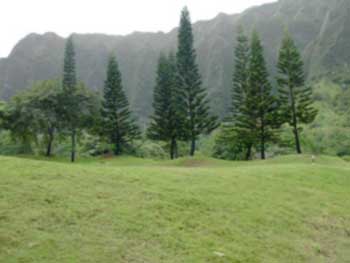
Norfolk pine, belongs to the ancient genus of evergreen conifers, Araucaria, which includes the newly discovered extinct Wollemi pine. It is hardy in zone 10-11. In the wild this semi-tropical tree can get up to 200 ft. tall. Norfolk pine grows a massive straight tree trunk with symmetrical lateral branches that are an impressive sight in the landscape. When grown indoors as a potted houseplant the diminutive version usually grows up to 8 ft. tall.
Care
Indoors provide a cool, bright filtered light, humid environment with temperatures of 60-72F during the day and slightly cooler at night. They prefer a few hours of direct sun but can adapt to bright indirect light. Be sure to rotate the plant to maintain a symmetric shape and keep the plant from leaning over to one side. Norfolk pine also need 50% humidity which can be difficult to provide during the dry heating season in winter. Some ways to increase humidity is to run a humidifier or use a pebble tray filled with water.
Water when the top inch of soil feels dry and let the water drain from the bottom. Do not let it stand in water or saturate the soil, over watering will cause bright yellow needles that eventually fall off. Conversely, keeping the plant too dry with low humidity will cause brown tips. Keep it away from heating vents or cold drafts which can dry out the needles.
Feed your plant when it is actively growing (not winter) with a diluted, balanced houseplant fertilizer every 3-4 weeks. Feed new, younger plants every 4-6 months and older plants every 3-4 months.
Repot every 3-4 years.
Prune only brown dead lower branches. Do not cut off the growing tips. If the growing top is damaged, it will not be replaced and you will get a misshapen tree.
Pests: Common pests that attack Norfolk pines are spider mites, scale and mealybugs.
Did you know: In nature, Norfolk pine cones take 18 months to mature, then break down. The scales produce edible seeds that Green parrots favor.
From the reader archive
Useful reader questions
brown and droopy branch tips Hi, We got a Norfolk from a dear friend who was relocating. I don’t know how old it is, but it is approx. 10-11 feet high, with 3 trunks. The tallest trunk has almost no branches lower…
Read Linda discussionHi, and thanks for the great article and answers to the commenters questions. I was so excited to find at an Orchard Supply Hardware yesterday a Norfolk Pine (about 3′ tall) that must have been left over from Christmas. The root ball…
Read Mary K. discussionI just bought two Norfolk yesterday for very cheap at a Wal-mart. Some of the low branches that are down inside the pot are brittle (I assume they didn’t get enough light and probably weren’t watered yet since they received them). I…
Read Amy Lurken discussionMilky sap my beloved norfolk lose needles & has a milky white dried looking substance on sections of branches & needles.Top appears unaffected. Just lower. Also looks like trunk is cracked open slightly & leaking in the middle .have used neem oil.…
Read barb discussion
My Norfolk pine is looking a little ‘leggie’ (for lack of a better word). The bottom branches are somewhat close together however as it grows the branches are getting further apart (about 8″). All the Norfolk pines I’ve seen are bush like with branches close together. Is there a trick to getting it to become more bushey?
My pine seems healthy, but the lower branches droop. Upper, newer layers are fine – the branches grow perfectly flat, not upwards as in your picture – but as they age, they sag. Sort of like people? Should I transplant?
I rescued my Norfolk Island Pine from a Kmart many years ago when it was a Charlie Brown tree. They had planted multiple seedlings in the pot to make it look fuller. Only 2 survived and one is the larger dominant one and another smaller that somewhat alternate branches. It has gotten quite big as I repot it every 3-4 years but has remained somewhat leggy. In the past several months I’ve noticed yellowing at ends of lateral “fingers” and now they are falling off. This effecting both trees and both have new growth at top and tips of branches. I don’t detect any pests
Any ideas?
Repot
Hello:
I have two N.I.P. trees – one is almost 4ft in a 12″ pot and the other is just over 4 ft in a 14″ pot. I’m trying to decide if I should replant into a bigger pot. They are doing so great right now although one is leaning a bit. Can’t remember the last time I repotted. Any suggestions would be appreciated. Thanks Janet
I inherited a friend’s norfolk pine and it has moved across the country, survived a curious 3 year old with scissors -etc…i left it in a friend’s care for a couple weeks while i was out of town and she didn’t water it (at all i think!) i came home to a very sad plant.
it’s not dead but its taking a long time to spring back, the branches are all are still pretty droopy and a few have dried up….i’m not sure what to do! water it more than usual? fertilizer? i’m not an expert and would love some thoughts!
I was told a long time ago that touching the branches of Norfolk Pines makes them turn yellow. Is there any truth in this at all?
Milky sap
my beloved norfolk lose needles & has a milky white dried looking substance on sections of branches & needles.Top appears unaffected. Just lower. Also looks like trunk is cracked open slightly & leaking in the middle .have used neem oil. tried systemic bayer 4 desease & fungus but seems 2 have put it in another cycle of the above!Not sure if this is disease or fungus or bugs or scale ?
We have a 70 foot Norfolk Pine in our back yard where we live at Coogee Beach. Since a thunderstorm 2weeks ago the branches which are laden with cones are falling off, this has bent the clothes line ..The branches have white sap ozzing from the….do you think it could have been struck by lightening..? Its an otherwise healthy tree with lots of new growth..can you advise..
I just bought two Norfolk yesterday for very cheap at a Wal-mart. Some of the low branches that are down inside the pot are brittle (I assume they didn’t get enough light and probably weren’t watered yet since they received them). I watered them today (about16-20oz per each 2.11 gal pot) and they are sitting on a desk in the east windows with blinds partially closed to make the light more indirect. One has ornaments on it already, and the other does not. I have read that you should take the ornaments off as soon as possible. Should I un-decorate it for now? Is there anything special I should do for them? I have them sitting next to each other to hopefully help with humidity. I thought about putting a pan of water in front of the vent underneath the desk (plants are protected from the stream of air and the are about 3 ft from windows (I think I may move them farther back at night since it may seem drafty.
.
Also, one is leaning with little foliage on the side that is pointed more “upward” because of the lean. Can this be fixed by turning that side out toward the window to straighten back up?
Vacation watering
I HAVE A HEALTHY INDOOR NORFOLK PINE, 8 YEARS OLD, 5 FOOT TALL. I’M GOING TO BE AWAY FROM HOME FOR A MONTH OR MORE. I’D LIKE TO KEEP IT ALIVE IF I CAN, BUT IT’S TOO TALL AND HEAVY TO TAKE TO ANYONE ELSE’S HOUSE. ANY ANY SUGGESTIONS ON KEEPING IT WATERED?
I had one when hurricane Katrina struck we were away for 3 months when we returned that was the only houseplanr that was alive.
Separate clumped Norfolk pines
I recieved a small (12′)norfolk for xmas, it has 3 distinct trees in the clump… do I leave them together, or can I separate for 3 individual plants?
Norfolk pine disease
I have the exact problem as Sue and am looking for an answer too! My N.P. is about 12 years old and 5′. In the summer, it loves the outdoors and in the spring/fall/ winter has grown equally as well indoors. All of a sudden, this past year it started to drop (as Sue said) the individual “fingers” and then entire branches. There are black spots on the branches and I have also noticed a white mildewy buid up on the top soil and at the base of the plant. I repotted this past summer and have been treating it for powdery mildew ( which is what I read it could be) but I have not see any improvement – if anything it’s getting worse. HELP! Like so many others . . . it’s my beloved plant.
insect problem
My mom has a Norforlk pine tree in the house, Its branches is droopy and sticky,but growing new branches, what should she do with it.
Spider mites on Norfolk pine
I am housing several norfolk pines over the winter for a friend. I mist them 2-3x weekly and keep the soil evenly moist. there is never any standing water in the drip pan. I am now seeing what looks like webs on some of the individual fronds. not cottony balls like from mealy bugs. these fronds also pull off easily. what do you think.
thanks for the reply. will treat plants and see what happens. will also keep up the misting will things get worse before they improve? dont want to give up too soon.
Trim lower branches on Norfolk pine
i have a triple, twenty foot tall norfolk pines with branches from the bottom up. could i trim the existing branches from the bottom 6′ or so to create an area for a table underneath?
Straighten a tree
Hi,
After a recent storm, my otherwise straight, outdoor Norfolk pine has a lean beginning about 4ft, from the top. The tree is about 16 ft. tall. What do you recommend to straighten it? Will it resolve on its own?
Thank you kindly,
Chris W.
i have a Norfolk pine with oozing sap and in the middle of the pine tree its cones are yellowing. Theres sap comming out of the top trunck as well i the middle plus some branches have sap oozing out what do i need to do to correct this problem?
Thanks!
Hi ROB
One possibility is Golden mealy bug, a sap sucker that progresses to leaf eater. see http://www.treeworld.info/f2/large-norfolk-island-pine-dead-top-6460.html
Hi, and thanks for the great article and answers to the commenters questions.
I was so excited to find at an Orchard Supply Hardware yesterday a Norfolk Pine (about 3′ tall) that must have been left over from Christmas. The root ball was partially sticking out of the soil so that the tree was tipped to one side a bit, but there was fresh green growth at the ends of most of the upper branches, and the bottom branches are dark green and healthy looking, so I bought it. When I got it home, I left it in the container but pushed it upright and packed potting soil around the root ball so it is now standing upright (though it’s leaning a bit toward one side at the top, I think because it was facing one way for so long at the store). I wasn’t particularly gentle with the root ball when I was packing the soil around it and hope I didn’t damage it. Is there anything else I should do for it, and would it be better to leave it outside for the spring and summer (I live in hot Pasadena, but the place I’m thinking for it is tree-shaded most of the day)? Thanks for your advice!
I discovered my cat is used my 5 ft Norfolk pine’s pot as a litter box. I removed the droppings and took out a top layer of soil. Should I re pot with new soil? It’s kind of big and probably needs a new pot anyway. If re potting is required, is compost too sweet for an acid loving pine?
All limbs have fallen off my pine except the ones next to top. My question can a pine be layered and new roots produced so it can be replanted and saved. It is 14 years old.
Air layering of Norfolk pine top
My Norfolk Pine got shock. It has been losing lower branches, but showing strong life at the top. Whereas base is not as healthy as top. Can a plant of this nature be lopped off like other plants and grow new roots ? I would hate to think that it will eventually croak….
I transplanted a small norfolk plant and overwatered it way too much. is there anything i can do to save it. should i sit it outside as it is summer for a while during the day, will that help?
can a norfolk pine stay outdoors in the winter? I live in Virginia
Norfolk pine is hardy in zone 10-11 and would have to be brought indoors for the winter.
brown and droopy branch tips
Hi,
We got a Norfolk from a dear friend who was relocating. I don’t know how old it is, but it is approx. 10-11 feet high, with 3 trunks. The tallest trunk has almost no branches lower down, and all 3 trunks have full growth high up. We keep it in a south facing room, rotate it every few weeks (she had kept it in a north facing room). We do mist it on occasion. We water it but the pot no longer seems to drain well. When we first got the tree, we’d water it and excess water drained from the bottom into the tray and we’d absorb up the excess after a few minutes. Now, within a few seconds of watering, the water pools on the top. I wait a few minutes to give some of it a chance to sink in and then absorb the excess with towels.
We seem to be losing many of the “fingers” of the tree, and there are some brown needles scattered on it as well. And some of the fingers seem droopy and dry. The higher up on the tree, the livelier it seems– brighter, supple fingers, and it doesn’t lose fingers when touched. Likewise, the shorter trees in the pot seem livelier than the tallest.
We’ve tried not to overwater, though it has been overwatered a few times. I only water it when the soil is dry. We have not repotted it, and it is not near vents. The room has a stable temp between 68- 72 year round (except when we lost power during a week long heat wave last summer). Transport conditions a few years ago when we moved the tree a few years ago: temp in the low 70s, clear skies, 20 minute drive while tree was covered.
My question is this: how can we limit the loss of fingers and prevent droop and discoloration? I’m most concerned about the loss of the fingers (we’ve lost very few whole branches).
Thanks for the advice, and let me know if you need a pic!
Thanks for the suggestions! I really dread the idea of repotting, as I’ve heard NIPs dislike it, and our tree is so large, I can’t even imagine how we could repot it. I also just something new today, again on the largest trunk. There is a fairly long gash in the bark, not oozing or anything. If it were a snake, I’d say it looks like it is shedding skin. Also, the middle trunk looks fairly brown. I’m wondering if it may be time to call in an arborist? Or is it too late for the larger trunks? The smallest looks very good and is supple to the touch. There is also a very tiny fourth trunk staring to grow in the pot.
We recently bought a norfolk is. Pine for our christmas tree. And it has been doing well, this morning i watered it and out of the bottom of the pot came some kind of larve or worm. Look very simmular to a cross between a cut worm and millipede? About 1/4″long. Any ideas? Not sure where kasey bought it most likely our grocery store. Never seen a bug like that. Not sure how to proceed.
Growing tips
Hey. I recently bought a Norfolk Pine tree from a Hy-Vee. My past history with keeping plants alive is not very good. Any suggestions on how to keep it alive would be very appreciated.
Leaf transpiration
I have a 9-10 ft tall tree that has oil dripping out of the ends of branches. Looks like little pearls on the tips. Is it anything to worry about.
Disease on Norfolk pine
I have a Fully mature Norfolk pine age over 100 years. It appears to be badly suffering from a disease that has been spread by birds. It starts at the top and weakens the trunk causing die back to branches as it moves down. There are patches of white sap coming through bark. The tree is in a well watered position on a hillside aout 900 feet above sea level and about 3 miles from ocean.
This dissease is found through out the Illawarrara region on thr coast south of Sydney.
I am seeking help on a treatment – maybe with a neem oil mixture.
Any advice appreciated.
Stephen
almuhit @optusnet.cpm.au
Cold damage on Norfolk pine
I have a NIP that is about 7 feet tall. I live in South Louisiana and my pine was left outside when the temps dropped into the twenties. It was under roof so it did not get hit with a frost but is damaged from the cold. Is there anything I can do to help it recover. I don’t want to lose it as it was my deceased mothers.
We planted a large NIP outside in San Diego about six months ago. It has black residue taking over limbs & needles on lower side towards morning sun. We did just put sprinklers for grass in the area. However, it looks to be spreading upwards. Otherwise, tree looks pretty healthy. Please HELP. Thx!
Hi there,
I have a single norfolk that is about 7′ tall in one pot, and then a group of trees that are about 6′ tall in a second pot. They are both very healthy appearing. Can I repot them together for a fuller appearance, or will the root disruption for norfolks of this age/size kill them?
Thanks!
Hello:
I have moved a Norfolk Pine Bought for Christmas to an outdoor location and the top branch is browning and folding. Do you have any suggestions?
thank you,
Tricia
Hey there. I live in Florida Zone 10. About 5 or 6 years ago I planted a NIP in my neighbors yard because we thought we were going to move. Well we didn’t move. My neighbor and I are no longer speaking and I’m afraid that she will have it cut down. It is approximately 12 ft. high now with 2 smaller shoots on it.
I want to dig it up and transplant it into my yard. Will it survive? If not, then I would like to get a cutting off of it to restart a new one. How do I do that? Thank you for your help. I absolutely LOVE this tree.
I gave a Norfolk Pine to a friend. It was only a few feet high. Her puppies dismantled it. I have the main trunk with a few roots attached and a few other pieces of roots. Any chance I can save it?
Chris
I got my wonderful NIP when it was 12″ tall and it is now over 5feet. It lives in our family room near a bow window and has done beautifully until recently.
This summer, for the second year, I put it outside on our deck (and I also repotted it for the first time at the start of the summer).Last year it thrived and seemed very happy. This year when I brought it back in,, some of the top branches were turned/ angled sideways, and some of the lower larger ones were brown on top along the spines, and the “fingers” are falling off! Please help – this tree is very precious to me!
G’day,
Im from New Zealand with a fairly temperate- moderate climate. I have a well established 20 yr old Norfolk growing on the lawn, very healthy, no problems. But it has never ever produced any cones. Can you tell me why this might be please? Do they need a certain cold temp to produce cones? cheers in advance 🙂
I have three two gallon pots with several Norfolk pines in each pot. My work place purchased them as decorations for Christmas. I noticed the trees were bending from the wind and needles were yellow and dry looking. I have brought them into my office to try to save them. What should I do first? I bought new pots, soil and peet moss to transplant. They are very wet due to snow as well. Need help!
I was gifted a beautiful Norfolk Island Pine — there are three trees growing together in a small pot. Recently one of the trees went completely dead — in other words all the branches turned brown and fell off. The other two trees are fine and look healthy at the top, though some of the shorter bottom branches have turned brown. Just next to the dead tree a new tiny tree has sprouted and is growing very quickly. The dead tree remains in the soil — there is just a long stem/stump (or trunk?) sticking up with no branches. I haven’t touched it since all the other plants look fine. Should I leave things as they are? Should I uproot the dead stump or cut it at the level of the soil? Should I wait to repot and at that time remove the dead stump?
Also, why are the branches turning brown?
Help would be appreciated.
Hello. I have had my Norfolk since 2003- 13 yrs. It began as a small xmas tree barely a foot tall and is now well over 7 feet tall.
This past August, I re-potted the tree. And it is doing ok however over the past few weeks, the lower branches are very droopy. I was afraid the pot is not draining adequately but in trying to get into different pot, it is too difficult and I do not want to over stress or shock the roots.
I am not sure what to do; I do not want to loose this tree.
I have a Norfolk Pine over ten years old, it was my grandmothers and now it’s my mothers and will be mine. However, my mom had to suddenly move, in the middle of the winter on a really cold day and a lot of her plants got really cold, almost frost-touched, her Norfolk included. It looked better than any of the other plants that really got hit bad, even had some bright green on it still. But then it got more droopy than usual, and now it’s turning gray and listless and dull. It’s still got a little bit of bright green here and there and that doesn’t seem to be going away, it’s not going brown or dry and we’re watering as normal but it’s droopy and gray. Any ideas? Thanks.
hi, i have a seven foot norfolk island pine about 25 years old and though some branches dried and fell off at the lower part it now has a growth in the middle of the trunk that looks like the top does when a new row of stems starts…it is growing where one of the branches fell off – can i cut it and plant it? it really looks like a two inch new tree!
Hi Irene
The problem is that the 2 in tree has no roots. You can experiment by cutting it off and dipping it into a rooting hormone, then plant it in well drained potting soil. Keep it in a humid shaded area (outdoors) when it’s warm out. Don’t let the soil dry out. I have never tried it so can’t tell you if it will work.
I have had a Norfolk pine for 7-8 years that grew from about a foot to over four feet. I’ve transplanted it twice, most recently 2 years ago. It has been doing really well but now one of the two trunks – of equal size – is turning brown. The over is still a very healthy green. Any ideas on if/ how I can rejuvenate the browning one? Or should I just cut the browning one at the trunk base and hopefully give the healthy one more space? Thanks
Hi – due to hurricanes Irma and Maria, which ran us over (US Virgin Islands) as Category 5 storms, our 40 feet + Norfolk Pine is completely naked, with all but a handful of branch stems missing. It looks like a spiked flagpole. Several very tiny pieces of green pushed out in two places but now is browning in part. This has always been a perch for local Kestrels, so I do not want to give up hope. It is now four months since the first damaging storm. Should I keep waiting or just have the tree taken down before storm season. Thank you for your help.
Is it common for a potted, indoor Norfolk pine to drip sap that would ruin my carpet? I don’t have one but I would like to.