Mandevilla care and tips
Mandevilla belongs to a large family that also includes plants that were formerly known as Dipladenia. It was named after a British diplomat/gardener Henry Mandeville. This exotic plant bears trumpet shaped flowers in shades of pink, yellow and white (some fragrant) on twining vines with puckered, oval leaves.
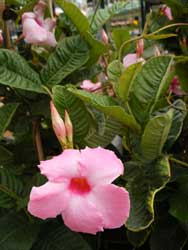
This tropical plant is hardy (depending on cultivars) in zones 9-11 and is for the most part of the U.S. treated as a houseplant. It is grown outdoors for the summer and in colder regions taken indoors to endure the winter.
Care
Outdoors:
Mandevilla is cold sensitive and can be taken outdoors after the danger of frost has passed and night time temperatures are over 50ºF. It prefers full sun to part shade in the summer and a deep rich, well-drained soil.
It will also need a trellis to support its long trailing vines. Provide plenty of water during the hot days of summer. To keep a healthy blooming plant, feed it every other week with a high phosphorus fertilizer (10-20-10) in the spring and summer. In order to maintain the tangled growth during the season, pinch off new shoot tips which will produce a bushier plant. Trimming will not reduce flowering as it blooms on new growth.
Propagation
Mandevilla can be started from seed at temperatures of 70-80ºF. A faster way is to take cuttings in the spring and summer which will root and develop new plants. More info on how to Propagate Mandevilla.
Watch out for mealybugs, scales, whitefllies and red spider mites.
More info on Winterover mandevilla
From the reader archive
Useful reader questions
Virus? So glad I found this site, have a problem no one has mentioned. This is my third year with previously beautiful, flourishing pink Mandevillas that grew up the sides of the porch and even across the top, making a beautiful, tropical…
Read Judie Blanke discussionHi and thank you for your speedy reply–awesome. The only thing is where we are, it will not get to be in the 50’s at night until mid June anyway and gets cold in September. What should I do for the interim?…
Read Tina Gale discussion*Mandevilla care tips I have 18 plants-most from cuttings. Here’s what I’ve done every year and, so far it works. Do this BEFORE the night time temps get below 40. Prepare for winter 1)a WEEK before you are planning to move it…
Read lynn discussionSpider mites Can spider mites kill or harm my plant? How often/long should I treat the plant for? Since its indoor how often should I water? You have been very helpful. Hope you and your family have a safe and enjoyable holidays.…
Read Jen discussion
Whitefly
What are the white, flying bugs that look kind of like aphids? Are they aphids and how do I get rid of them? Also, what kind of damage do they do to Mandevillas? Thank you, Christa
Yellow leaf drop
Regarding the Mandevilla – I live in Dana Point, California right on the coast. It’s temperate here and never drops below 50 degrees. Still, my plant leaves are getting sparse and yellow. What should I do?
I know this is going to strike you as funny but my husband has a goat that keeps eating the ends of my mandevilla vine. what can I do to stop this? (short of shooting the goat)
Ants on plant
My mandevilla has tiny ants all over the leaves and the blooms and also yellow stuff, kind of looks like very tiny eggs.
I also have mandevillas that are turning brown and dying. I have already lost two this summer and two more that are dying. The leaves turn brown mostly on the tips and outer edges first then move to the whole leaf. Some of the flower buds also turn brown. They also have long shoots with no leaves or flowers. They have done well in past years.
I am trying to find some photos of a Mandevilla. We have a vine with large red flowers and have been told it is a Mandevilla but the only info I can find tells me the Mandevilla is pink or white. Please help
speed up flowering
I have a question on flowering of the mandevilla. This is my third year with the plant, I have done everything that you suggested when it comes to winter storage and fertilizing. I live in Ontario, Canada and wanted to know if there is any way to speed up the flowering. I know the flowers come from the heat. It seems like my flowers really on come in August-September I was wondering is there any way to get flowering going earlier… say late June?
Thanks Paul
Epsom salt
I had inquired about a beautiful Mandevillea and was told that Epson salt was scratched in the soil that made it look so pretty. I was wondering if you heard anything about this trick?
Not blooming
We received a mandevilla last summer, put it in the ground at our NJ home, and watched it bloom prolifically. We brought it inside in the fall, and it sent up new shoots about February. After the last frost, we moved it to the same outdoor spot it was in last year. Though it has grown well since then, it hasn’t bloomed. Please advise. JS
Jeanette Johnson
My mandevilla appears to be growing healthy and happy. I have it in a sunny location, out doors. I am feeding it a liquid feed three times per week, Miracle Grow All Purpose 24-8-16. I am getting no flowers. How come?
I live in Santa Monica, CA. I would like to plant Mandevilla on a trellis that is 15 feet high. It gets partial afternoon sun on the west side of the house. Will they survive in these conditions. How many plants need to cover fifteen feet spread? All the best. Steve
Spider mites
Can spider mites kill or harm my plant? How often/long should I treat the plant for? Since its indoor how often should I water? You have been very helpful. Hope you and your family have a safe and enjoyable holidays.
Leaf spot disease
I have brown spots on my mandevilla vine leaf especially near the veining. What is this and what do I do?
Tubers
I live in Savannah GA & did not bring my Mandevilla in for the winter. When I dug it out of its planter, it had many healthy looking tuberous roots. Can I replant the root/tubers and expect them to grow? How long to maturity?
I purchased a hanging potted mandevilla…then discovered it will climb…can I place it near a trellis or what works best for Midwest weather?
Start from tubers
Is it possible to start a mandevilla from the tubers of an older plant? Just the tubers, not the whole root.
Slow to bloom
I pulled up my Mandevilla this spring thinking it was dead but discovered a sprout from one of the fleshy roots so I replanted it into a large pot. It finally recovered from the shock and has lots of leaves/vines but no blooms. It bloomed into the fall last year. Any ideas?
Thanks,
Sheryl (south Louisiana)
I have a pot of Mandevillas that have bloomed. My question is does the Mandevilla come with the trumpet type flower as seen on most sites and also a double or rose type bloom? Mine has both on the same plant. The double one almost looks like a carnation with large petals around it. Is this normal?
Pruning Mandevilla
I live in Clearwater, FL and want to cut back my potted mandevilla vine to rejuvenate new growth. How far back is recommended? Should it be to the old growth? I would like to get flowers throughout, not only on the tips.
Cold damage
I live in Orlando, FL and have multiple gorgeous mandevilla plants growing over the fence around my back yard. We recently had several very cold nights, including a hard frost, and all my mandevilla have turned completely brown. Are they dead? Will they come back? Do I cut them back to the base of the plants?
I have aphids on my Mandevilla plant that I have in my kitchen for winter storage. I want to get rid of the aphids without spraying a chemical in my house . Is there anything that will treat them by adding to the pot of soil it is planted in. It’s a huge vine and praying it would be difficult inside my home. This happened to my mandevilla last year inside the house and it lost every leaf. I put Rosebush insect treatment in the soil and it didn’t work, then I bought an indoor aphid spray and sprayed the few leaves and the vine . It suffered so much I cut it back . It grew when put out in the spring but never bloomed. Now what can I do. It was doing so good inside until now.
What can I do? Any suggestions would be greatly appreciated.
My mandevilla has tiny ants all over the leaves and the blooms and also yellow stuff, kind of looks like very tiny eggs.
Pruning mandevilla
Hello, I purchased three Mandevilla plants through ebay. They arrived last week in great shape and in the bare root form. I planted them in 100% very well seasoned compost. They are about 2 to 3 feet tall. They are doing pretty well. Lost a few leaves but other wise OK. My question is. Can I cut them back to make them bushier or will that be too hard on them? If not then when? We live in St. Louis. I do not expect to set them out for another 60 days. Will I have to harden them off at that time? Do I harden them off just like a young perennial or annual seedling? Best regards
i was just wondering if there is a specific bird or butterfly that like the Mandevilla?
Hi. I seem to have had bad luck with these plants. I’m on my third new one and the leaves become mottled, turn yellow, then brown until they dry up and fall off (along with the buds). It looks awful and may not make it. I do try to keep it in the sunnier room but not direct. I try to watch it does not dry out but wondering if the soil needs replacing even though it has been here for a month so chances are it is me, not the soil. I’ve tried a mild fertilizer. They are expensive to buy here and wondering what I am doing wrong. I live in northern Ontario, Canada. Thank you so much in advance.
Hi and thank you for your speedy reply–awesome. The only thing is where we are, it will not get to be in the 50’s at night until mid June anyway and gets cold in September. What should I do for the interim? Also, I noticed that the plant has a double container–the one in which the plant is in has drainage holes and the other outer one has no holes, so I’m wondering if the plant is sitting in water and is suffering root rot. If I water it just a bit when needed–the soil will be hard, hard on top, but the soil at the bottom is wet. This is why I was thinking it needed to have new soil that is “dry” to absorb any excess moisture and top dress it with new soil. Is it OK to leave it in that type of pot being that it should not sit in water? (sorry for all the q’s–just frustrated as I’m pretty good with plants) Thanks again.:)
have a pair of white mandevilla planted outside on trellis in 2/09. both were flourishing until about 3 weeks ago. one continues to look great. other has wilted leaves and some dead shoots. replanted wilted one 2 weeks ago thinking it might be getting water trapped at roots. gave it some fertilizer. do not see any signs of insects. wilted one looks same except more dead leaves, shoots, etc. what would you suggest as next step?
I just purchased two Mandevilla plants to brighten-up the sunny area in front of my brickfront townhouse. I saw the plant flourish last summer nearby and fell in love. Unfortunately, I didn’t do much research before buying it and need help. I currently have it outside (4/23/09) and am concerned about temp. I’m not sure if the commercial brand potting soil is right for this plant. I’m hoping to get advice on whether these plants should be out yet, how I should treat the soil, and how I can maintain them throughout the spring and summer months.
*Mandevilla care tips
I have 18 plants-most from cuttings.
Here’s what I’ve done every year and, so far it works. Do this BEFORE the night time temps get below 40.
Prepare for winter
1)a WEEK before you are planning to move it inside, feed it well. The plan is to get it strong for the winter hibernation. WATER IT WELL THE DAY BEFORE OR MORNING OF YOUR PLANNED REMOVAL.
2)on the day of removal, cut it back to about 1 – 1 1/2 feet from the soil with one good chop. Clean up the severed vines and discard.
3)press your shovel ALL THE WAY TO THE GROUND in a circle around the plant about 6 inches from growth. Gently lift the plant out and place it in a pot that will hold it for the Winter.
3)give it some water but not enough to run out of the pot.
4)place the whole thing in a clear plastic trash bag and put it in a place that will not get below 40 degrees in the winter. A heated garage, a basement or a cool room. Tie the bag closed so that it will stay humid and dry out very slowly allowing the plant to adjust slowly. Here’s something that I do: once I put the plant in the bag, I give the plant a quick, LIGHT shot of all-purpose bug killer and then I tie the bag up. It seems to kill off anything that thinks it might hang out on the plant for the winter.
5)now, forget about it until Spring.
SPRING:
Remove 2 shovels full of soil from the spot where you plan to put your Mandevilla. Fill in the spot with 2 shovels full of organic matter (compost) and sir it up and over very well. This will give the plant a happy home for the season. Remember to keep about half of the soil that is on the roots in the pot when transplanting.
when the night temps are 40 or higher (in New Jersey I wait until April 20th)I move them outside, discard the plastic bag and water JUST A LITTLE. Because it hasn’t been in the sun for a few months, the leaves will burn. That’s normal. It WILL look dead and will lose any leaves that sprouted. This is normal. Just clean it up and know that this is the way the plant adjusts to the sun. Water it gently a few times until you are ready to put it in the ground. May 1st is when I plant mine.
Before storing your containers for the summer, remember to wash them out with bleach and a mild dish detergent to kill off anything that’s not supposed to be there.
Fertilize weekly with a weak solution of all purpose food.
ENJOY FOR THE ENTIRE SUMMER!!
Thanks for the insightful comment!
I HAVE A MANDEVILLA PLANT I HAD LAST SUMMER. I TOOK IT IN FOR THE WINTER. KNOW THE DIRT LEVEL HAS DROPPED ABOUT 6 INCHES BELOW THE POT. HOW DO I TREAT THIS CONDITION?
Poisonous
Are mandevilla vines or plants poisonous to dogs?
I bought 4 mandavilla’s for my porch, the containers they came in did not have any drainage holes so they held alot of water, 3 of the plants leaves turned brown only 1 new shoot on each how can I save my plant? No new leaf growth either.
I bought my Mandevilla on clearance and it only had one flower on it. Since then I have repotted it and fertilized it but still no flowers. The leaves are growing with new stems, however I don’t see any signs of flower buds. Did I buy a lemon?
Pruning Mandevilla
I live in Houston, TX and have two mandevillas in my back yard, shaded with 30 – 40 ft magnolia and live oaks. These plants had taken over the back yard and were climbing all over the trees. Two years ago, I decided to have them cut to the ground (taking part of the magnolia and live oaks with them). They are growing back fine. I’m training them to follow my fence, rather than climb the trees. So far they have not bloomed. Do they need full sun to bloom or is it just a matter of time? They get more sun now that the trees had to be trimmed. Also, what is the best time to trim these? They are very hardy and have lived through all our winters. I would love some flowers, but need to control their growth some. Thank you.
Deer resistant
I just bought 2 mandevilla plants and want to put them outside for the summer. Do deer eat mandevilla?
Adding on to my post, we were looking for the 10-20-10 combo for plant food but the best we have in our area that even comes close is 15-30-15 which is the same ratio just higher levels of each. We didn’t get it yet. The other option of course is Miracle Grow’s 20-20-20 all purpose. Thoughts
Hello. I am new with Mandevilla. I live in Orlando and have three (2 red and one pink) that i purchased about 2-3 months ago. It has been amazingly hot here (over 95) and these poor guys are right in the blistering heat. I have sandy soil and have been making sure to water them more due to the intense (and unusual) heat. But all growth has stopped and the leaves are yellowing. In fact, the red ones seem to be shrinking. What can I do to save them?
I was just reading over the comments on here and was really surprised by the number of people having problems with their mandevillas. Some observations: the pink is the strongest of the types – reds and whites don’t seem to be as vigorous. For two years I’ve grown mine on either side of the entrance to my front porch – eastern exposure – full sun until around noon. On one side there is a downspout from the rain gutters – that plant gets lots of water and, while it has good drainage, the ground stays wet – IT DOES GREAT! The other plant (while it still does well) is only about 1/2 to 2/3 the size – I try to keep it watered every few days. I don’t try to save mine when the cold weather comes here in North Carolina – they are cheap enough to replace each year. I think that since mine are never really stressed may be the reason I never have bug issues.
I do have a question however – in a tropical setting without a dry season – do these plants flower 12 months a year?
Spider mite problem
I am following up to the message I sent in last night. I found webbing on my plant this morning; it wasn’t there before. I’m guessing spider mites. What is the best way to get rid of them and keep them from spreading to my other plants or coming back? I have placed this plant back outside for the time being since the temps are back in the 50’s here. Thanks again for your help!
I puchased two mandavilles last summer and planted them in hanging pots. They both thrived all summer long. I brought them in for the winter and left them in their hanging pots in front of two windows so they would get plenty of sun. I watered them when the soil was dry and gave them plant food once a month. They died slowly but surly. They just dried up and no amount of water I gave them would help. I dont know what I did wrong… please help.
Watering mandevilla
I just got a brand new Mandevilla for Mother’s day and I just had a question about over watering. I have never had one before so I dont want it to die. How much water is too much? I live in San Antonio so its very Humid and the dirt seems to dry out really fast at the end of the day. Should I water it more when it’s like that or just wait to water it the next day or even the next week? When you do water it, How much water should I put in the pot? I really like it and want to make sure I do everything to keep it alive. Thank you.
My son just bought me a beautiful Mandevilla in a pot which has a small trellis. I live in Illinois, and wonder if I should leave in the pot, or when the temp. doesn’t get below 50 at night, transplant in the ground. I have had it inside right now, and the blooms are falling off, but I know it isn’t getting near enough sun. Any thought’s would be much appreciated! Thanks so much! I don’t want to kill it as it is such a beautiful gift from my son!
Bud drop
I just purchase a giant crimson mandevilla plant about 3′ high. It’s beautiful but all the new buds are dropping off. Why?
Reading this site has made me feel much more confident in caring for my expensive special mandevillas, as well as showing me where to buy things- glad I found this!- but also I was left with a question. All the info I have gathered through the years on flowering plants tells me that removing the seed pods before they mature encourages more flowering. Is this not true with Mandevillas? I would like to try the seed pods, but not at the expense of flowering beauty.
spots on the flowers
I just got a Mandevilla a couple weeks ago. I live in Oklahoma and have lots of clay in our soil. We have had some of the flowers fall off and also have white spots on the flowers. Is this because I am watering it too much? Our weather has been in the 90’s. Could it also be from the shock of replanting?
Insects
I have three beautiful Mandevillas that I planted at the beach in 8in by four foot pots and added white fan trellises. They are doing beautiful but one now has little black somethings and some ants. I sprayed with a solution of dish soap and Dreft and water. I just love these plants. Thanks for all the information. Since they were expensive I will try to over winter them following the advice of the three day prep and then clear plastic bags. Next year I will put more in as they are just so cheerful,and beautiful. Again thanks for the advice!
Trimming
i purchased 2 mandevillas this past spring for my apartment patio. i inserted bamboo arches into each one and the vines really twisted around them. i want to take out the bamboo supports and let the plants “catch onto” the balcony railings. problem is, i would need to majorly trim them in order to untangled and remove the supports.
is this a bad idea to do this now, in the middle of july? will it really affect them or harm them?
Yellow leaves
I have two pink mandevillas in large pots which were doing very well since the beginning of June and now, all of a sudden they have lots of yellowing leaves. The pots have good drainage but it has been extremely hot here in Illinois for the past two weeks. Can yellowing leaves be from the heat? The plants are on a rooftop deck and get sun most of the day.
Not blooming
I purchased a Mandevilla vine about 6 weeks ago, great looking plant but no blooms when i bought it. I repotted in a hanging planter on my back patio, here in Central Florida. The plant looks great, very healthy and some new growth, but no blooms still!! Am i doing something wrong? It gets full sun. Thanks for help!
Leaf spot disease
I have Mandevilla plants in large pots on each side of my spa on the pool decking. I have noticed the leaves yellowing with black spots. Do I have aphids or what could be causing this?
Overwatering
I had three mandivillas, but now only two. They all seem to be doing the same thing. They were thriving before the hot temps (90-100). They are well watered, but they begin with yellow and browning leaves, and this seems to travel up the plant all the way to all of the new growth. Eventually, they die. They are all near a sprinkler. Could they be getting too much water?
Thanks,
Billie
We have 2 pink Mandavillas (2 years old) and both were healthy until 2 weeks ago. I live in Northern California- we noticed a “white dust subtance” on the leaves, eventually turning into tiny black dots with a sticky “tar like” subtance. It’s killing our leaves and flowers. Please help!
Larry, I’m curious. How are you doing the cuttings? I’ve tried a few times and it never worked.
Propagate mandevilla tip
To make cuttings I use “kys-cubes” which you may be able to get from a nursery or greenhouse operation. Keep them wet and mist them often, out of direct sunlight. They’re a little slow to root. If trying in cool or cold weather bottom heat will help.
Sunny, concerning cuttings, I forgot to say that I take a terminal stem with about 3/4 inch below a pair of leaves. Insert the piece into the cube so that the leaves just barely wedge into the cube, which helps to stabilize it. Also, the use of a rooting hormone will help.
Cat repellant
I have 4 cats that nibble on plants. Will Mandevilla red or Bright Light harm them?
Poisonous Plant?
Hi,
I have a Mandevilla that I brought inside to ride out the winter. My problem is that my cats think it’s a salad bar. My main question is, is this considered a poisonous plant and should I disgard it? I’ve seen conflicting posts and would like an educated answer before I throw out the plant. Thanks.
Feeding indoor mandevilla in winter
Are you supposed to keep fertilizing the mandevila plant during the winter while it’s kept inside?
Low light/no flowers
I’m in Denver and trying desperately to get my first Mandy to survive the winter. I have it by a west-facing window with a sheer curtain, and I also have a grow light on it, but I’m not sure how it’s doing. I whacked the heck out of it about a month or so ago and it seems to have quite a bit of new growth (lots of new little leaves where I whacked it, no flowers though), but it’s also dropping leaves like crazy. Is this normal or am I doing something wrong? I have not fed it at all since I brought it in around the middle of Oct., it does dry out before I water it, and I try to keep the temp around 65 (if I could get my hubby to leave the thermostat alone). Does it need more light, less light, fertilizer, etc.?
Hi — my mandevilla did beautifully last summer but when I put it back out this year it developed small brown spots all over each leaf and isn’t growing well…is this a fungus or a bug — what should I do? Perhaps it needs to be fertilized?
I live in Naples Fl. Temps daily are in the high 90s. My 2 mandevilla plants are in pots (2nd year for both). The pots are in all day sunlight, and we are not in rainy season. Curremtly I am getting a lot of yellow leaves. Could I be overwatering? Underwatering?
Thanks
Don
Poisonous
Is this plant poisonus to animals?
Small dogs and cat
I just purchased a mandevilla plant and it looks like it’s wilting. I have watered it because we have had day temps in the upper 90’s. Is it to hot for my palnt?
Hi! I recently planted red Mandevillas around my salt water pool in northern Ohio. Now that the kids are swimming more, certain plants are getting splashed with the pool water. The red flowers on these plants are turning pink and even white in some places. Is the salt in the water affecting the alkalinity of the soil? I want my red blooms back!
Leaf drop
Hi-
I have always had luck with Mandevilla before, but this year is different-
Its been a wet, cool summer so far, and my Mandevilla seems to be in trouble. I am trying to keep it from getting too wet, but the vines seem to be turning brown and dying off, and the leaves just drop off. They aren’t yellowed or browned- they look to be perfectly healty leaves until they drop. Any ideas for what to do or what might be wrong? Thanks!
Ants in plant
We discovered our mandevilla (potted) was infested with ants – not the leaves or flowers but all throughout the dirt and roots. We applied insecticide and replaced half the dirt. Our girl is still turning yellow – from the bottom up – but she still has new growth on top. Is there any hope for our gilr?
I am having a terrible time with Mandevilla plant in just one pot this summer. It is just wilting and dying. I have checked the soil and it is not too wet and I also have other plants growing in the same pot. This is a very large pot that has a match on the other size in a pool area, the other Mandevilla is thriving but cannot keep one alive in this pot. There are no browning or yellowing of the leaves just one day I walk out and the plant is wilted. This is the 3rd plant in this pot and each one has had the same problem. Lost as to why?
Ok, now my Mandavilla vine has turned totally brown and I think It’s about dead. Can I cut it way down and hope that is will come back? There is really no reason for the dying leaves it’s been watered, not too much, I’ve been taking care of it. Is it a lost cause?
I Just purchased two of these beautiful Mandavilla plants. Do these climb? should I plant in the ground or pots? What other plant’s look good with them?
I purchased 2 of these plants and love them. One plant shriveled and died all of a sudden. Now the other one is starting to do the same thing. Turning brown from the vine up. Inbetween time, I purchased 2 more and don’t want them to die too. I live in Kansas, 80-100 degrees and wind. They are on my deck which is covered by a huge maple tree but still get 1/2 day sunlight. I don’t think we’re under or over watering & the pot has drainage. Any ideas what I might be doing wrong?
Propagate and winterize mandevilla
We would like to start our own mandevilla plants in a indoor green house are they easy to raise? We live in upstate new york and have cold winters, can we bring them in in the fall and keep them going until spring?
hi… I am a new mandevilla owner.I live in central Minnesota,and we are having an unusually long period of rain and cool weather. Is this going to hurt my plant ?
Leaf spot disease
located in northeastern pa.
1 of 2 mandevilla plants is slowly dying; leaf drop, spotting, curling. One bloom on the way. I water the plants once every two days or so. they both get full sun. the soil is rich and has a few inches of stone on the bottom of the pot for positive drainage. I have dilluted some fertilizer in water (slightly less than asked for on the directions) and applied the mix to the plants 3 weeks ago.
the strong plant has been getting more leaves and deepens in healthy green color. My first bloom is on the way. I have had them in pots now for almost 6 weeks.
the weather has ranged from 70 to 90 degrees with evening thunder showers every few days.
I purchased two 4 foot potted plants in May. Both plants blooming. One dropped all flowers and shows no signs of returning blooms. They live on the patio near each other, same environment. Will blooms return? Anythink I can do to coax them back?
THX!
Some stressful condition caused the plant to drop its blooms. Is it possible that the plant is pot bound and dries out quickly?
Wintered over not blooming
My mandevilla plant looks healthy, but is producing no flowers. This is a potted plant, second year, and receives approximately 6 hours of strong sunlight per day. Last year this potted plant flowered all season, in the same location. Any advice? Thank you.
It sounds like you have a Dipladenia.
I maybe wrong but the leaves are a darker green thicker and the flowers are a very dark red?? I live in Summerville I grow both. The Mandivilla I use a 2 foot pot and 9 foot bamboo poles stuck in it as a trellis. I use electrical wire to hold them together. they grew 9ft in 3 weeks.
I have several Mandevilla plants. One has dark green leaves 6-7 inches long, others have much smaller leaves and do not vine like the one with big leaves. The large leafed one seems to be much more vigorous than the smaller leafed ones. What is the difference in the plants? Do I need to care for them differently?
I have read that Mandavilla is hardy to zone 9, but then I read that it needs to be inside when the temp dips below 50F at night. I see zone 9 temps are down to as low as 20F at night. Will I have to take my new Mandevilla in for the winter in San Mateo CA which is solid zone 10, down to 30F at night?
I have two beautiful Mandevilla planted in large pots. They get direct sun in the afternoon and both are blooming profusely, but they’re not climbing! I’m so disappointed; I have beautiful trellises in the pots to train them. Is there a trick to get them to climb? The only thing I can think of is that they went from small pots at the nursery to my very large pots, and the roots are growing but the plant is not. Is that right?
Yes it is in full sun during afternoon. In the morning until about 11:00 it is in the shade
Virus?
So glad I found this site, have a problem no one has mentioned. This is my third year with previously beautiful, flourishing pink Mandevillas that grew up the sides of the porch and even across the top, making a beautiful, tropical display.
This year, all the new leaves at the top are coming our very small and disfigured, mottled ends, some with out much of anything on one side of the leaf. Growth is sparse also. Fertilized regularly with Miracle Grow and Bloom Booster, as we did in years past. Did use one dose of Superthrive, which says it is vitamins and hormones??? I took it to the local botanical gardens and they thought they saw a few spider mites spots, but there are no webs or bugs to be seen. I sprayed both of them with purchased insectide soap, but have this sick feeling, there is more to it, that that. Oh, how I hope you can shed some light on this. Thanks in advance.
Hi Judie
Are they growing in the ground or pot? If in a pot did you replant in fresh soil this year.
Hi there,
Yes, they are in the same pots as last year, when they did so beautifully. I did use new Fertilome soil, that even says good for tropicals. I washed both of them with purchased insecticidal soap. Wondering now if I should look for Neem Oil. Still getting some blooms, but not as many as before. One at least is climbing with it’s little leaves, the other is definitely lagging behind and it seems the older, established, larger leaves are disappearing. I am mystified….and bummed. : o /
Brown leaves
I live in west Texas, where we have had 30 100+ degree days so far this year. I’ve been successfully growing Mandevilla in pots for a few years. This year I found some in hanging baskets which are perfect for my east-facing balcony. They have done beautifully until 3 days ago when I discovered several of the upper leaves are turning brown on the tips, then gradually the whole leaf withers and dies. This isn’t like the disease where the leaves develop small purplish spots, then turn yellow and fall off. It’s more of a rusty color. I water once a day (being in hanging baskets they drain well)and fertilize every 2 weeks. I haven’t seen this condition before. Help!
This is my first experience with the Manevilla plant. I purchased two and have them planted in full sun in large pots on an outdoor patio. One of them died, so purchased another to replace it and this one is being infested with sticky orage, what I think are aphids. What can I do to get rid of them?
Help!!
why can I not get my Mandevilla to bloom? It is is mostly all sun in a nice big pot and fertilized once every two weeks or so. It looks healthy just no blooms.
I live in Waco, Tx and the temperature is 100-102 degrees right now. My mandevillas leaves are turning yellow/brown. I water them every/every other day. One of them gets morning sun; the other one gets afternoon sun. What do you think might be the problem?
yes I am fertilizing about every week and a half with 10-10-10.
Try using a high phosphorus fertilizer (10-20-10) or a bloom boost every 2 weeks.
Heat stress
My Mandevilla, is in a large planter, w/soil – think it’s Miracle Grow – that retains the moisture & isn’t supposed to allow the plant to absorb TOO much water. The leaves are turning yellow. We live in Texas, the plant is on the front porch, which faces West, and the temperature gets quite hot in the afternoon, what temperature & prolonged exposure, is too much. Additionally, the front porch is essentially a brick oven – bricks on house & slab of porch…..(I didn’t design this place…). Could the yellow leaves be from TOO much water? Or TOO LITTLE? Not enough fertilizer? I just checked the pot, and the soil is quite dry on top.
Yellow new growth
Great website! I live in the desert. I have one potted mandevilla which I placed in my garden under a pergola last winter. It bloomed profusely and thrived through a freeze (which killed some bouganvilla) Now it’s not blooming at all~We’ve had several days well over 110~ It’s healthy otherwise, and climbing well~Have been feeding a blooming fertilizer every couple of weeks, and watering daily. The other 2 which I planted in the ground get the same care but are yellow on all the top leaves. They get some filtered sun & mostly shade during the day, and have not bloomed at all this summer. Too hot? Thank you!!
I live in Long Island, New York and have a couple of Giant Pink Mandevilla planted in pots climbing the front columns of my house. They have been there for about 2 months and doing nicely. Whenever they are watered the water is quickly absorbed into the soil.
Yesterday – in the midst of this heat wave no less – I noticed one of the plants was very wet, puddling in the soil, which was odd because )a of the heat wave and b) it had not been watered since the day before and c) all the other plants around it were dry. This morning – same thing. The soil is mysteriously very damp.
I am baffled, and hope this is not the beginning of the end for this plant, like drowning in its own… whatever.
I did add some soil to the pot which has seemed to stav the ‘wetness’ but the plant is looking rather sad.
Thank you in advance for your comments and suggestions.
Hi!
I have two identical mandevillas potted on my front porch. They get direct sunlight most of the day. The plants are very bushy but the leaves are starting to turn brown from the middle of the plant. The brown leaves have spread to the outer leaves and the plant looks to be dying. The other plant is just starting to turn brown from the inside also. I’ve had mandevillas for years and never experienced this problem. Can I save the healthier one?
Thanks!
I live in west texas (zone7) Can I plant Mandevilla outside.
Please help me this is my first time with mandevillas. I have two lovely plants in separate containers on my front porch which is sunny in the morning hours. At the beginning they were growing beautiful with healthy looking leaves and dark pink flowers. I water then every day and fertilize then every other week. Suddenly, the flowers on one of the plants turned very light almost white, then the buds were brown at the tips and they all fell, now the leaves are turning yellow and the other plant is getting brown spots. I am worried. What should I do? I live in the New York area.
Thank you
I just purchased a Mandevilla. It is beautiful. Before I even plant it I want to make sure I do it “right”. I live in the Inland Northwest where it gets hot in the summer……cold in the winter. What is the best place to plant this…..southern exposure? Stay in the pot in came in or transplant to a bigger plant? Thanks.
I have three Mandevillas. They were all doing really good till this Monday. I left the water on in my pool over night by mistake and over filled the pool. It took it all day then next day to quit draining out into my yard. Within 24 hrs…two of my Mandevillas were wilted looking…just kinda droopy and by second day the other one started getting yellow leaves. I have not watered all week now…as I know they were way over watered. I am not seeing any improvement. I have wondered if that pool water ph was not good for them…or if it was just sitting in standing water for over 24 hrs.
Aphids
I have a mandevilla in my patio and it constantly is getting little yellow aphids (bright yellow little bugs with black spikes)…within a day or two an entire branch is covered..I spray it with Neem Oil and they turn into black soot..but sure enough they reappear a few days later elsewhere–short of spraying them everyday which seems impossible because I tried and its not working.. do I either get rid of the gorgeous plant that is thriving and flowering beautifully or do I give up and let the aphids go at it until winter approaches. I live in Southern California.
I planted a Mandevilla in between two evergreen shrubs and now they are staring to look a little sick. Is there a compatibility issue that you know of?
Soil ph
I removed all the yellowed leaves, mulch really well with an organic compost…still a little droopy on two of them…but they are putting out new leaves. I did check the ph and it was at about 6.5. I know this is a little high for them…I am hoping the compost will help…it is specific for mandevillias and palms. I am going to check ph in few more days…if it is still a little high…do you have any ideas for lowering the ph?
Yellowing leaves from flowers
I know this sounds crazy, but we have been growing mandevilla (Alice Dupont) in pots, training them to grow up the posts on our porch for 8 years. (We buy new every year) We have often wondered why our ilex crenata planted around our porch yellows, and dies. It is only the plants that are under the Mandevilla that are dying. What happens is the spent pink flowers drop on top of the ilex, and that’s where it yellows?????????? Has anyone ever heard of the flowers being toxic??
They say the Mandevilla is related to a plant that is toxic?? Thanks
Aphids
I have these aphids and water is not knocking them off. Is there a pesticide
that I can use to get rid of them permanently. I want to make sure, they are
actually moving on the vine. Is this what Aphids are? The plants are continuously
blooming. Please advise.
quick question!
I live in Washington state — just purchased 3 beautiful red Mandevillas in hanging baskets. Did not know they would need to be taken in for the winter. Is there a place to plant them near the house or something that i can leave them in the ground year-round?
Hello – I love reading the mandevilla stories. I have some questions.
I bought two mandevilla (white) this past summer. They repotted them for me at the nursery when I bought them and they are doing great. I can’t believe how often they flower and I am usually death to plants. Anyway, my questions are:
Will I need to repot them soon? How can I tell?
Would they prefer to be in a clay pot next time? They are in plastic now.
Will it hurt them if I trim their thin shoots that like to attach themselves to other things?
Thank you very much,
Caterpillars on mandevilla
I have a beautiful Mandevilla plant growing in our front yard. I just noticed that there are these orange spiny catapillers eating the leaves. We live in Florida and it gets plenty of sun. How do I get rid of the catapillers?
Hi, I live in Scottsdale, Arizona. I have two red mendevilla plants in pots with well-drained soil & in outdoor shade (front porch). I have had them for about 5 months. They have been very healthy until recently starting to have the browned spots on leaves and wilting. I removed all the brown leaves, got more careful with watering and move both pots indoor with light through the glass because of the continuing excessive heat over 110 degree recently. Should I use the fungicide to treat the plants and also keep them indoor for sometime? Do I need to repot? Thanks!
Cut back mandevilla
Can you tell me when and how far back I can trim our mandevilla. I was told that if you cut them back they would not bloom for a year. We live in Louisa Va. The plants are kept inside in the winter and out on the deck in the summer. We have had them for years but they are looking stringy because we don’t cut back anything but the dead ends.
Winterover mandevilla
I bought a small but beautiful Sun Parasol Crimson Mandevilla in late summer, full of blooms and vey healthy. I live in Nashville, TN (Zone 7) and know of course it would never survive one of our winters. I have a basement which would provide shelter but no guarantee of above-freezing temps. What about putting my Mandevilla in an unheated bedroom during the winter months but which does not have much sunlight? How much sunlight and at what temperature range does a Mandevilla require to successfully winterize it? Would love advice from anyone so I might enjoy this beautiful plant again next summer.
I’d like to grow mine in the kitchen trellised up a wall. I understand the risks of rot and bugs, and am researching a good grow light to hang from the ceiling. I got advice that light would have to be very close and on the blue side to produce adequate growth for flowering. I’m in Santa Fe NM so i could cut back nd summer outside but would hope they could remain part of my kitchen design yearround. I could always rebuy each year, but I’m handy enough, any additional advice?
I’m thinking maintain new root cuttings away from inside plants, maybe start annually for growing season outside?
I appreciate all your wisdom shared in precious posts…very interesting!
Hi! I’m a first timer with Mandevilla and I have 2 Sun Parasol Crimson red Mandevilla that I bought late spring and fell in love with these plants, both are doing great, healthy and still blooming. I live in northeastern New Jersey and have an unheated enclosed porched that allows morning sun in and that’s where I plan to keep my mandevillas for the winter. Do I have to keep them dormant or treat like houseplant. I have spikes and citrus plant that I kept in the porch during winter and so far managed to survive. Please, I need your advise on how I can take care of them during winter. The porch is really very cold during winter. Thank you very much!
Trim vine for winter
I live in Western Pennsylvania. I have a Giant Crimson Mandevilla – which has been beautiful since I got it in the spring. I understand it needs to come inside for the winter. My question is – should it be pruned back or left to grow as is? If it needs to be pruned, how much should be cut off. Thanks for you help
Shedding yellow leaves
Hi,
I live in Southern Ontario, Canada and purchased my first “Pretty Pink” Sun Parasol plant in June. I had it in a full sun location all summer and it grew and bloomed beautifully. I brought it in for the winter and put it in a sunny window. It was doing great and even bloomed for a couple more weeks but lately I have noticed the leaves are turning yellow pretty fast. What can I do so keep this wonderful plant from dying? It is still in the 12″ pot I purchased it in and I have been watering it once a week like I do my other plants. Is that too much or too little? Do I need to fertilize? What kind, how much and how often? It did not come with much information so any that you can offer would be a huge help.
Thank you in advance for responding!
Grow from seed
I live in Fort Worth,Texas and I got some Mandevilla seeds from a neighbor. Can you tell me what is the best way to get them to germinate and when should I start germinating them if I would like to let them climb around my patio? I’m not sure if they will die over winter or not.
leaf drop in winter
I live in Ohio, so I winterized my mandeville vine as specified and brought it in the house. It looks dead. I did not over-water it, but the leaves are dried out. Did I kill it?
Hi from Minnesota. I have a dipladenia that is wintering in my sunny sunroom when there is sun. It has developed white fuzzy bits that are on the branches, in the crooks and on either side of the leaves. The fuzz when removed has a pinkish moist interior. The plant otherwise seems to be doing well with normal dropping of leaves. Flowering has stopped. Vines are growing. What gives?
Aphids
I have a red Mandevilla that has some kind of growth on the new leaves and stems they are ayellow fuzzy type growth. They wash off but come right back the next week.
The plant was outside and we moved it inside for the winter.
We think that they might be insects.
I was recently given a potted mandevilla which had been stored in a cool unlit room. It has numerous green shoots ranging from a few inches to 3 feet and filled with lots of tiny buds. It was not cut back as suggested. What I do with it now that it has shoots? I do not have a sunny room to store it.
Thank you,
Robin
Thank you for your prompt reply. I have a wall of east facing windows. Will that do for light or would you suggest that I put it into this light and still prune it back in the spring?
Thank you agian.
Robin
new growth dieback
I put my mandevilla outside last week and it was in the 60’s and 70’s during the day, but got cold at night (never below freezing though). On one or 2 of the days it was outside it was really windy. I brought it in when I realized it was going to go below freezing. All the new growth it had formed while being indside during the winter has died and there is no green on the plant. Did the cold from one or 2 nights kill it or is it just dormant?
We purchased a mandevilla last spring and planted it in our back yard on our fence. We live in the high desert of Southern California zone 8B. It gets sun almost all day and did great thru the summer. We did not do anything to winterize the plant but had a pretty mild winter. The whole plant is brown, vine and leaves. It is just starting to warm up for spring with temps in the 60’s & 70’s. Did we kill our plant or is there a chance it may come back and we should wait a few more months? What is the best way to winterize when being left outside?
Still nothing. It’s been 2 weeks since my previous post…
Slow growth on Mandevilla
I have always grown mandevilla very successfully in pots but in my new residences I wanted privacy and plant 5 plants to climb over a wrought iron terrace railing unfortunately they are very slow growing and not the normal lush amount of leaves.
Hi Caroline
Perhaps your mandevilla need some fertilizer or the soil is not condusive to good growth. They need well draining soil.
Nutrient deficiency
Hi I was wondering if anyone knew if Mandevilla was prone to either Iron or Manganese deficiency? I have some in a bedding plant greenhouse and the new growth is showing some interveinal chlorosis starting from the base of the leaf (tips are still green?).
I live in far west texas & thought the madevilla would be good to plant in the backyard so it would vine up on the fence for privacy (like my honesuckles do)…but all the comments I read see that this plant is in pots. Am I wishful thinking that this flowering beauty will survive hot summer sun & cold-ish winter (zone 8)?
My daughter brought me my first Crimson Mandevilla plant today, it is beautiful.I transplanted it into a larger pot, but the pot is not quite deep enough. At the top outside edges I mounded the sides up with good potting soil. Will this be ok.
I want to keep my crimson mandevilla indoors. I have a large picture window but no direct sunlight. Would my plant survive indoors under these conditions?
Thanks for the response! we’ll check that out!
If my plant went dormant, how long will it stay dormant?
I live in San Antonio, TX. I purchased a Mandevilla last spring (2011). It is in a large container on my front porch. Since we had a very mild winter it made it through with flying colors. I bought a very large single trellis and keep wrapping the new growth around. It is almost four feet tall and everyone comments on how beautiful it is. I wanted to move it, but was told it does not like afternoon sun. Is this correct? Thank you for your reply.
Spider mites
I have 2 mandevilla plants. One’s leaves are dark green and plentiful.
The other day I noticed my other plant’s leaves are mottled, and light-green/yellowish. I also noticed that it has far fewer leaves.
Upon very close inspection, I saw all these delicate little webs, and the tiniest little bugs! EWWWW!!!!
I live in southern Michigan and have had these plants… AND THESE BUGS!… in my house all winter long!????!? WHAT IS IT?
Also, is it recommended to change out the soil in the pots after winter, before acclimating them to the outdoors?
Purchased 4 giant crimson and white mandavillas at 3-3 1/2′ tall w/plenty vines. We created 3 – 2’x 2′ hand crafted wooden planters on our deck. Planters are about 20″ deep and lined with rubber roofing material, a drainage pvc piping from bottom of planters. Water should drain off back side of planter off deck. The 3 planters are connected by framed lattice for climbing. We placed Hydroton (explanded clay)inside planters with window screen on top. Will place soil and plant on top of this. Living 15 miles inland from Boston. Does this seem to be a proper system? We will receive plenty of sun. I’m anxious to transplant but concerned with the weather. It is only May 5. Also, how do I store the plants in the meantime? Keep outside overnight unless under 50 degrees?
I had nursey plant my mandevilla in a pot with
a trellis. They wound several of the vines
around the trellis. The leaves at the bottom
look great and have flowers. However, the leaves at the top look limpy. Should I cut
the vines back to the area where the leaves look ok, or simply leave it as it is?
Leaf drop
Hello,
3 weeks ago I bought a crimson mandevilla in Ikea, and within a few days it started losing leaves. On the 2nd week the flowers and many of the leaves completely dried and fell off, and now I’m left with about 1/3 of the leaves…
I keep it indoors, on a windowsill. I water it about 3 times a week, and when I touch the soil on the remaining days it’s not dry – it feels slightly moist but not wet. The bottom of the pot is not wet either. What did I do wrong?
Hi, I bought a new mandevilla just the other day and repotted it and watered it.
Not the Blooms that were on it are droopy and the leaves are droopy and it seems like it is not doing well at all.
It is under a porch and not in full sun all day but in the afternoon it gets a few hours.
Do you think I have overwatered it? The leaves are also turning yellow.
Please help! I love Mandevillas!
Repot mandevilla
I just bought a beautiful potted mandevilla and was wondering if I should repot it to a larger pot. Do they prefer to be root bound? If I transplant it will regular potting mix work? Thank you.
Petal blight
I purchased a white mandevilla last week. It has numerous flowers but the petals are turning brown and the flowers are falling off. Fortunately, I separated it from my other two which do not have this problem. Help please.
Robin
Petal blight treatment
We have had rain almost daily for weeks, I would not be at all surprised if this was the problem. How to I handle petal blight organically?
Thanks for the quick reply.
Robin
My mandevilla buds but the buds don’t open, start to rot and drop off. Morning sun, and last year in the same place did fine until scaley stickey stuff appeared late summer.
Thanks.
I recently purchased 2 Mandevillas and will need to bring them in for overwintering. I don’t want too large of a pot since I will have to bring it indoors so I don’t know how large of a pot is required?
My red mandevilla’s started off with beautiful deep red flowers, and now the flowers look washed out, and loosing color. leaves are fine. Plant has part sun, plenty of water and has added fertilizer. Please help?
Hi Lisa
too much direct sun will tend to fade the flowers.
My mandevillas are really doing well but I noticed yellow stuff on the offshooting vines. Are these bugs or pollen? Bad or good. Do I need to do anything to them?
I have grown Mandevilla’s sucessfully for the past 5 years, until this year. Some of the leaves are brown and dry along the edges and the pink flowers are white along the edges of the petal. The flowers are a lot smaller in size too. Can you suggest a remedy?
Thank you for this site.
Faye
I should have added that I did use a different soil this year. Suppose to be comparable to the Miracle grow stuff. I am also fertilizing with the miracle grow every 2 weeks. I have it planted in a big pot outside and it has been outside since shortly before Memorial Day here in Wi. Weather has been favorable here.
my scarlet mandevilla’s are in pots. we live in southern california in the coastal range. they are 5 years old. moved them a month ago to their morning sun position and began feeding and watering. new growth began very shortly thereafter.
now lots of strong new growth and the beginnings of flowers BUT all the older growth has yellowing veins and drop off. this is the reverse of Rachael’s problem.
one garden specialist said needs iron. the older guy says over watering. i slowed down the watering and the leaf yellowing got worse! should i give it my camelia food or repot or flush the pots? HELP!
The veins are green and rest of leave is yellow. i thought virus, but then decided to give it camellia food. seems to have helped. oh, and i also flushed the pots to get rid of some accumulated salts. the yellow leaves were actually part of the new growth. just yellow leaves immediately followed by strong new growth.
Hello:
My Crimson Mandevilla was beautiful when I first received it about 5 weeks ago as a gift. It was very lush with thick, waxy, dark green leaves and plenty of hearty crimson blossoms. I’t in the sun half the day and shade the rest. I definitely think I did a few things wrong including overwatering it and also spritzing the whole plant lightly with water a few times. I don’t have it up against a lattice yet as it’s still in the orginal pot and just up against a fence. Before I had the chance to let it dry out (from the overwatering) the leaves started to change color with some yellow showing up in the middle, along the veins, and the texture of the leaves became sort of rough. A lot of leaves actually turned brown and fell off and the blossoms have turned dark and fallen off as well…not all of them but most of them. I noticed that spiders have moved into a lot of flowers as it appears to be a good place for them to put a small web. Also, some of the leaves appear to be changing shape overnight with one side of the leaf losing it’s regular curve and having a new “S” like shape instead. I do plan on getting the lattice set up ASAP as the top parts of the plant are too heavy to stay up on their own and seem to be suffering because of this and getting very weak and droopy. I really loved the original look of this plant and would like to restore it to it’s initial beauty if possible. I don’t know if I just overwatered it or if something else is going on. Help! Thanks : )
Hi I live in Louisville ky which is zone 6, I recently bought 2 giant crimson growing well and look great. Will Ibe able to keep these plants through the winter and if so how will I go about maintaining them
Encourage blooming after wintering
I bought my plant last year. It bloomed all summer. I brought it in for the winter. I’ve taken it back outside this spring, I’ve fertilized with bloom burst. The leaves look healthy and there are vines growing but there are no signs of blooms. We live in Mo. Help.
So no one has any answers for Tonimac? I forgot to mention that I planted in the ground because my son was so disappointed I didnt have planted in the ground. THought I would just dig up and put in pot for the winter months.
Hi, We bought a white and red Mandevilla a month or so ago and planted them in the ground in the corner of our yard with a nice trellis, used a good Mirical grow soil when we planted them. They get good drainage, but it has been very hot and dry here so been watering everyother day. (we live in south Texas, been in the 100’s) Planted both the same, in same corner across from each other to fill the corner. Now the white one seems to be dieing. Part of it just lost all its leaves, and turned brown, part of it looks ok and trying to put on blooms, but then some is starting to get yellow leaves. The red one looks great. Did we water to much thinking it was to dry, they are in full sun, is it just to hot on them. What do you think
Did anyone find out what the “yellow stuff” on the stems towards the ends of the branches is? I do not think pollen because it is too far away from the blossoms. I’ve been cutting them off. Plant seems healthy.
I want to keep my mandevillas comfortable in 12″ pots as I cannot pick them up to bring them indoors in the larger pots. How do I keep them from becoming root bound and how can I control their growth? Should I clip the roots periodically? I also need to control their height. They begin to produce leaves in Feb. Wouldn’t it be best to prune them back by 1/3rd.in the fall? Sorry about so many questions. Thank you. Robin
Hi Kary 1
Yes, every other day is/was to much of a good thing. wait until the leaves start to droop and then use water sparingly.
Many thanks for posting “Mandevilla”. I personallymay really wind
up being coming back for alot more reading and commenting soon.
Thanks, Beatriz
My mandevilla has lost almost all its leaves in a matter of a few days. I have had it about 6 weeks and I transplanted it and situated it according to directions. I have been letting it dry out between waterings. It never flowered, just kind of sat there, and then some leaves dried up and fell off and others just fell off. I don’t see any evidence of fungus or bugs (no bumps, spots or webs). I have cleaned up all the leaves and cut the dead vines back. Did I just get a worn out old plant that was ready to die?
HELP!!! My Grandmother gave me this beautiful crimson red mandevilla and it bloomed and had beautiful dark green vines and leaves this past summer. This winter I had it in an outside room and I assume it got too cold and I brought it in the house, its leaves were droopy and brownish green, I watered it, now its leaves have dried out and are falling off, I repotted it in hopes that this would help, is it dead? can I save it? Please HELP!!!!
Would a Blackeyed Susan vine or a Mandevilla be best to us as a groundcover for my septic tank mound?
Hi, I have two Mandevilla plants potted separately. One is doing great and the other looks sad, droopy and the flowers are not opening. They both are on the same water feeding system. What should I do.
Any-time I touch my Mandevilla vine that end dies. It seems very healthy and is bushing out. I have to touch it to guide it onto the trellis. I don’t get it?
Winter over mandevilla
Hi, I have a beautiful Giant White Sun Parosol in a pot and it is wrapped around a very tall post. It is very happy and growing very fast. How do I protect it from the winter conditions. Do I bring this big plant indoors? It is very, very tall. I have only had it since spring. Is thier a way to protect it and still leave it out side?
I live in south new jersey what do I feed my mandevilla vine when they are outside and what do I feed them inside
My mandevilla has large seed pods this fall. I winter it over inside and it blooms all winter. Should I cut the seed pod off to keep it’s focus on blooming Thanks Tammy
hi. i have a mandevilla i got in ohio and brought it down to florida in orlando area. it stays very warm all winter here. i have it outside and it is getting very leggy and no flowers. there are long tube-like things growing on it now. are these seed pods?? how can i get it to grow flowers?,
thank you!
Hi Barbara
The tube-like things may be seed pods. If the have some color, they are the flowers.
Hi! I recently bought a mandevilla plant and I was thinking of planting it outside next to my porch so it can grow tall and attach itself with the pole. Before this, I was researching what fertilizers & vitamins to buy so it can grown beautifully. However, I’m not sure if this type of plant fits well outdoors. Can I plant it outdoors all year long? I live in Los Angeles, CA. Thank you in advance!
I live in south Texas by the gulf of mexico so it gets VERY hot here in the summer. I keep my mandevilla outside and water it frequently it is growing nicely and very healthy. However I’m going on vacation for three weeks and don’t have anyone who can water it for me while I’m away. Would the plant be better inside during this time so its not totally going to dry out in the heat? Or is it OK to be left outside? I don’t want to come home to a dead plant!
hi, I really need your help!… please…
Recently I received a mandevilla, it was so healthy and it really looked great!
I honestly followed all the instructions provided for taking care of my red awesome mandevilla!….but:
on the second day it started to loose its buds!… that was really sad!…
gradually, day after day, its flowers started to fade!… but there was some hope left: some buds were opening!…
after that, some leaves stated to go yellow. I knew that could be a sign of being over-watered so I reduced the amount of water I was giving. But didn’t look like being any help!… because the leaves were continuing on going yellow… wilting… and then… falling!…
I raised the amount of water to the primary amount… again, it was no useful!…
and now, it’s approximately a month passed from when I first met my unique mandevilla….. I can say there is nothing left from that showing off, inspiring feature!… nothing but some wooden branches and stem.
Hopefully all branches are flexible, I mean when you try to break it or snap it, it will not break or snap. So my mandevilla is alive! but I don’t know how to help it to grow, to blossom!..
please, please help me before it’s too late!…………….
(I just wanted to add:
I have my mandevilla in a container and it’s behind a window with a transparent curtain.)
HI. Reading through I noticed that almost every one has their mandevilla In pots. I have a pink one In a hanging basket on my deck. It gets a couple hours of sun and the rest In shade. I live In AR and the summers get very hot here. I do water deeply every couple of days and mist once In early morning and again In early evening. It’s getting happier by the day. Is there anything special I need to do with It? Thanks.
Hello
I have a white sun parasol , but the branches are mainly brown and brittle. Also it’s lacking leaves…
How do I fix this?
Thanks in advance
Thank you very much for the reply. I do have a quick question. Do Mandeville’s bloom off and on through the summer or do they bloom continually? The blooms are declining a bit so can I assume It’s taking a rest In-between bloom cycles? I did just fed some bloom bloom boost just the other day. It seems like only one side has been blooming only. Thanks.
Sorry I didn’t described it more properly
It have leaves at the top and the tip of the vine has flowers and leaves but very sparse
Also the tip with flowers are green in color
Also now the flowers and leaves have some brown spots.
Is there still a chance to make my plants lush?
My plant is woody at the bottom but green leafy and viny at the top with flowers
Flowers and leaves have brown spots and it’s exposed to full light
How do I make it more fuller with leaves and flowers?
Is my mandevilla plant going to die?
I accidently damaged 1 of the thick root from my mandevilla when I removed it from the pot. Now the leaves are tiny and yellow…
If it’s transplant shock , will it die or will it grow back ?:(
I read your comments about yellowing leaves due to need for nitrogen. I’ve been using a 0-10-10 fish fertilizer for blooms, so no nitrogen (I bought this for my amaryllis and thought it would help all my blooming plants) Do you have any suggestions about how to correct? Just add a balanced fertilizer?? Thanks for any help.
Help!! My beautiful mandevilla vine was infested with aphids. I sprayed with water and soap mixture. The bugs have died but Damage I’d done. Where the bugs were the stems are turning black. Leaves are dying and dropping off vine. Should I cut them back? I’m just sick at how my once full plant is now extremely thin.
Hi. I have a Mandevilla Trellis plant which I planted this spring. It is doing very well but now that fall if here, I’m wondering if I need to prepare it for the winter. I live in an area with a hardiness zone of 6a. The plant is too big to bring indoors. Is there anything in particular that you recommend to increase its chance of surviving the winter? Thank you.
Good morning. Since my last post I have pruned and brought my mandevilla In. I have It In front of a sunny window which gets about 3 hours of sun and In the evening gets some artifical light. I have just cut off all the vines for now and It’s losing a few leves mostly the tiny ones. Its still looking green and healthy. Will It make It over the winter In this location? Thank you.
I’m sorry, I forgot to ask. Do I treat my mandevilla ctting the same way as the mother plant?
[…] Mandevilla – Hort Chat – HI. Reading through I noticed that almost every one has their mandevilla In pots. I have a pink one In a hanging basket on my deck. It gets a couple hours of sun and …… […]
I live in Georgia and our night time temps are hovering around 42. I am going to bring my beautiful Mandevilla plants in . Should I cut these back now or is it safe to wait until Spring ? Thank you for such a wonderful site for information !
Happy new Year to all. I hope this question doesn’t sound strange. I have my mandevilla In dormancey but about mid December It started to show signs of grow and now I have vines growing. I keep It on the dry side and in a cool section in my sun room. Is early growth like this common? Should I cut back the ne growth or leave It alone?
Hi Leslie
My mandevilla did the same thing. I’m going to trim it soon. Ideal pruning time is Jan/Feb for May bloom. If the vines are getting too long and stringy cut them off now to make your plant more manageable. It is common for new growth to start again in late winter.
Thank you very much for the Info. I’m not sure if there’s enough to trim back so I’ll wait a bit longer. What do I do with braches that are bare and look dead. Will they start to sprout or am I to assume they should be trimmed off? Thanks again
can i grow the mandevilla under fourescent light?
I have three big beautiful mandevilla in containers outside in lots of light and warmth. They are big and green with out a single flower. How do I get the to flower?
Hi,
My mother brought me a red mandevilla home from Florida to nj. She cut it back as she thought it was getting too big for her house and it stopped flowering as she kept it inside for a month. She gave it to me mid May and I immediately planted it. It is now the end of June and it is growing like crazy but not one sign of a bloom. It gets plenty of sun and water, and it looks very healthy.
What can I do to make it bloom?
Hello. A few weeks ago I bought a alice du pont mandevilla. It was doing great it grew real nice and new flowers were blossoming. It is in a pot, with a hole, so the water drains out. Recently, about a few days ago it got real sad, so I moved it to where it could get a bit more shade than before, since it gets over 100°. I put miracle grow, but still no change. The roots feel somewhat hollow and the vines a drooping, like they’re sad. I’m worried about my plant. Please help. How can I make it better? I still think there could be some hope. Thank you.
I have a yellow mandevilla and the buds are rotting at the base where its attached to the plant. What causes this?
Hi, I’m in Michigan. My Mandevilla is very healthy w/flowers but it’s all in clump w/a very few vines. I have a beautiful trellis but it doesn’t seem to like it. What can I do?
Hi mine loves the trellis it died back over the winter and produced 3 fruits, are they safe to eat? If not I can always get more seeds from them. I have a yellow one with the shinny leaves.
I’m in Zone 9 in north central Florida. I bought a mandevilla last year and put it in a large pot in my garden. It was not getting enough sun. This Spring, I transplanted it to a larger pot and moved it onto the patio where it gets at least six hours of sun. I fertilize every couple weeks: with plan fertilizer and then with acid-loving plants fertilizer and then with bloom booster. I finally see the first yellow bloom! However, every day my plant drops about five or six healthy looking green leaves. These leaves are not turning yellow and there is no spot on them. What am I doing wrong?
Are these plants toxic to dogs?
I live in PA. I have a mandevilla that was beautiful last summer. I cut it back to bring it inside for the winter. It was getting new green vines growing, but after I put it back outside when the weather was nice, it now looks like it is dead. It still has a few green leaves, but the stems are brown. What happened?