Iris borer
Iris borer (Macronoctua onusta) is a pinkish caterpillar with rows of black spots on their sides. When full grown, it is about 2 inches long. The larvae emerge from the ground in April or early May when iris leaves are about 4-6 inches tall. They enter the leaves through tiny pinholes and burrow their way down to the rhizome. By midsummer they eat their way through the rhizome leaving only the outside shell and then return to the soil to pupate. In August-October, iris borer emerges as a night-flying moth with brown front wings and yellow-brown hind wings and a wing span of 2 inches. The moths will then lay creamy white eggs which later turn lavender on foliage or debris which will winterover and start a new lifecycle the following spring.
Early signs of iris borer are disfigured foliage with irregular tunnels in the lower section of the leaf and chewed leaf edges that appear in early spring. Leaves may also have water soaked streaks.
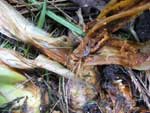
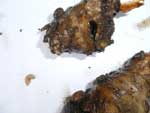
Bacterial soft rot
One of the major problems that iris borer introduces to the leaves and rhizomes is bacterial soft rot (Pecotobacterium carotovorum). Rhizomes become soft, mushy and have an offensive odor. The leaf tips are withered and leaves have long brown streaks or appear water soaked. Bacterial rot can also be introduced through careless cultivation. Crowded, shaded growing conditions can make the plant susceptible to infection. More info on iris..

Diseased iris from QVC
I purchased Irises from cottage Farms via QVC. They were small when received but just kept shrinking. I got replacements that were a tad bigger. All of them within a couple weeks died and mush inside. Not having experience with the Iris while planting I noticed a worm. That night I noticed another by my plantings,it actually glows in the dark. I showed my husband this worm and he thought it came from the irises since we never saw anything like it before.I researched and identified it as THE IRIS BORER. This company sent me diseased plants!!!!! I have dug them all up (rotten and mushy). Poured bleach in the ground to kill anything left behind. I have 3 Rose bushes,4 Peony bushes and several lilies near by,will these bugs kill them too? Any suggestions? Anyone? Help!!! What should I do?! TY
Joanne, Thanks for the tip about Dial Antibacterial soap. I used medicated foot powder on some sickly looking peonies rhizomes that were given to me and they have been healthy ever since. Can someone advise me on what to do with droopy leaves long after the Iris have stopped blooming? They are unsightly, but I read you should only clip the leaves if transplanting or dividing. My Japanese Iris are beautiful, too, but also droopy after blooming.
Jan from Michigan
I bought some re-blooming irises last fall, and they established before winter. Now, the only one that is blooming is rotting away. I am assuming this is a borer, and I am also assuming that the borer came with the rhizomes. I have never had borer problems before. Should I ask for my money back? And, should I dig them all up and throw away, since the borer might spread to my peony?
Freeze damage
I have a few iris plants with leaves that have accordian like folds in them and some of the buds are deformed. Any answers Thx
The best way to get rid of bacterial soft rot, which is caused by a bacteria not the iris borer, is to scrape the rot from the rhizome without removing it from the ground and then pour Dial Aniti-bacterial Hand soap directly on the rhizome and the surrounding soil. I grow 300 varieties of irises and used to use the chlorox, but the soap works much better
Is this the kind you use straight from the bottle that is alchohol based or the regular liquid handsoap. And how much? Thanks Liz
I WAS TOLD TO DIG UP AND DIP RHIZOMES OF THE IRISES IN 1 PART OF BLEACH TO 3 PARTS WATER AFTER CUTTING OFF ANY ROT WITH A KNIFE AND TO CUT BACK YOUR IRIS LEAVES IN THE FALL TO 3 TO FOUR INCHES TO RID OF EGGS LAID ON TIPS.BEST OF LUCK…Lorrie
How to get rid of borer
Thanks for all the info regarding Iris. Relative to the borer – please advise what do you do to the dirt in your beds to get rid of the borer? Need to know ASAP. Thanks
Treating iris borer
Concerning my iris tubers with pinholes, how do I treat them? Someone told me about using a mild bleach solution but I don’t know how much or how long.
My bearded iris seem to be dying all of a sudden, the leaves are going brown, what can I do, I have been growing them for years and moved them in to the rose beds some time ago they grew wonderfully until last week.