Spider Plant
Spider plant
Chlorophytum comosum also known as spider plant, airplane plant, ribbon plant originally from Africa and is a member of the large lily family. It was a popular ornamental houseplant in the Victorian era and still is today.
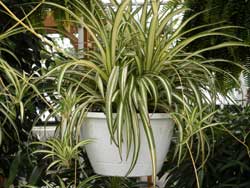
The variegated, strap-shaped leaves which grow in a cluster send out pale, yellow, wiry stalks which can get over two feet long. Initially, the cascading stalks bear small white flowers which later form little plantlets referred to as spiders. There are many varieties of Chlorophytum, some of the most popular cultivars are: C. Vittatum which has a wide white band down the center of the leaf, C. Variegatum has a white stripe down the outer margins and ‘Picturatum‘ has a broad yellow center stripe and ‘Mandaianum‘, a compact form with dark green leaves and irregular dull yellow-green stripes.
Spider plant is primarily used as a foliage hanging basket but recently it is also used as a landscape bedding plant in mild climates. They are frost-tender and grow in zones 9-11.
Care
Spider plants are generally easy to care for. For optimal growth Spider plant grow in bright light with some direct sunlight during the winter. Keep it away from hot midday sun or you will scorch the leaves. It will also thrive in semi shade. It does well at room temperatures 65-75 but grows poorly when temperatures are below 45 degrees.
Water
During active growth in the summer, water as often as needed to keep the soil moist and feed it every two to four weeks with a balanced fertilizer. In winter, keep it on the dry side, water just enough to moisten and then allow the top 1 inch to dry out before watering again. Pale bleached leaves will indicate that the spider plant is too dry and needs water. If the center of the plant is rotting then you are overwatering and keeping the soil to wet.
A healthy, mature plant will send out plantlets (when the days get shorter) which can easily be rooted in water or when if placed in moist soil.
Repot when the thick, fleshy rhizomes and roots are pot bound and force the soil above the pot rim level making watering difficult. This is also a good time to divide spider plant. Division will produce a mature plant much faster than from plantlets.
Troubleshooting
Brown tips or tip burn can occur when the soil is kept too dry or hard/fluorinated water is used. Spider plants are sensitive to fluoride which can be present in low-grade fertilizer and city tap water; to avoid this problem use rain water and a good quality fertilizer. Overfertilization can also cause brown tips.
Common pests that attack Spider plants are: whitefly, scale and aphids.
Dull gray leaves can indicate red spider mites. Look under and between the leaves for small webs.

Although Spider plants are said to be one of the easiest houseplants to grow, mine seem to always need the most grooming and care than any other types of houseplants I have. I find them difficult and fussy. I have yet to see a healthy one even at garden shops this year. I have wondered if there is some type of blight going on with them right now. Many nurseries seem to have fewer for sale and they are tossed often. I really love to look at a healthy one, but what I’ve seen this year, they’re limp, yellow, or lanky looking. They’re a tough plant for me. Love them but a true challenge.
I recently purchased a spider plant. The stems are yellow, is this normal? It has lots of babies that have brown leaves around them but the centers of them are alive and healthy. But the yellow stems concern me. The leaves are not yellow, they are healthy.
My spider plant turned light green .Is in a very bright afternoon window spot where i have it, sure sun was too much for it turned light green. Can this be fixed…..want it back to its dark green! Also is it better to water on top or from bottom? Thank You…Sandra
OK, I WAS GIVEN A SPIDER PLANT AS HOUSE WARMING GIFT. I HAVE RECENTLY NOTICED THAT THE LEAVES ON MY PLANT ARE TURNING YELLOW AS WELL AS SOME OF THE LEAVES ON THE BABY SHOOT. AM I OVER WATERING? ALSO THE TIPS OF THE LEAVES ARE TURNING BROWN. PLEASE ANY SUGGESTIONS?
Hello,
I have a large spider plant that I’ve grown from a baby. It has produced lots of babies since and was doing really well until four weeks ago. Suddenly the leaves started going transparent and ‘disintegrating’. They look grey in places and I’ve noticed lots of tiny black bits (I don’t knows what they are) on the floor under the plant. There are even some of these ‘bits’ stuck to the wall. Could you please tell me what’s happening ?
Thanks
I saw the coment about the Gnats but my problem isnt that the soil is to wet but that for some reason my house attracts gnats and house flies. So I have gnats and house flies all over the tips of the leaves at night. Also I put my spider in front of a window and open the blinds every morning. It was doing great, watered once a week or as needed (I was using tap water but will no longer) but now my plants leaves look pale green almost ghostly and some of the tips are brown. Is it the bugs, the watering, might need to be replanted, the light getting to it being that its summer and the sun is hotter? Oh one other thing when I first got my plant it produced “babies” but when I took those off do to them not looking healthy it has sense not produced any. I have replanted and fertilized since then but just not sure what is going on.
Thanks in advance
I have a non variegated spider plant that I grew from a plantlet and has its first baby (so excited) however this morning I was watering my plants and noticed it was tipped sideways and upon further investigation it was time to re-pot. So as I was re-potting it there was a foreign whitish spotty like, light green type mold or fungus (not sure if at all either) in the dirt around the root system. I have never seen this before and so I removed all the dirt from the roots and gave it fresh dirt in the new pot. Can you tell me what this could have been I put the pot and the dirt that it came out of in a bag and sealed it just in case it is bad news. Can you tell me what this is . Thank you for your time.
I have a Hawaiian spider plant that is very big and healthy. It has many many many beautiful babies that have developed big roots of their own. I thought that you can leave the babies on. Now, one by one the stems are turning brown at the ground level and I am having to replant all the babies. Do the stems last or eventually do they turn brown?
I have a ten year old spider plant which has started in the past two months to die on me no matter what i tried. I watered once a week when the soil was dry. Using reverse osmosis water i bought from a store. I repot once this year. I used spray and grow macronutrient treatment. The woman rep sent me bills perfect fertilizer. I used that and there still seems to be no improvement. Now she has no leaves only the root is left. I have looked everywhere. I asked greenhouses if it was possible to save her even if i only had the root left. They told me to repot the root in perlite and leave about 1/2 inch of it popping out. She is still dying. I have four white root bulbs left. How can she create photosynthesis if she has no leaves? Ive heard they are hearty plants that thrive very well. This particular one was very old and id like to keep her in the family as long as possible.
I have a spider that produces babies but they dry up before they mature. What am I doing wrong?
spider plant growing tip
I love my spider plants and they’ve been with me for years- I think I began with one or 2 some 20 years ago. Now I have huge mostly healthy ones all over my home. My son had one that he kept in a dark room all winter, He brought it to me this spring. The leaves were faint green and all but see through and terribly soft. No strength to the plant. so, I cut it back to the base. It was going to die, so I thought I’d try it. I also put it outdoors. It is now fantastically happy! Rich green thick strong leaves. I’ve tried it on a few smaller ones of mine and same thing. I’m very excited about this and feel I should probably move all my plants outside for the summer.
Though I love having them indoors. Can I take them in and out occassionally?
Also, I’m a little worried about bringing the ones I’ve left outside all spring and summer back inside this fall.
Should I do it in stages?
Not producing plantets
I have 2 spider plants that were taken off the mother plant 5 years ago. They are both healthy, however, have never had any babies. Am I doing something wrong? Why no babies yet?
Hi Kris,
I have 2 spider plants which I grew together in a large pot. They have both done beautifully, sending out numerous ‘babies’, which I have allowed to continue growing on the main plants. Recently I noticed the leaves are getting yellow towards the base, and from the comments above, I assume I am overwatering (once a week), plus I used regular tap water- which I will cease hereon! What I would like to know is whether I can leave the ‘babies’ because the whole arrangement looks gorgeous. Makes entry to my apartment very ‘tropical’! Or is that detrimental to both ‘babies’ and ‘mother’ plants? I don’t wish to grow new plants and am loathe to cut off and discard the ‘babies’ – your advise would be appreciated, and followed as always…
Thanks!
Too much water
My mom was given a baby spider plant as a party favor this last October. She didn’t have time to care for him, so I took him with me back to my dorm. I’ve grown so attached to the little guy, I’ve even named him. Unfortunately, not too long after I re-potted him, I realized I had done everything wrong! (potted him in moisture-holding soil, gave him extra fertilizer, placed him in direct sunlight right over a heating vent, etc.) I quickly corrected my errors once I had done my research. He is now in a large pot with all-purpose soil, five feet from an east-facing window. I water him with distilled water, and only when the soil feels dry.
Despite my efforts, he continued to wilt. One by one, his leaves started to get soggy and turn brown, starting at the tips and spreading to the base. I tried turning down the heat in my room because I read that it can be too drying for spider plants. I sing to him, talk to him, I even play some Bach for him whenever I find the time (I told you, I am VERY attached)… Nothing I do is helping. He had two new-growth leaves, but they have both died. He is left with a single, pale-green, two-inch leaf.
Please, please help me. He means so much to me. ):
I have a spider plant which is quite old. It was pot bound and transplanted. Now all the leaves are turning a rusty brown color at the base of the plant. Put is outside under a tree and it did produce some babies over the summer but the base plant does not look healthy. I thought it was not getting enough water and that is why I moved it outside but it has had plenty of water over the summer and it still looks bad.
I received a spider plant from my father 6 or 7 years ago. He gave it to me in a hanging basket, and the plant was 3 babies. Two of the babies died, and I decided to move the lonely plant to a smaller pot. It is now at 6 to 7 years of age finally having babies, BUT it is laying sideways and has what looks like roots that are 1/4- inch long growing out of the base. Can I repot this and plant deeper so it is upright, and all the root nubbins are under dirt?
Fungus gnats
I have an interesting problem.
There are 2 different bugs on my spider plant but neither are showing any signs of harm(yet and this has been a couple of weeks) first one im pretty sure is a common fruit fly. or its something very very similar. i have set up a cone paper trap that is moving a lot of them into the jar. they seem to be mostly interested in the soil. crawling from the bottom and around the top.
Second which is a little more mystifying is almost microscopic white bugs. really fast for their size. they too are mostly interested in the soil. crawling everywhere there is soil. now i bought this plant off of a random person. im not sure what kind of soil they used but i know they are very plant conscious.
please help. i dont want to use any unnatural chemical if possible. but i do want to move it back to the bedroom.its in the bathroom away from us and other plants.
No baby spiders
I’ve had my spider plant for about two years. It sits in indirect sunlight, I water it with filtered water about every one and a half to two weeks and I fertilize it once or twice during the spring and summer time but it has not produced any “babies” yet :o( I’ve even added “babies” from a friend of mine’s plant! I guess I’m just not sure what I’m doing wrong here as the plant is fully green and is without brown tips!
Non-toxic spider plant
Are spider plants harmful to cats/dogs
I have about 5 or 6 of these plantlets shooting out and are getting about a foot or two long. Where do you cut these at so I can start new Spider plants. Do I plant them in water or in moist soil?
Last fall, I got one spider plant in 8 inch pot. Early winter, it began to have little babies. I didn’t want to cut them because I wanted to wait until spring. Now, it has 12 babies on it (some of them are quite big), and they all look yellow and sad. Did I overburden the mother plant? When is the best time to cut and plant those babies? Thank you.
I was given a spider plant with many babies on it for Christmas. It was in “I’m guessing a 6 inch” ceramic pot. The plant was noticably too small for the pot, but was still doing great. I actually had to break the pot with a hammer to get the plant out. The roots were all balled up and smushed at the bottom. I replanted it in a 9″ ceramic pot using African Violet mix which gave it about a 1 inch or so space all around the sides. I also stuck 3 miracle-grow plant food spikes (for houseplants) in the soil. The directions said to use 5 spikes, but after doing some research on the internet they said to use half the ferterlizer so I took 2 out. Does this sound like the right way to have replanted this spider plant? Should I have replanted it? Is the pot too big? I just really love this plant and I’m worried about it.
By doing this A couple babies came off so I stuck them in small vases with water for them to root. Am I doing this right?
I’m an amateur gardener in NJ and the only plant I’ve had sucess with is the madagascar dragon tree which I’ve had for 5 years and is 5 foot tall!
I also have an afican voilet that hasn’t bloomed in 2 months and a money tree that is hanging on by a thread with 4 leaves left on it. I’m determined to be better at this!! 🙂
.
I BROUGHT MY SPIDER PLANT INDOORS FOR THE WINTER-AND NOW THEY NEED REPOTTED-IS IT TO EARLY TO REPOT THEM-
Hi Sandy
Wait till early spring to repot, the plant will respond much better to transplanting.
I have 2 spiderplants one big and one small i recently repotted them and now they are turning yellow and falling the small one some of the leaves has wilted and falling so there is a big gap in the pot also its also creating flowers in winter is that normal and will it servive? i dont realy now wat to do with the gap in the pot, as for the big one some of the leaves is turning yellow and falling it also has not made babies yet why? i was told i done the wrong thing by repotting it so i should get some babie plants and fill the gaps but now the babies are turning brown and faling what am i doing wrong some one please help thanks.
Hi,
I have recently bought a Chlorophytum Comosum “bonnie”. I think it’s absolutely beautiful. I have only had it maybe 2 weeks and in that time have given it one good watering and a couple of light waters.
About a week ago it started losing leaves by way of the leaf rotting near the base. So I have been pulling them off as they start to go brown. I have removed maybe a dozen leaves in this way??? The plant seems to be healthy otherwise. It is in a brightly lit position, gets some morning sun but not direct sunlight all day and it’s produced 3 of the off-shoot things already since I brought it home.
All the websites I have looked at mention the leaf tips going brown, none have said anything about the base of the leaf??I live in Brisbane Australia. Temperatures have reached about 30degrees celcius in the last few weeks but I am I know it should be able to tolerate that.
Does anyone have any ideas what’s going on with my plant?
Thanks!
Tonia
I have a beautiful green spider plant which is dying in the middle. Its leaves are turning yellow. This plant recently was rid of Scale. I have 7-10 plantings of spider plants now. Most are mixed type plantings.
I have 3 of the long stems with multipe plantlets on my spider plant, can I place them all in one plant for now as they are smalll and winter is coming real soon, some have long roots, some have just a nub, should I root the nib ones for longerr roots before placing in soil?
Hello, I bought a spider plant over the summer (hanging basket) that I kept outsied and it did great, I have tons of babies that grew from it, but now that the weather is getting cold I brought the spider plant inside and placed it on top of my hutch that is in a corner by a window, I have cats who will eat it if I put it anywhere else, but now the plant is looking sad, the stems the babies grow from are truning brown, the plant is dying, I’ve taken out the dead leaves and placed some of the babies in water hoping they will root and I can transplant them, how do I keep my spider plant alive through the winter? I love my plant.
Hi. I have a C.Vittatum Spiderplant in my bedroom ad recently I noticed that a few of his, Harrys, leaves had started to die. Then I was looking at him the other day and I noticed that there was a fuzzy mold growing on the soil. I water harry with bottled water whenever he feels a bit dry and I feed him slow release plant food pelets. What do you think this mold could be and how can I cure it and prevent it from coming back again?
I have sticky spider plant leaves. Can you help.
I recently got myself a spiderplant and later found it to be a ” bonnie ” wich i cant seem to find alot of information about, is there anything to be done or not done diffrently with a bonnie? it currently gets late morning to all afternoon indirect sunlight and its leaves are thick and green with life, it looks stunning but ive had it about 3 weeks now and i wondered if theres any diffrence ? Ive also noticed three babys coming thru so now is the time where i start hoping and i don’t ruin it.
many thanks nikki
Here’s some info
I have 3 little spider plants that have popped up in my front yard under a tree. Can they be transplanted into an eastern facing flower bed in front of my house or will that produce too much light and heat for them. I live in North Central Florida (Gainesville/Orlando area). Or should I put them in pots and take them in the house?
Thnks you